
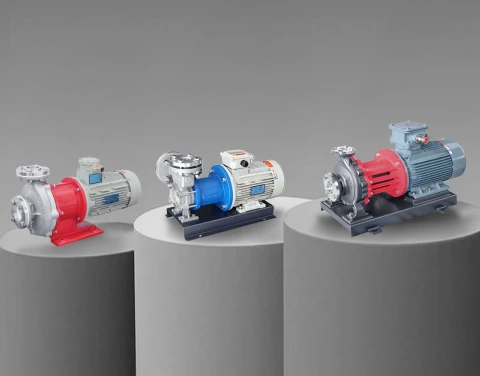



High Flow Rate Pump Solutions for Rapid Volume Transfer
Aulank provides high flow rate pump solutions designed to move massive volumes of water or fluid within a short timeframe. Compared to standard pumps, these units are engineered with larger discharge diameters and optimized hydraulic profiles to prioritize volume throughput over high pressure. They are the critical backbone for applications requiring rapid filling, emptying, or circulation.

Working Principle & Pump Types
Centrifugal Operating Principle
High flow pumps primarily operate based on the centrifugal principle. Driven by a motor, the impeller rotates at high speed, creating a vacuum at the center (eye) to suck water in. The rotational force then accelerates the fluid, throwing it outward through the volute casing to the discharge point with high kinetic energy.
Pump Types for High Flow
- Axial Flow Pumps: Propel water linearly like a boat propeller, offering the highest flow rates with low head (ideal for flood control).
- Double Suction Split Case Pumps: Draw water from both sides of the impeller to balance axial thrust and double the flow capacity compared to single-suction designs.
Typical High Flow Pump Applications
- Agricultural Irrigation Projects: Drawing water from rivers or reservoirs to irrigate vast fields efficiently, ensuring crops receive adequate hydration during dry seasons.
- Flood Control & Drainage: Rapidly removing excess stormwater from urban areas, low-lying lands, or roadways during heavy rainfall to prevent infrastructure damage.
- Industrial Plant Water Transfer: Circulating large volumes of cooling water in power plants, steel mills, or chemical facilities to maintain process temperatures.
- Infrastructure Construction Drainage: Fast dewatering of construction sites, tunnels, or cofferdams to allow excavation work to proceed safely and on schedule.
- Emergency Services (Fire & Municipal):: Providing high-volume water supply for firefighting trucks or emergency municipal drainage during pipe bursts.

Key Selection Considerations for High Flow Pumps
To ensure optimal performance and cost-efficiency, consider the following factors:
- Flow Rate Requirements: Calculate the exact volume needed per hour (m³/h) or gallons per minute (GPM). Consider the time window available to complete the transfer (e.g., draining a tank in 2 hours vs. 4 hours).
- Liquid Type & Quality: Determine if the water contains solids, debris, or sand (common in flood control). This dictates whether an open impeller or wear-resistant materials are needed.
- Pressure Requirements (Head): Even high flow applications have resistance. Ensure the pump has enough head to overcome pipe friction and elevation, but avoid selecting a pump with excessive head, which reduces flow efficiency.
- Maintenance & Cost: High flow pumps consume significant power. Evaluate the hydraulic efficiency to control operational costs (OPEX) and check for ease of access to impellers for clearing potential clogs.
Common Issues in High Flow Pump Operation
- Cavitation: High flow suction lines are prone to pressure drops. Ensure suction pipes are large enough to prevent cavitation damage.
- Vibration: Moving large masses of water can cause vibration if the pump is not securely anchored or aligned.
- Clogging: In flood or raw water applications, debris can block the intake. Use proper strainers.
FAQs
Q1. What is the difference between a high flow pump and a high head pump?
High flow pumps prioritize volume (GPM) with wider impellers and outlets, while high head pumps prioritize pressure (PSI) with narrower impellers to lift fluid vertically.
Q2. Can high flow pumps handle solids?
Standard centrifugal high flow pumps are for clean water. For flood control with debris, specialized non-clogging or semi-open impeller designs are required.
Q3. How do I maintain efficiency in a high flow system?
Minimize suction lift and use large-diameter piping to reduce friction losses. Regularly check wear rings, as internal recirculation significantly drops flow rate.