



High Temperature Pump Solutions for Thermal Fluid Circulation
Aulank provides specialized pumping solutions designed for heat transfer fluids and high-temperature process circulation loops. Targeting media such as Thermal Oil (Heat Transfer Fluid), Superheated Water, and Molten Salts, our pumps are engineered to operate continuously at temperatures ranging from 180°C to over 400°C. By employing unique thermal management structures, we solve common issues like seal failure and bearing seizure caused by extreme heat.

Pump Types & Working Principles
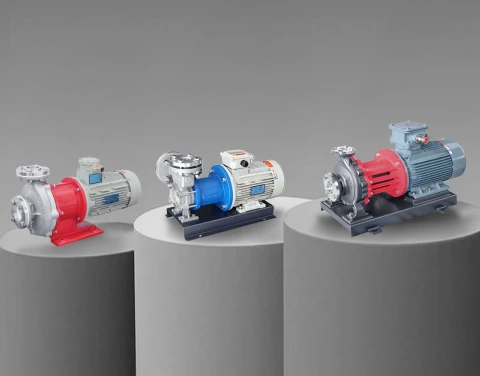
Air-Cooled High Temperature Pump
- Working Principle: Utilizes a physical thermal barrier chamber and cooling fins between the pump casing and the motor. A shaft-mounted fan dissipates heat naturally, ensuring the temperature at the mechanical seal and bearing housing remains significantly lower than the fluid temperature.
- Advantages: Compact structure requiring no external cooling water, simplifying installation and reducing maintenance costs for systems like mold temperature controllers.
Water-Cooled / Jacketed Pump
- Working Principle: Designed for ultra-high temperatures or fluids requiring precise temperature control. A cooling jacket surrounds the seal chamber or bearing housing, where circulating water actively removes heat.
- Advantages: Provides precise thermal control for extreme conditions (>350°C) or prevents fluid solidification (via steam heating) in polymer processes.
Key Features of High Temperature Pumps
- Thermal Barrier Design: Effective heat isolation structure prevents high-temperature heat flux from directly transferring to the motor or sensitive bearing components.
- Thermal Expansion Compensation: Features centerline support or floating structures to allow the pump casing to expand uniformly when heated, preventing misalignment and internal friction.
- High-Temp Sealing: Equipped with metal bellows mechanical seals or high-temp magnetic couplings (SmCo magnets) to eliminate leakage risks associated with seal degradation.
- Material Stability: Casings made from cast steel or stainless steel undergo stress-relief annealing to ensure no physical deformation under combined high temperature and pressure.

Typical High Temperature Applications
- Thermal Management & Temperature Control: Circulation pumps for Mold Temperature Controllers (TCU), die-casting cooling loops, and reactor jacket heating systems.
- Chemical & Polymer Industry: Transporting high-temperature polymer melts, resins, and synthetic fibers requiring consistent heat to maintain viscosity.
- New Energy: Molten salt transport in Concentrated Solar Power (CSP) plants and high-temp drying processes for lithium battery electrodes.
- Industrial Boilers: Boiler feed water systems, condensate recovery, and high-pressure hot water circulation grids.
Key Selection Considerations for High Temperature Pumps
- Fluid Type & Boiling Point: For Hot Water, you must consider vapor pressure to prevent cavitation (flashing). For Thermal Oil, an assessment of coking tendency and permeability is required.
- Operating Temperature Range: Distinguish between standard high temp (<180°C), medium (<300°C), and ultra-high (>300°C). Different ranges dictate whether air-cooling is sufficient or water-cooling is mandatory.
- Cooling Method: Verify site utilities. If cooling water is unavailable or expensive, prioritize air-cooled high temp pumps for fluids under 250°C.
- Inlet Pressure (NPSHa): High temperature increases the fluid's vapor pressure, reducing safety margins. Ensure sufficient Net Positive Suction Head (often requiring flooded suction) to prevent cavitation.
FAQs
Q1. What is the difference between an air-cooled and a water-cooled pump?
Air-cooled pumps use a fan and heat sink, requiring no external piping, suitable for up to 250°C (oil). Water-cooled pumps use a cooling chamber, capable of higher temperatures but require a water source.
Q2. Can I use the same pump for 150°C water and 150°C oil?
No. Water at 150°C has high pressure and low lubricity, requiring specific seals (like SiC/SiC). Oil provides lubrication but creeps easily, requiring different sealing elastomers (like Viton/FKM).
Q3. Can magnetic drive pumps handle high temperatures?
Standard ones cannot. High temperature magnetic pumps must use special SmCo (Samarium Cobalt) magnets to prevent demagnetization (torque loss) above 150°C.