


Agrochemical manufacturing puts several hard pump problems in one plant. The active-ingredient synthesis side runs aggressive chemistry — chlorinated, phosphorus-based, and sulfur-based intermediates, halogenation steps, and the acids and bases that go with them. The formulation side handles flammable aromatic solvents, abrasive milled solids, and viscous concentrates, and it lives or dies on accurate ratio dosing. Running through all of it is the fact that the product is toxic by design: a leak is not just lost product, it is a worker-safety and environmental event. A pump that is merely “chemical duty” in a catalog does not cover this. The wetted material has to match the specific fluid, and the architecture has to remove the leak path.
We have supplied magnetic-drive and canned-motor pumps into agrochemical synthesis and formulation plants for over a decade, across producers in China, India, Brazil, and Southeast Asia. This guide covers how to select pumps for the main stations in a crop-protection plant — active-ingredient synthesis, solvent transfer, suspension-concentrate milling, emulsifiable-concentrate blending, precision dosing, and effluent handling — with the corrosion, zero-leakage, and dosing-accuracy requirements that define agrochemical pump duty.
1. The Pump Stations of an Agrochemical Plant
A crop-protection plant splits into two worlds: the synthesis of the technical active ingredient (the AI), and the formulation of that AI into a sellable product. Each has distinct pump duties:
● Active-ingredient synthesis — reactor circulation, intermediate transfer, and acid/base handling through chlorination, phosphorylation, and other aggressive synthesis steps.
● Solvent transfer — bulk movement of aromatic and oxygenated solvents (xylene, Solvesso-type aromatics, cyclohexanone, DMF, alcohols) in flammable-atmosphere zones.
● Suspension-concentrate (SC) milling and circulation — circulating water-based slurry of solid AI through bead mills to reduce particle size below 5 microns, with abrasive solids loading.
● Emulsifiable-concentrate (EC) and emulsion blending — dissolving AI in solvent with surfactants, and blending oil-in-water emulsions (EW, SE) at controlled conditions.
● Precision dosing — metering AI, solvent, surfactant, thickener, and antifoam into the formulation at tight ratios that control product stability.
● Filling and packaging — accurate volumetric transfer of finished product into containers.
● Effluent and scrubber handling — moving contaminated wash water, spent solvent, and scrubber liquor to treatment.
Five constraints cut across these: compatibility with corrosive synthesis chemistry and aromatic solvents, zero leakage of toxic active ingredients, tolerance for abrasive milled solids, volumetric accuracy for formulation stability, and flammable-zone electrical compliance. No single pump covers all of them, so the plant runs a portfolio matched to each duty.
2. Active-Ingredient Synthesis: Corrosive Chemistry and Zero Leakage
AI synthesis is the chemically hardest part of the plant. Reactions involve chlorinated and halogenated intermediates, phosphorus oxychloride and related reagents, sulfur chemistry, and the strong acids and bases that drive and neutralize them. Two pump requirements dominate here:
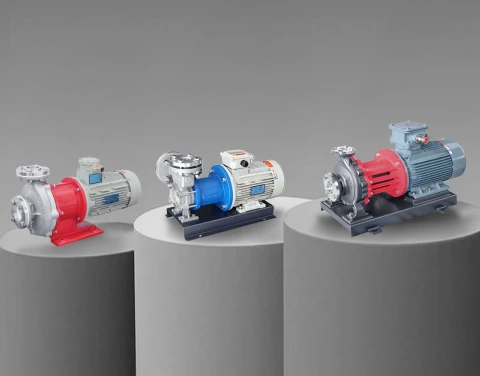
● Material compatibility with halogenated and acidic chemistry. Chlorinated intermediates, HCl, and other halogen-acid byproducts attack carbon steel and most stainless grades. Fluoropolymer-lined wetted parts — PTFE, PFA, or ETFE — give the chemical inertness this chemistry needs. Our AMC-F PTFE-lined magnetic drive pump is the unit we most often configure for halogenated intermediate and acidic synthesis service.
● Sealless architecture for toxic-fluid containment. Active ingredients and their intermediates are toxic by design. A mechanical-seal pump weeping a toxic intermediate is a worker-exposure and environmental incident, and mechanical seals fail predictably on aggressive synthesis duty — solvent attack, crystallization at the seal face, thermal cycling. Magnetic-drive pumps remove the dynamic seal entirely. The engineering is set out in our industrial magnetic drive pump selection guide.
For lower-aggression synthesis duties — neutral-pH intermediates, organic suspensions within stainless compatibility — a 316L magnetic-drive vortex pump such as the MDH stainless steel vortex magnetic drive pump is a lower-cost option. But once halogen or strong-acid chemistry is in the fluid, fluoropolymer lining is the safe default. The material framework is on our corrosion-resistant pump solutions page.
3. Solvent Transfer for Emulsifiable Concentrates
Emulsifiable concentrates (EC) are the workhorse liquid formulation: the AI is dissolved in a water-immiscible organic solvent with emulsifiers, so it disperses into a milky emulsion when the farmer mixes it with water. The solvents are aromatic hydrocarbons — xylene, Solvesso-type aromatics — plus oxygenated solvents like cyclohexanone and DMF. Moving these is a flammable-solvent duty with two main requirements:
● Explosion-protected motors in classified zones. Aromatic solvent handling areas are classified flammable-atmosphere zones. Pump motors need the correct explosion-protection rating matched to the solvent gas group and temperature class. Standard motors are not acceptable.
● Solvent compatibility and zero vapour leak. Aromatic and oxygenated solvents attack many elastomers and leak as vapour through a worn mechanical seal — a fire risk and a VOC emission problem. Sealless construction with fluoropolymer or compatible wetted parts removes both issues.
For aromatic and oxygenated solvent transfer, the MDW stainless steel vortex magnetic pump in 316L with an explosion-proof motor covers clean-solvent duty, while AI-laden or trace-acidic solvent streams are better served by the AMC-F PTFE-lined pump. For continuous solvent recovery and VOC service, the PWH/PWD/PWM canned vortex pump series gives the canned-motor alternative. The leak-containment logic is on our leak-proof pump solutions page.
4. Suspension-Concentrate Milling: Abrasive Slurry Circulation
Suspension concentrates (SC) are water-based formulations where solid AI is wet-milled to a particle size below 5 microns — smaller particles give better coverage and efficacy. The circulation pump that feeds the bead mill handles a duty that combines abrasive solids with shear sensitivity, similar in character to paint mill-base circulation. Three considerations:
● Abrasion resistance. Milled AI solids and grinding-media fines erode standard pump internals. Silicon-carbide bearings and hardened or fluoropolymer-lined wetted parts extend service life in SC milling loops.
● Controlled shear. Over-shearing an SC can destabilize the suspension and cause particle agglomeration or sedimentation. Steady, controlled circulation preserves the formulation, so pump speed and hydraulics matter, not just flow.
● Solids tolerance without clogging. The pump and any suction strainer must handle the solids loading without clogging or erosion. Regenerative-turbine vortex hydraulics tolerate suspended solids better than tight-clearance closed impellers.
The wear-and-maintenance framework for abrasive-solids service is covered in our chemical pump parts lifespan and maintenance guide, and the broader handling of viscous and solids-laden fluids in our pumping high viscosity fluids selection guide.
5. Precision Dosing: Where Formulation Stability Is Won or Lost
A crop-protection formulation is a recipe, and the ratios decide whether it stays stable on the shelf or separates, creams, or sediments. AI, solvent, surfactant, thickener, and antifoam are metered at controlled ratios — an EC formulation typically runs 100–350 g/L active, 150–500 g/L adjuvants, up to 400 g/L solvent, plus small additions of antifoam at 0.1–20 g/L. Hitting those ratios repeatably is a positive-displacement dosing duty:
● Active-ingredient and adjuvant dosing. Metered transfer of AI concentrate and adjuvant into the blend with repeatable volume. Magnetic gear pumps give consistent volumetric output with no seal to leak toxic concentrate. The MDC-K magnetic gear pump covers mid-range dosing.
● Antifoam and micro-additive dosing. Small additions where accuracy matters disproportionately — too much antifoam or the wrong surfactant level changes the whole formulation. The MDC-M micro mini magnetic gear pump handles sub-litre-per-minute additive dosing.
● Viscous concentrate handling. Thickeners and some finished concentrates are viscous, and need pumps sized for higher viscosity. Magnetic gear pumps run at low speed for viscous media, and the larger MDC-X medium-large magnetic gear pump covers higher-throughput viscous transfer. The positive-displacement principle behind this is in our positive displacement pump working principle and selection guide.
6. Filling, Effluent, and Scrubber Duties
The end of the line and the environmental systems carry their own requirements:
Filling and packaging
Finished product is filled into bottles, jerry cans, and drums with accurate volumetric delivery and clean cut-off. Positive-displacement gear pumps give the dose accuracy and clean shut-off filling needs across the viscosity range from thin EC to viscous SC. Because the product is toxic, the sealless flow path matters here too — no drip, no leak.
Effluent and scrubber handling
Agrochemical plants generate contaminated wash water, spent solvent, and scrubber liquor that capture process vapours. This is corrosive, often toxic, variable-composition fluid moving to treatment. Fluoropolymer-lined and canned-motor pumps handle the transfer, and the MDC gear family meters neutralization and treatment chemicals. The zero-leak requirement is, if anything, stronger here because the fluid is concentrated waste.
For continuous effluent and scrubber duty where static O-ring exposure is undesirable, the PWH/PWD/PWM canned vortex series is the structural choice; for general lined transfer, the AMC-F covers the corrosive-fluid duty.
7. A Pump Selection Matrix for Agrochemical Manufacturing
The table below condenses our typical recommendations across the main stations. These are starting points; specific chemistry, viscosity, solids loading, and flow always need validating against the real process:
| Station | Fluid | Key requirement | Recommended pump |
| AI synthesis (halogenated/acidic) | Chlorinated intermediates, acids | Inert lining, zero leak | AMC-F PTFE-lined magnetic drive |
| AI synthesis (neutral) | Organic intermediates | Sealless, moderate duty | MDH stainless magnetic-drive vortex |
| Aromatic solvent transfer | Xylene, Solvesso, DMF | Flammable zone, zero vapour | MDW 316L with Ex motor |
| AI-laden solvent transfer | Solvent + dissolved AI | Inert lining | AMC-F PTFE-lined magnetic drive |
| SC milling circulation | Abrasive aqueous slurry | Abrasion + controlled shear | Lined magnetic drive, SiC bearings |
| AI / adjuvant dosing | Concentrate | Volumetric accuracy | MDC-K magnetic gear pump |
| Antifoam / micro-additive dosing | Small additions | < 1 L/min, repeatable | MDC-M micro magnetic gear pump |
| Viscous concentrate transfer | Thickened concentrate | High viscosity, low shear | MDC-X magnetic gear pump |
| Filling / packaging | Finished EC/SC product | Accurate cut-off, no drip | MDC magnetic gear pump |
| Effluent / scrubber | Contaminated waste | Corrosive, zero leak | AMC-F or PWH canned vortex |
8. Why Sealless Architecture Is the Default in Agrochemical Plants
For agrochemical synthesis and formulation, the case for sealless pumps is unusually strong. Four reasons:
● Toxic-product containment. Active ingredients are toxic by design. A mechanical-seal leak releases a toxic substance into the workplace or environment. Sealless architecture removes the dynamic-seal leak path, which is increasingly a written requirement in agrochemical plant specifications and environmental permits.
● Aggressive chemistry that destroys seals. Halogenated intermediates, aromatic solvents, and strong acids attack seal faces and elastomers, making mechanical-seal life short and unpredictable on synthesis duty. No dynamic seal means no seal failure mode.
● No seal-flush contamination of formulations. Mechanical seals often need flush water that dilutes and contaminates the formulation — a real problem in recipes where ratios are tight. Sealless pumps need no flush.
● Lower lifecycle cost across a multi-duty plant. An agrochemical plant runs many pumps across synthesis, solvent, milling, dosing, and effluent duties. Cutting seal replacement and unplanned downtime across that population is a meaningful operating-cost saving, and stable performance protects formulation consistency batch to batch.
9. Aulank Agrochemical Pump Portfolio
We have supplied sealless pumps into agrochemical synthesis and formulation plants for 17+ years across the major crop-protection producing regions. The portfolio we typically recommend across a plant:
● AMC-F PTFE-lined magnetic drive pump — halogenated and acidic AI synthesis, AI-laden solvent, abrasive SC milling, and corrosive effluent, with full fluoropolymer wetted parts and zero leakage.
● MDW stainless steel vortex magnetic pump and MDH stainless steel vortex magnetic drive pump — aromatic solvent transfer with explosion-proof motors, and neutral-duty synthesis circulation within stainless compatibility.
● MDC-M micro mini magnetic gear pump, MDC-K magnetic gear pump, and MDC-X magnetic gear pump — AI, adjuvant, antifoam, and viscous-concentrate dosing plus filling, across the full flow range with volumetric repeatability.
● PWH/PWD/PWM canned vortex pump series — canned-motor variant for continuous solvent recovery, VOC, and scrubber duty where static O-ring exposure paths are undesirable.
What an agrochemical producer gets from us specifically:
● Material matched to each duty — PTFE, PFA, ETFE lining and 316L options selected per station rather than one material for the plant.
● Explosion-proof motor options matched to aromatic-solvent gas group and temperature class for classified zones.
● Silicon-carbide bearings for abrasive SC milling and dry-run tolerance during change-over.
● Magnetic gear sizing for viscous, accurate dosing — low-speed high-displacement configurations for viscous concentrates and tight ratio control.
● Documented quality control — ISO 9001, TÜV CE on magnetic drive vortex pumps, individual parameter test records, and 50+ patents on the synchronous permanent-magnet drive structure and shielded vortex hydraulics.
If you are sourcing pumps for an active-ingredient synthesis plant, a formulation and filling line, or a retrofit replacing leaking mechanical-seal pumps, send us your station-by-station chemistry, viscosity, and flow requirements and we will return a recommended portfolio with material specifications and quotes within two business days.
Get a Custom Agrochemical Pump Configuration
Whether you synthesize technical active ingredients, formulate emulsifiable and suspension concentrates, or build agrochemical processing and filling equipment as an OEM, our engineering team can match the right sealless magnetic-drive, canned-motor, or magnetic gear pump to each station in your plant.
Talk to our team: Contact Aulank | WhatsApp: +86 13773157367 | Email: info@aulankpump.com
Browse the relevant product and solution pages:
● Positive Displacement Pump Series