









Hot Oil Pump: Technical Guide for Industrial Thermal Fluid Systems
A hot oil pump is a pump specifically designed to circulate thermal oil (also called heat transfer oil or thermic fluid) through industrial heating systems. Unlike standard water pumps, hot oil pumps must handle fluids at temperatures commonly between 150°C and 400°C, with high thermal stability and reliable sealing under sustained heat. They are critical components in thermal oil boiler loops, mold temperature controllers, reactor heating jackets, and various process heating equipment.
This guide covers the key technical aspects of hot oil pumps — including working principles, pump types, material selection, and practical selection criteria — to help engineers and procurement teams make informed decisions. For a broader introduction to thermal oil pumps and how they fit into heat transfer systems, see our article: What Is a Thermal Oil Pump? Complete Guide for Engineers.
How a Hot Oil Pump Works
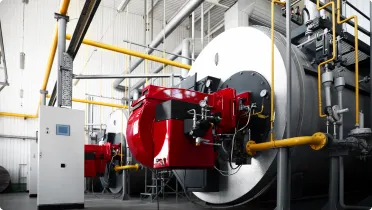
A hot oil pump works by converting motor energy into fluid kinetic energy, moving thermal oil through a closed-loop heating system. The thermal oil absorbs heat from a heat source (such as a boiler or electric heater), travels through the pipeline to heat exchangers or process equipment, releases heat, and returns to the pump for recirculation.
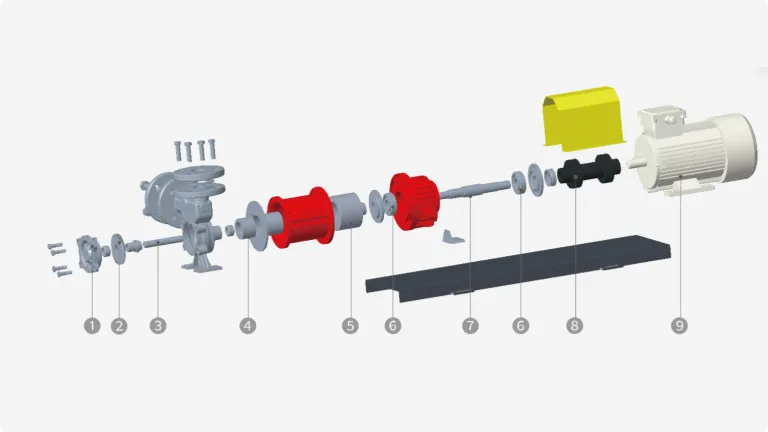
In centrifugal-type hot oil pumps like the Aulank WRY-H, the impeller spins at high speed inside the pump casing, creating centrifugal force that pushes the oil outward and into the discharge pipe. The suction side draws in return oil continuously, maintaining a steady circulation loop. In magnetic drive models, the impeller is driven by an external magnet coupling through an isolation sleeve — there is no shaft penetration through the pump casing, which eliminates the need for a dynamic seal.
For a detailed comparison between centrifugal and gear-type hot oil pumps, read: Centrifugal vs Gear Hot Oil Pump: Which Type Is Right?
Types of Hot Oil Pumps
Hot oil pumps used in industrial thermal fluid systems generally fall into two categories by drive type:
Coupled Centrifugal Hot Oil Pump
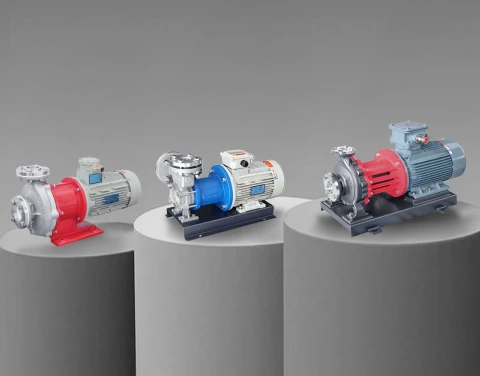
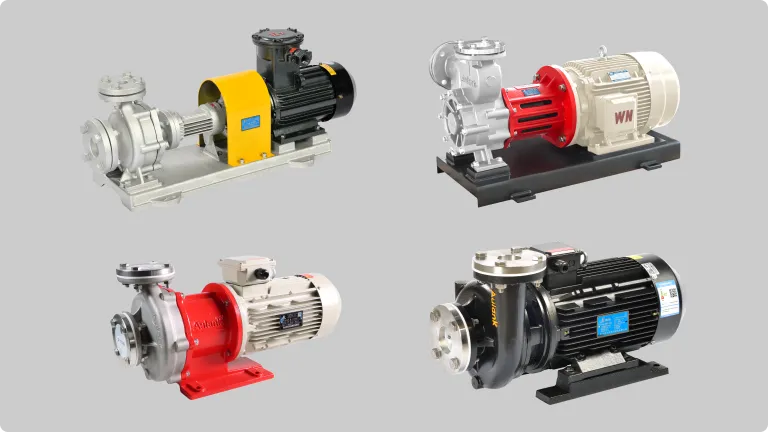
This is the most common type for medium to large thermal oil systems. The pump and motor are connected through a coupling, and the pump uses a mechanical shaft seal to contain the fluid. Aulank's WRY-H series is a coupled centrifugal hot oil pump with a split-type body, air-cooled bearing housing, and rated operating temperature up to 350°C. It is widely used in thermal oil boilers, heat treatment equipment, and industrial mold temperature control systems.
Magnetic Drive Hot Oil Pump
Magnetic drive pumps use permanent magnets to transmit torque through an isolation sleeve, completely eliminating the mechanical seal. This makes them ideal for systems that demand zero leakage. Aulank's MDH and MDW series are stainless steel magnetic drive vortex pumps that can operate with thermal fluids up to 400°C. They are used in semiconductor temperature control, chemical reactor circulation, and other precision or safety-critical thermal systems.
Gear Pump for Hot Oil (Positive Displacement)
For high-viscosity thermal oil or precise metering applications, gear pumps offer stable, pressure-independent flow. They are less common in standard heating loops but important in specific process applications. See: Centrifugal vs Gear Hot Oil Pump: Which Type Is Right? for a detailed comparison.
| Feature | Coupled Centrifugal (WRY-H) | Magnetic Drive Vortex (MDH/MDW) | Gear Pump (MDC-X/MDC-K) |
|---|---|---|---|
| Max. Temperature | 350°C | 400°C | up to 400°C (MDC-X) / 250°C (MDC-K) |
| Seal Type | Mechanical seal | Sealless (magnetic coupling) | Magnetic or mechanical seal |
| Leakage Risk | Low (seal-dependent) | Zero | Zero (magnetic) / Low (mech.) |
| Flow Characteristic | High flow, moderate head | Low flow, high head | Stable flow, pressure-independent |
| Best For | Boiler loops, large systems | Precision TCU, chemical reactors | High-viscosity oil, metering |
| Cooling | Air-cooled (no water needed) | Self-circulating | Varies |
Key Materials for Hot Oil Pumps
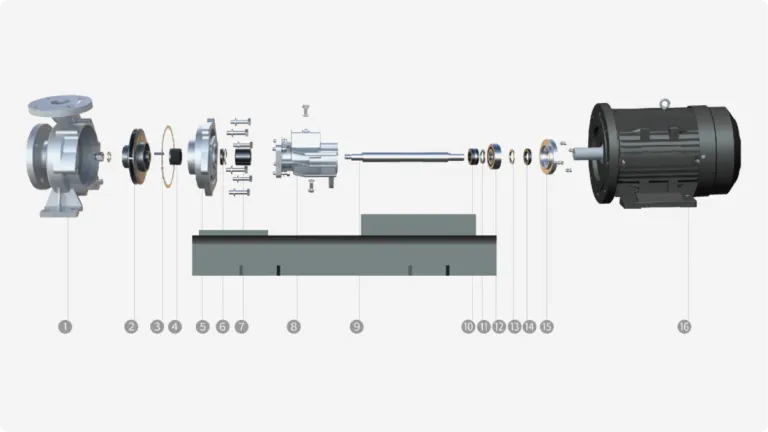
Material selection directly affects pump life and reliability at high temperatures. The main components and common materials used in Aulank hot oil pumps include:
| Component | WRY-H (Centrifugal) | MDH/MDW (Magnetic Drive) |
|---|---|---|
| Pump Body | Cast iron | Stainless steel (304/316L) |
| Impeller | Cast iron | Stainless steel |
| Shaft / Spindle | Carbon steel | Ceramic / stainless steel |
| Bearing | Sliding bearing (oil-lubricated) | Ceramic bearing / SiC |
| Seal | High-temp mechanical seal | None (magnetic isolation sleeve) |
| Isolation Sleeve | N/A | Stainless steel / Hastelloy / PEEK |
Aulank also uses advanced materials such as PEEK impellers and ceramic isolation sleeves for applications that require higher chemical resistance or lower eddy current losses at extreme temperatures.
How to Select the Right Hot Oil Pump
Choosing the right hot oil pump starts with understanding your system parameters. Here is a practical checklist we use when helping customers with pump selection:
1. Operating temperature: What is the actual working temperature of the thermal oil? If it is below 350°C, the WRY-H centrifugal type is usually sufficient. Above 350°C, magnetic drive models like the MDH series are a better fit.
2. Flow rate and head: These are determined by your piping layout, heat exchanger capacity, and system resistance. Oversizing wastes energy; undersizing creates flow shortage. We match models to your calculated or measured values.
3. Leakage requirement: If your facility cannot tolerate any thermal oil leakage — for example, in semiconductor cleanrooms or food-adjacent processes — a magnetic drive pump is the clear choice. For standard boiler rooms, a well-maintained mechanical seal pump works fine.
4. Installation space and piping: Some systems have tight installation constraints. Pump dimensions, connection orientation, and inlet/outlet sizes all need to match the available space. We provide dimensional drawings and can adjust flange or thread connections.
5. Motor requirements: Voltage, frequency, explosion-proof rating, and efficiency class vary by region and application. We configure motors based on your local power supply and site conditions.
For long-distance thermal oil piping systems, pump selection involves additional considerations around friction loss and NPSH. See: Hot Oil Transfer Pump: Selection for Long-Distance Piping.
For a step-by-step guide on selecting high-temperature oil pumps for specific systems, refer to: How to Choose a High Temperature Oil Pump for Your System.
Hot Oil Pump Maintenance Basics
Proper maintenance extends pump life and prevents unplanned downtime. Key maintenance points for industrial hot oil pumps:
Monitor bearing temperature: For WRY-H air-cooled pumps, check that the cooling fins are clean and unobstructed. Dust or debris buildup reduces heat dissipation. Bearing temperature should remain within the manufacturer's specified range.
Check for seal condition (mechanical seal pumps): Inspect the seal area regularly for oil weeping or dripping. A small amount of seepage is normal during break-in, but persistent leakage indicates seal wear or damage.
Thermal oil quality: Degraded thermal oil increases viscosity, accelerates carbon buildup, and shortens pump component life. Follow the oil manufacturer's replacement and filtration guidelines.
Vibration and noise: Unusual vibration or noise during operation can indicate bearing wear, impeller imbalance, or cavitation. Address these early to prevent secondary damage.
Magnetic drive pumps: These require less routine maintenance since there is no seal to replace. However, ensure the thermal oil is clean and free of ferromagnetic particles, which can interfere with the magnetic coupling.
Understanding Thermal Oil Circulation in Heating Systems
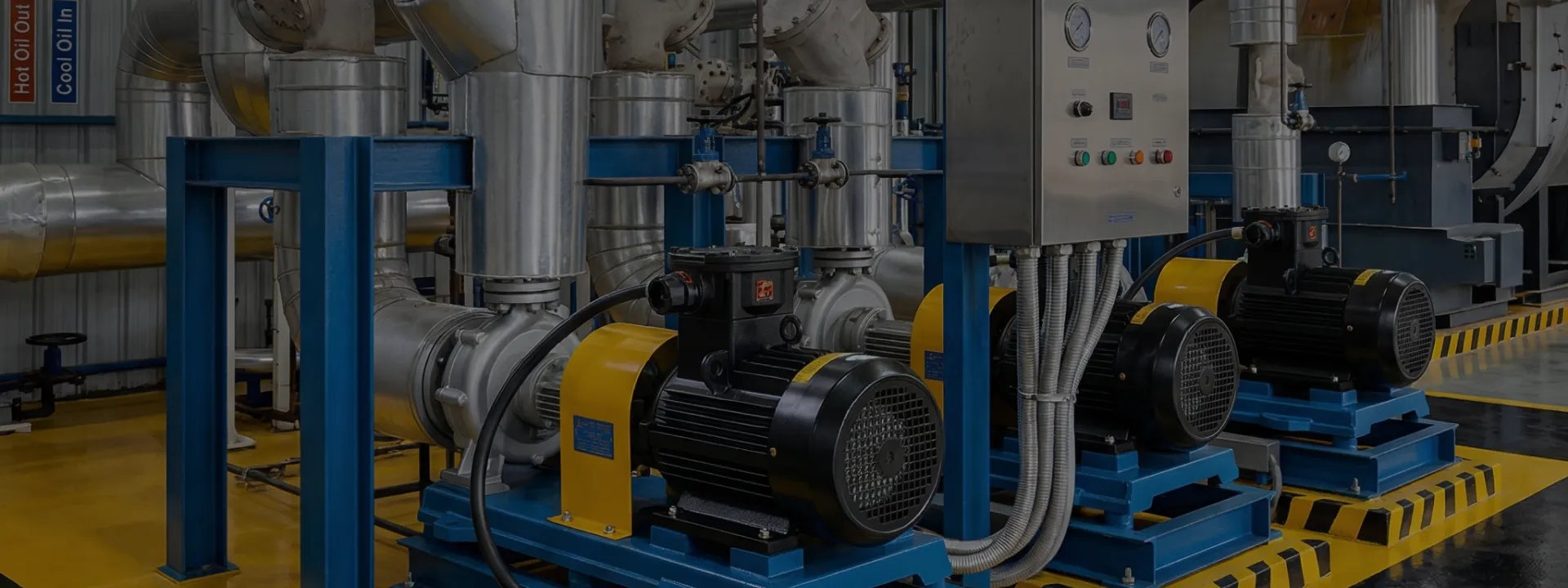
In a typical thermal oil heating system, the hot oil pump is installed between the heat source (boiler or electric heater) and the process equipment (mold, reactor, heat exchanger, etc.). The pump keeps the thermal oil circulating at a constant flow rate, ensuring uniform heat delivery to all points in the loop.
System design factors that affect pump performance include total pipe length, number of bends and valves, elevation changes, and heat exchanger pressure drop. The pump must provide enough head to overcome the total system resistance while maintaining the required flow rate. For thermal oil circulation system design principles, see: Thermal Oil Circulation Pump: How It Works and Selection Guide.
Why Work with Aulank for Your Hot Oil Pump Needs
Aulank has been manufacturing industrial pumps since 2008, with a focus on high- and low-temperature fluid transfer. Our hot oil pump range — including the WRY-H centrifugal series and the MDH/MDW magnetic drive series — is backed by over 17 years of application experience in thermal oil systems across chemical processing, new energy, die casting, and equipment manufacturing industries.
We provide direct factory supply, technical selection support, OEM customization, and after-sales service. With 77 patents, CE and CCC certifications, and an annual production capacity exceeding 100,000 units, we are equipped to support both sample evaluation and volume production for your hot oil pump requirements.