


In 2024, the average rack power density in a hyperscale data center was 12–20 kW. In 2026, AI training racks running NVIDIA Blackwell GB200 or GB300 systems routinely exceed 130 kW, with some liquid-cooled deployments running above 250 kW per rack. Air cooling collapsed as the default thermal solution about 18 months ago, and the industry is now in the middle of a structural buildout: every major hyperscaler, every new colocation Tier III/IV facility, and every advanced HPC site is being designed liquid-cooled by default. The component sitting at the center of that liquid loop — the one that fails first, sets the noise floor of the data hall, and decides whether the cooling distribution unit (CDU) hits its uptime SLA — is the pump.
We have spent more than a decade building magnetic-drive and canned-motor pumps for thermal management applications across semiconductor, EV battery, and process industries. The AI data center duty cycle shares features with all three, plus a few constraints that are genuinely new. This guide covers how to select pumps for direct-to-chip (DLC) cold plate loops, single-phase and two-phase immersion systems, CDU primary and secondary loops, and the rear-door heat exchangers (RDHx) that bridge air-cooled and liquid-cooled racks in transitional facilities.
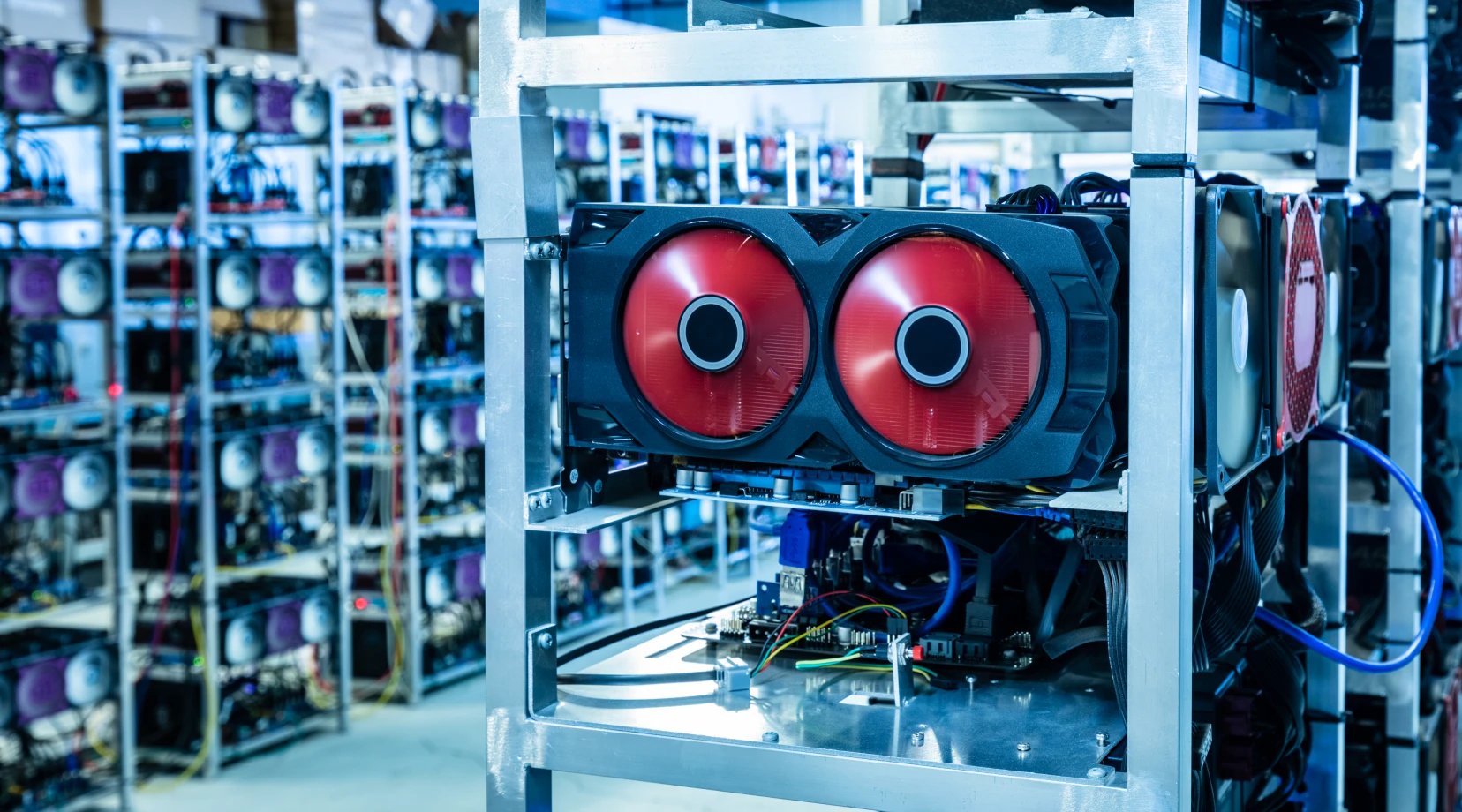
1. The 2026 Data Center Cooling Pump Landscape: Why Air Cooling Broke
Three forces are reshaping data center pump procurement simultaneously. First, AI chip thermal design power has jumped from ~700 W per accelerator on H100 to 1,200–2,000 W on Blackwell and Rubin generation parts. Second, rack power density has crossed the 100 kW threshold where air cooling becomes thermodynamically impossible to scale without unacceptable airflow and acoustic penalties. Third, sustainability targets (PUE below 1.2, water-use effectiveness regulations in Europe and parts of the US) make evaporative-only cooling unviable in many new build sites.
The five fluid-handling stations a 2026 liquid-cooled data center contains:
● Direct-to-chip cold plate loop (secondary side) — treated water or PG25 (25% propylene glycol) circulates through cold plates mounted on GPUs, CPUs, switches, and HBM stacks. Tight pressure control. Flow rates 5–20 L/min per server, 200–1,200 L/min per rack.
● CDU primary loop — rejects heat from the secondary side to facility chilled water or to a dry cooler. Higher flow (1,000–6,000 L/min per CDU), higher head, less stringent purity than the secondary side.
● Single-phase immersion tanks — dielectric fluid (mineral oil, synthetic hydrocarbon, or fluorinated coolant) circulates from a tank-side pump through a heat exchanger and back. Lower head (immersion tanks are physically short), but very high flow.
● Two-phase immersion systems — dielectric fluid boils against the chip and recondenses at the lid. Active pumping is minimal but often required for makeup, vapor recovery, and condensate return.
● Rear-door heat exchanger loops — rack-mounted water-cooled heat exchangers replacing rear panel airflow. Mid-flow, low head, often retrofit installations with pre-existing facility chilled water.
Five engineering constraints cut across every one of these stations: zero leakage (a single drop on live electronics is a serviceability event, not a maintenance event), low pulsation (cold plates have narrow microchannels and pulsation drives erosion), low acoustic signature (24/7 service in human-occupied data halls), continuous duty at 5+ year MTBF, and material compatibility with whatever coolant the facility selected at design time.
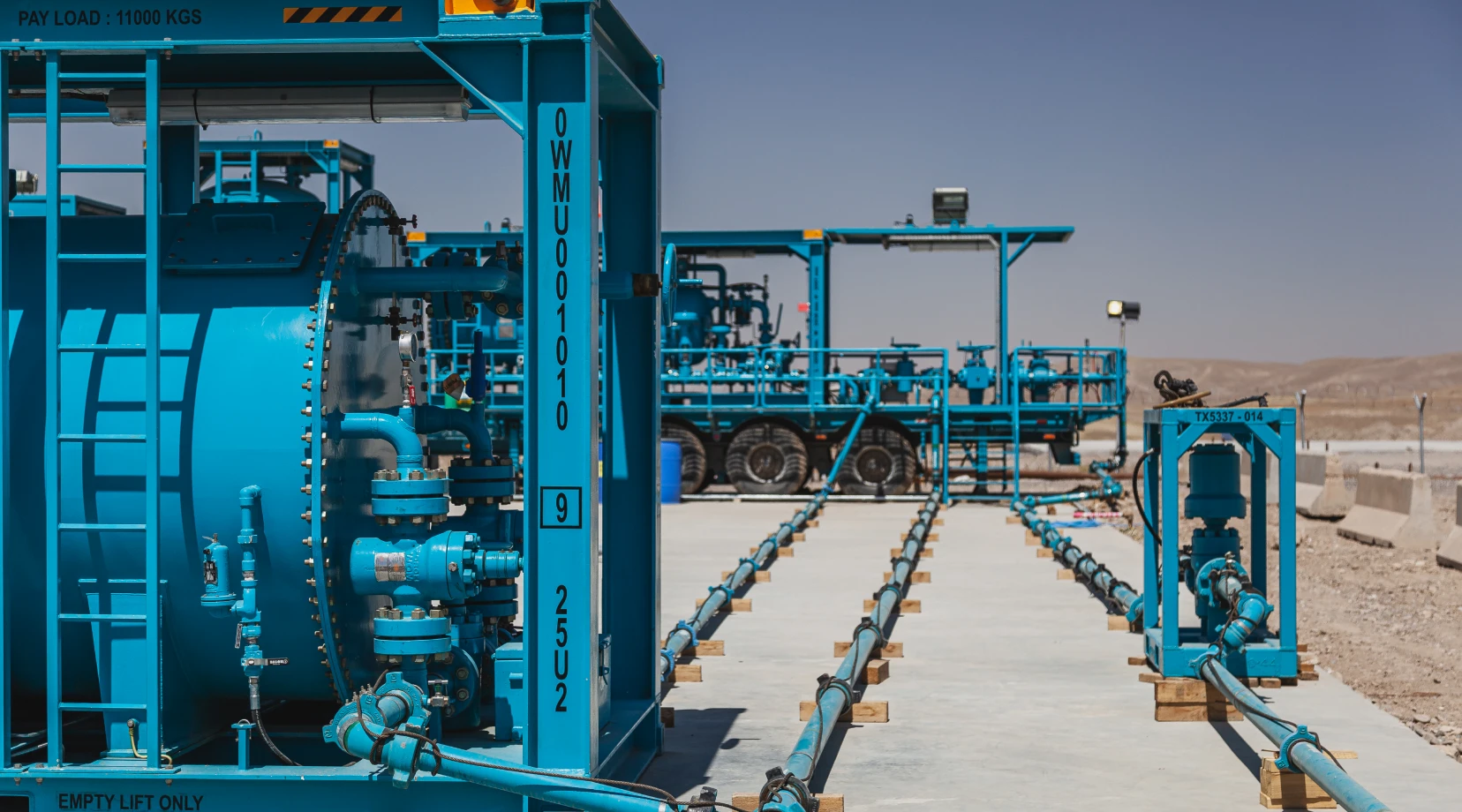
2. Cold Plate Loop Pumps: Treated Water, PG25, and the Microchannel Constraint
Direct-to-chip cold plates are the most common liquid cooling deployment in 2026 because they retrofit into existing rack form factors and reuse much of the facility chilled water infrastructure. The pumps that feed them are subject to four engineering pressures the rest of the data center plant does not see:
● Microchannel erosion vulnerability. Modern GPU cold plates use copper or stainless microchannels with 200–500 µm hydraulic diameter. Any particulate above ~50 µm can plug them; any sustained pulsation accelerates erosion of channel walls. Specifying a pump whose pulsation is inherently low (regenerative turbine vortex over external-gear designs) saves the cold plate.
● Tight pressure window. Server cold plates are typically rated for 4–6 bar working pressure. CDU secondary loops run narrow band around 3 bar to leave margin against transient spikes. Pumps in this service need flat head-flow curves and predictable response to VFD speed changes.
● Treated water chemistry. The most common coolant is propylene-glycol-water (PG25) with corrosion inhibitor packages. ASHRAE TC 9.9 guidance and OCP (Open Compute Project) cold plate specifications converge on copper, brass, stainless 316L, and EPDM as compatible materials. Iron, galvanized steel, and zinc-bearing solders are out.
● Cleanroom-comparable cleanliness on first fill. The first 1,000 hours of service in a cold plate loop determine whether it ever runs reliably. Pumps shipping with internal contamination or post-machining swarf seed particulate that no amount of downstream filtration will recover from. Factory cleaning to ISO 14644 Class 7 equivalence is now specified by most CDU OEMs.
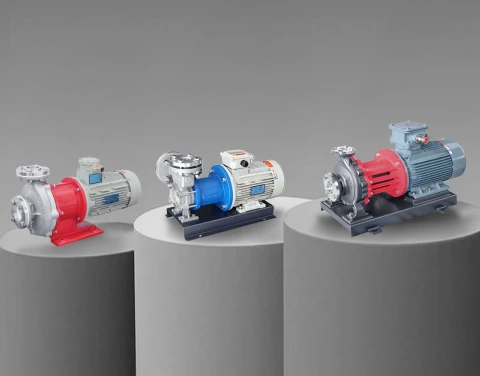
For mid-flow cold plate secondary loops in stainless 316L construction, our MDH stainless steel vortex magnetic drive pump and MDS stainless steel vortex magnetic drive pump are the units we typically specify into CDU integrator projects. The vortex (regenerative-turbine) hydraulic family inherently delivers high head against the pressure drop a cold plate manifold creates, while keeping pulsation peak-to-peak below 2%. For deeper background on the architecture, see our industrial vortex pump selection guide.
3. Immersion Cooling Pumps: Dielectric Fluid, Density, and the Pumpability Problem
Immersion cooling moves the thermal interface from the cold plate to the chip surface itself. Servers are submerged in a non-conductive dielectric fluid that absorbs heat by direct contact. Two operational modes exist:
Single-phase immersion
The dielectric remains liquid through the operating range. A pump circulates it from the tank through an external heat exchanger and back. Working fluids are typically synthetic hydrocarbon (GRC ElectroSafe, Submer SmartCoolant), polyalphaolefin (PAO), or specialty mineral oils with viscosities in the 5–15 cP range at operating temperature. Density runs 0.78–0.85 g/cm³, meaning the same hydraulic horsepower moves slightly more volume than water.
Two-phase immersion
The dielectric boils at the chip surface (FC, HFE, or PFPE grades with boiling points in the 40–60 °C range) and recondenses at the tank lid. Pumping demand is much lower — the thermosiphon does most of the work — but a small auxiliary pump is needed for makeup fluid transfer, vapor-side condensate management, and reservoir circulation. Because the working fluid is usually fluorinated, pump selection inherits all of the chemistry constraints we covered in our semiconductor coolant pump selection guide — specifically the post-3M migration toward Galden PFPE and HFE alternates from third parties.
Three pump-selection decisions specific to immersion:
● Material compatibility with the dielectric. Hydrocarbon dielectrics attack standard NBR and EPDM elastomers; FKM (Viton) or PTFE seals are mandatory. Magnetic-drive pumps with no dynamic seal eliminate the elastomer problem entirely. Fluorinated dielectrics demand PTFE-lined wetted parts at minimum.
● Tank geometry constraints. Most immersion tanks are physically shallow (700–1,200 mm deep). Pumps installed inside the tank must be compact and oriented horizontally; pumps installed externally must handle the short-suction-line geometry without cavitation.
● Fluid-loss intolerance. Hydrocarbon dielectric costs USD 15–50 per liter; PFPE costs USD 200–500 per kg. Even on the cheap end, a 5,000-liter tank holds significant capital, and dielectric loss to evaporation, leakage, or contamination is a serious operating expense. Seal-less pump architecture is non-negotiable.
Our PWH/PWD/PWM canned vortex pump series is the configuration we ship most often into single-phase immersion deployments — the canned-motor structure has no coupling and no exposed shaft, which makes installation inside or adjacent to an immersion tank straightforward and eliminates leakage paths. For fluorinated-fluid two-phase systems, the AMC-F PTFE-lined magnetic drive pump provides the chemical inertness those services require.
4. CDU Primary Loop Pumps: The Workhorse of the Liquid Data Center
A coolant distribution unit (CDU) is the heat-exchange and pumping module that bridges the rack-side secondary loop and the facility-side primary loop. In a typical Blackwell-class deployment, one CDU serves 2–6 racks (200–1,200 kW total IT load) and contains its own redundant pump pair, a plate-and-frame heat exchanger, instrumentation, and filtration.
CDU primary-side pumps see a different duty cycle from the secondary side: higher flow, higher head, but less stringent fluid purity (the primary side is facility chilled water, which has been managed by HVAC contractors for decades). The selection drivers are:
● Rotating redundancy. Most CDUs ship with N+1 pump redundancy: two pumps installed, one running at a time, switched periodically by the CDU control system. Pumps must reach setpoint quickly on hot-start, and the parasitic load of the idle pump (cooling, lubrication) must be near zero.
● Wide turndown. IT load varies hour-to-hour as workloads shift. A pump that can turn down to 30% of rated flow without losing efficiency or stalling against the cold plate manifold is essential. This typically means a VFD-controlled magnetic-drive pump with synchronous permanent-magnet motor.
● Predictable acoustic and vibration signature. CDUs sit in or near the data hall, often within meters of human operators. Sound pressure level (SPL) above 65 dB at 1 m is generally unacceptable. Vortex magnetic-drive pumps run significantly quieter than equivalent centrifugal designs because of their lower discharge pulsation and absence of impeller-blade-pass tones.
For a 6-rack CDU rated 1.2 MW IT load with a 7 °C secondary delta-T, the pumping requirement works out to roughly 2,800 L/min at 6–8 bar head. This is well within the operating envelope of our MDH and MDS magnetic-drive vortex families in standard configuration. For larger central CDUs serving multi-megawatt deployments, we configure paralleled-pump arrangements with shared header piping and N+1 redundancy.
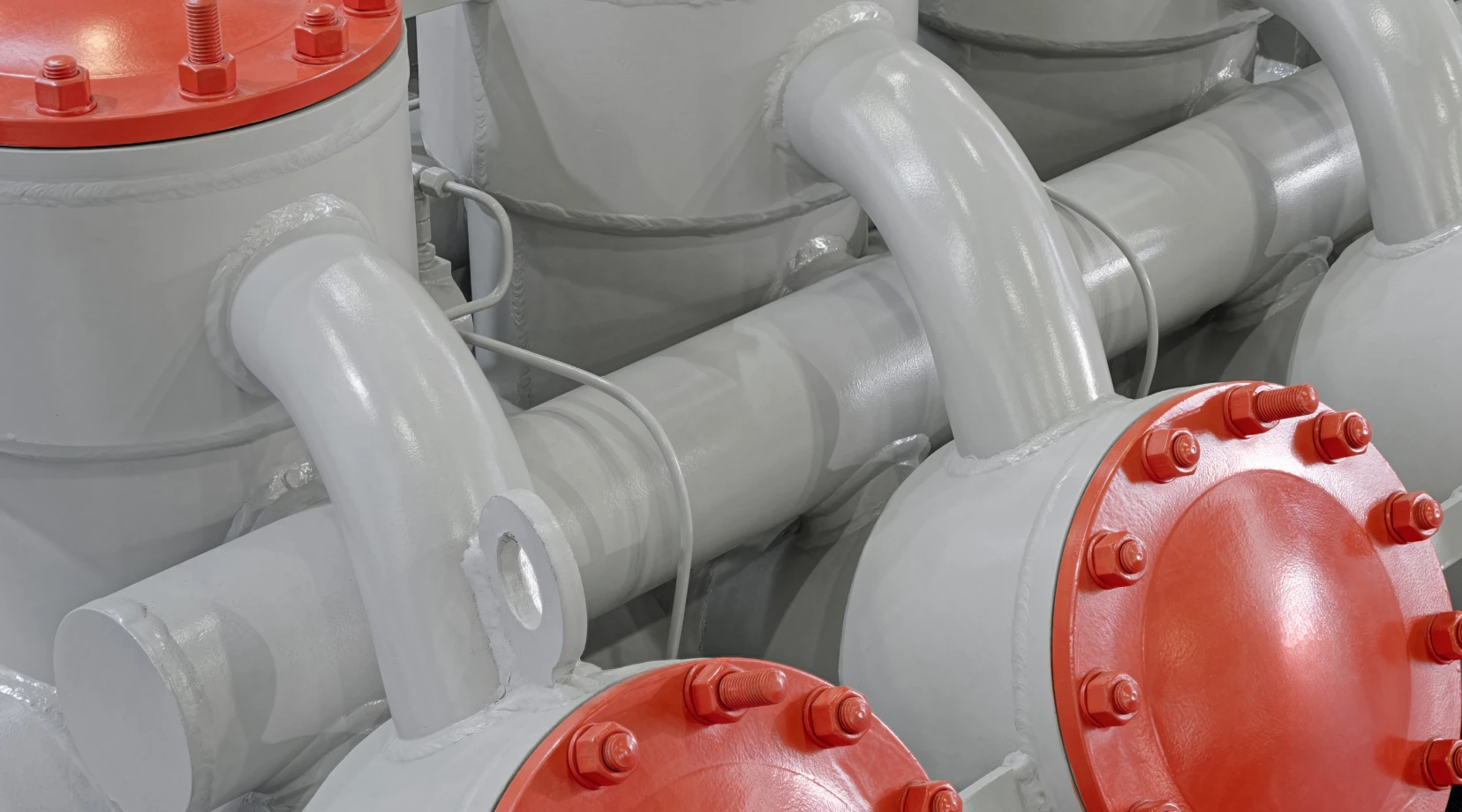
5. Why Magnetic Drive Pumps Replace Mechanical Seal Pumps in Liquid Cooling Loops
For 30+ years, the default circulation pump in a data center facility chilled water plant was a wet-rotor or close-coupled centrifugal with a single mechanical seal. That choice made sense when cooling loops carried ordinary HVAC chilled water at low pressure, the maintenance team had physical access to the plant room, and a small seal weep was a housekeeping problem. None of those assumptions survives in a 2026 liquid-cooled AI data center:
● Pressurized treated water at 4–6 bar. Cold plate secondary loops are pressurized far above conventional HVAC service. Mechanical seal specifications scale with discharge pressure; a seal that lasted 5 years on a 2 bar chilled water loop fails within 12–18 months on a 6 bar secondary cold plate loop.
● Cumulative cost of fluid loss. A 1 mL/min seal weep is roughly 525 liters per year. On treated water with inhibitor packages this is annoying but tolerable; on PG25, that is an annual top-up of expensive chemistry. On dielectric or fluorinated fluid, the same weep is a five-figure annual loss.
● Live-electronics adjacency. CDUs, immersion tanks, and rear-door heat exchangers all sit within centimeters of energized servers. Containment failure is not a maintenance event — it is a hardware loss event that an SLA cannot absorb. Magnetic-drive and canned-motor architecture moves the failure mode from “catastrophic leak” to “flow stop with no fluid escape,” which the CDU control system can detect and isolate.
● Unattended operation. Hyperscale facilities operate at minimum staffing. Mechanical seal pumps require quarterly visual inspection and annual seal replacement on a planned schedule; magnetic-drive pumps with silicon-carbide bearings demonstrate 50,000+ hour service intervals in clean treated water.
For deeper engineering background, our industrial magnetic drive pump selection guide covers magnet coupling theory, eddy currents, and decoupling-torque calculations. The canned motor pump technology guide compares the three structural variants of seal-less drive.
6. Sizing a Pump for a 130 kW Blackwell-Class Rack
The hyperscale industry has converged on a small number of standard rack designs, and a 130 kW GB200 NVL72 rack is the most common 2026 reference point. Here is how we size the secondary-loop pump for one of these racks:
● Step 1 — Determine the heat load. 130 kW total IT load. Approximately 95% of this is captured by cold plate (CPUs, GPUs, NVSwitch); roughly 5% remains as residual air cooling for power supplies, fans, and other components. The pump sizes against 124 kW of heat to be moved by the cold plate loop.
● Step 2 — Calculate the flow rate. For treated water with a 7 °C secondary delta-T (typical 25 °C supply, 32 °C return), flow Q[L/min] ≈ 14.3 × kW / ΔT = 14.3 × 124 / 7 ≈ 253 L/min. For PG25 with reduced specific heat (~3.85 kJ/kg·K vs 4.18 for water), the flow requirement rises to ~275 L/min.
● Step 3 — Compute the head requirement. Sum cold plate pressure drop (typically 0.8–1.5 bar across the rack manifold), supply/return pipework, and CDU heat exchanger drop (~0.5 bar). Total system head usually 3–5 bar at design flow.
● Step 4 — Apply turndown margin. Specify pump head 15–25% above calculated system head, with VFD turndown to 30% of rated flow. This handles partial IT load (idle GPUs), seasonal coolant temperature shifts, and fouling over time.
● Step 5 — Choose the architecture. For 130 kW per rack at 275 L/min and 5 bar, a magnetic-drive vortex pump in the MDH or MDS family with a 5.5–7.5 kW synchronous permanent-magnet motor and VFD is the right fit. For racks above 200 kW, parallel-pump configurations with N+1 redundancy.
For background on the energy-efficiency drivers behind these specifications, see our EU pump ecodesign regulation impact analysis — the same minimum-efficiency-index logic now applies to hyperscale CDU procurement in most jurisdictions.
7. Reliability Engineering: MTBF, Redundancy, and the Cost of a Pump Failure
A pump failure in a 1.2 MW CDU stops 6 racks for as long as it takes to switch to the backup pump. If both pumps fail simultaneously, those racks cycle off within minutes to protect the silicon. The business consequences are immediate: lost training cycles, broken SLAs, reputational impact on the colocation operator. The reliability engineering work behind a CDU pump specification therefore matters disproportionately:
● Demonstrated MTBF. Ask for field service data, not just bench data. Our magnetic drive pumps in clean treated water service routinely demonstrate 50,000+ hour intervals between planned bearing replacement; on PG25 with proper filtration, 30,000–40,000 hours.
● Predictive instrumentation. Vibration sensors on the bearing housing, motor current monitoring through the VFD, and outlet pressure transmitters allow the CDU control system to detect pump degradation weeks before failure.
● Hot-swap replacement. Pump installations with isolation valves on both sides allow a failing pump to be swapped without draining the loop. This is now a standard CDU OEM requirement.
● Spare-parts standardization. A hyperscaler running 10,000 CDUs cannot afford a unique pump SKU per design generation. Suppliers who standardize their bearing kits, magnet sets, and shaft assemblies across product families substantially reduce lifecycle support cost.
● Documented quality control. Every unit ships with parameter test data, material traceability, and (for our magnetic-drive pumps) TÜV CE certification. Tier-1 hyperscalers require this for procurement qualification.
8. Aulank Data Center Cooling Pump Portfolio
We have been building magnetic-drive and canned-motor pumps for thermal management for 17+ years, and data center liquid cooling has been one of our fastest-growing verticals since 2024. The configurations we ship most often into CDU integrators, immersion tank OEMs, and large hyperscale facility projects:
● MDH stainless steel vortex magnetic drive pump — the mainstream choice for CDU secondary-loop service on treated water and PG25 cold plate loops. 316L wetted parts, mirror polish, low pulsation, VFD compatible.
● MDS stainless steel vortex magnetic drive pump — higher-flow variant for central CDU plants serving multi-rack deployments and for large rear-door heat exchanger plant rooms.
● PWH/PWD/PWM canned vortex pump series — canned-motor variant for single-phase immersion cooling and for any application where the elimination of even static O-ring exposure paths matters.
● AMC-F PTFE-lined magnetic drive pump — full PTFE-lined wetted parts for two-phase immersion service with PFPE or HFE dielectric, and for any duty involving fluorinated coolants.
● MDC-X medium-large magnetic gear pump — for high-precision dielectric metering, makeup-fluid transfer, and any positive-displacement requirement in immersion plant rooms.
What a CDU OEM or hyperscale procurement team gets from us specifically:
● Custom electrical configurations — 200–480 V AC, three-phase, DC low-voltage for tank-mounted variants, VFD-compatible with hyperscale BMS integration via Modbus, BACnet, or OPC UA.
● Cleanroom-grade factory cleaning — ISO 14644 Class 7 equivalence on first-fill cleanliness, documented with particle count and TOC test data.
● Synchronous permanent magnet drive technology — one of our 10 core technologies, giving better efficiency at turndown than standard induction designs.
● Standardized spare-parts kits across product families — bearing kits and magnet sets are interchangeable across MDH/MDS/MDK and across PWH/PWD/PWM lines, reducing the hyperscaler’s lifecycle support inventory.
● Documented quality control — ISO 9001, TÜV CE certification on magnetic drive vortex pumps, 50+ patents on synchronous permanent-magnet drive structures.
9. The Liquid Cooling Pump Outlook Into 2027
Three structural trends will shape data center pump procurement over the next 18–24 months:
● Adoption of liquid cooling reaches mainstream. Industry data points to liquid-cooled new builds crossing 35–40% of total hyperscale deployments by end of 2027. Pump volume scales correspondingly. CDU OEMs are signing multi-year frame agreements with pump suppliers for the first time, prioritizing capacity reservation and long-term technical roadmap alignment over spot pricing.
● Two-phase immersion exits the lab. Several hyperscale operators are running two-phase immersion at production scale in HBM-heavy AI training clusters. Pump demand here is small per unit but technically demanding (fluorinated compatibility, vapor handling). The post-3M dielectric migration is forcing a re-validation of every two-phase pump specification, which we covered in our semiconductor coolant pump selection guide.
● Regulatory pressure on water use intensifies. WUE (water-use effectiveness) regulations in the EU, parts of the US, and increasingly in Asia restrict evaporative cooling top-up at large facilities. Closed-loop liquid cooling with dry-cooler or sea-water heat rejection becomes mandatory, which puts more pumps into the value chain at higher specification levels.
Get a Custom Data Center Cooling Pump Configuration
Whether you are a CDU integrator, immersion tank OEM, hyperscaler facility engineering team, or colocation operator building liquid-ready capacity, our engineering team can match the right magnetic-drive or canned-motor pump architecture to each loop in your design.
Talk to our team: Contact Aulank | WhatsApp: +86 13773157367 | Email: info@aulankpump.com
Browse the relevant product and solution pages: