


During the second half of October 2026, two major industry developments underscored a structural shift in global fluid handling procurement. First, market data released on October 14, 2026 confirmed that the global centrifugal pump sector has reached USD 42.8 billion in 2026—within a broader USD 77.82 billion to USD 91.03 billion industrial pump market—driven heavily by industrial decarbonization retrofits and modular thermal skids. Second, at the Carbon Capture Technology World Expo held at Hamburg Messe from October 20 to 22, 2026, over 1,000 exhibitors and EPC engineering firms highlighted a critical operational bottleneck as Carbon Capture, Utilization, and Storage (CCUS) transitions from pilot plants to commercial-scale deployment: the premature failure of mechanically sealed circulation pumps in post-combustion amine scrubbing loops. As cement plants, waste-to-energy facilities, refineries, and chemical producers install modular carbon capture skids in Q4 2026, process engineers are replacing conventional sealed pumps with hermetic sealless magnetic drive pumps and heavy-duty stainless steel centrifugal units. This industry report analyzes the chemical and thermodynamic challenges of amine-based CO2 capture and details the pump specifications required for continuous, zero-emission operation.
The October 2026 CCUS Shift: From Pilot Plants to Modular Skids
Throughout October 2026, engineering discussions across European and North American decarbonization projects have focused on reducing the Levelized Cost of Capture (LCOC) and eliminating secondary environmental liabilities. Post-combustion chemical absorption using aqueous alkanolamine solvents—such as monoethanolamine (MEA), diethanolamine (DEA), methyldiethanolamine (MDEA), and proprietary sterically hindered amines—remains the most mature technology for capturing $CO_2$ from low-pressure industrial flue gases.
However, feedback from commercial CCUS facilities operating in 2026 reveals that solvent degradation, amine makeup costs, and unscheduled pump maintenance represent a major portion of operating expenses (OpEx). In a continuous absorption-desorption loop, circulation pumps must run 8,000+ hours per year while handling hot, corrosive, gas-saturated solvents. Following the October 2026 technical sessions in Hamburg, EPC procurement specifications increasingly mandate zero-leakage containment on all rich-amine and lean-amine transfer lines to prevent solvent loss and comply with strict workplace exposure limits for amines and nitrosamines.
Fluid Mechanics and Chemistry of the Amine Scrubbing Loop
A standard amine-based carbon capture plant consists of three distinct hydraulic zones, each imposing severe mechanical and chemical stresses on pumping equipment:
1. Direct Contact Cooler (Flue Gas Quench Loop)
Before hot industrial flue gas (often 150°C to 250°C) enters the amine absorber, it must be cooled to approximately 40°C to 45°C in a quench tower. The circulation pumps in this loop handle large volumes of warm water contaminated with fly ash particulates, dissolved sulfur oxides ($SO_x$), nitrogen oxides ($NO_x$), and trace hydrochloric or sulfuric acid. This requires high-flow rate pump solutions built from corrosion-resistant austenitic stainless steels capable of passing fine suspended solids without clogging.
2. Rich Amine Transfer (Absorber Bottoms to Stripper)
Inside the absorber column, lean amine solution absorbs $CO_2$ exothermically at 40°C to 60°C, becoming "rich amine." The rich amine booster pump must draw this $CO_2$-saturated liquid from the absorber sump and pump it through the lean/rich cross-heat exchanger into the elevated pressurized stripper column. As the rich amine is heated in the cross-exchanger to 100°C–110°C, dissolved $CO_2$ begins to flash out of solution, creating a highly corrosive, two-phase gas-entrained fluid stream that aggressively attacks metal surfaces via carbonic acid corrosion.
3. Lean Amine and Reboiler Circulation (120°C to 135°C)
In the stripper (regenerator) column, steam heats the solvent to 120°C–135°C at 1.5 to 2.5 bar abs to strip the $CO_2$ gas. The lean amine at the bottom of the stripper sits directly at its boiling point. Pumping this high-temperature boiling liquid back to the absorber requires pumps specifically engineered for low Net Positive Suction Head Available (NPSHa) and high-temperature pump solutions.
| CCUS Process Loop | Fluid Medium & Temperature | Primary Hydraulic & Chemical Hazard | Recommended Aulank Pump Series |
|---|---|---|---|
| Flue Gas Quench / Pre-Scrubber | Acidic quench water with fly ash (40°C–65°C) | Low-head, high-flow abrasion and sulfurous acid corrosion | CPS-L / RGP Stainless Steel Centrifugal Pump |
| Rich Amine Transfer Loop | CO2-saturated MEA / MDEA + HSS (45°C–85°C) | CO2 off-gassing, carbonic acid erosion-corrosion, seal weeping | AMC-F PTFE/PFA-Lined or AMC-L 316L Mag-Drive |
| Lean Amine Booster & Reboiler | Regenerated hot amine near boiling point (120°C–135°C) | Low NPSHa cavitation, thermal expansion, fugitive amine vapor | AMC-L Heavy-Duty Process Magnetic Drive Pump |
| Chemical Makeup & Antifoam Dosing | Concentrated fresh amine, NaOH, corrosion inhibitors | High-precision low-flow metering against system backpressure | MDC Series Magnetic Gear Pump / MDW Vortex |
Why Dynamic Mechanical Seals Fail in Amine Carbon Capture
Historically, chemical plants utilized mechanically sealed centrifugal pumps with API Plan 52 or Plan 53B dual pressurized barrier fluid systems for amine circulation. However, field operational data compiled in 2026 shows three recurring failure mechanisms when dynamic mechanical seals are deployed in CCUS skids:
- Acid Gas Flashing Across Seal Faces: Rich amine contains high concentrations of dissolved $CO_2$. As the fluid lubricates the narrow micron-scale gap between rotating and stationary mechanical seal faces, frictional heat causes the dissolved $CO_2$ to flash into gas bubbles. This destroys the hydrodynamic liquid film, causing the seal faces to run dry, chatter, and fracture thermally.
- Heat Stable Salts (HSS) Crystallization: Flue gas oxygen and acidic impurities ($SO_2$, $NO_2$, $HCl$) react irreversibly with alkanolamines to form Heat Stable Salts (such as formates, acetates, oxalates, and sulfates). When minute amounts of amine weep across a mechanical seal face and contact ambient air, these salts crystallize into hard, abrasive deposits that score silicon carbide seal rings within weeks.
- Fugitive Amine and Nitrosamine Emissions: Alkanolamines are volatile, foul-smelling, and corrosive to skin and eyes. More critically, amines react with trace $NO_x$ in flue gas to form nitrosamines—compounds strictly regulated by environmental agencies due to their carcinogenicity at parts-per-billion (ppb) levels. Even minor seal weepage releases fugitive amine vapors into enclosed modular CCUS containers, violating 2026 environmental health and safety (EHS) permits.
The Sealless Magnetic Drive Standard for CCUS Skids
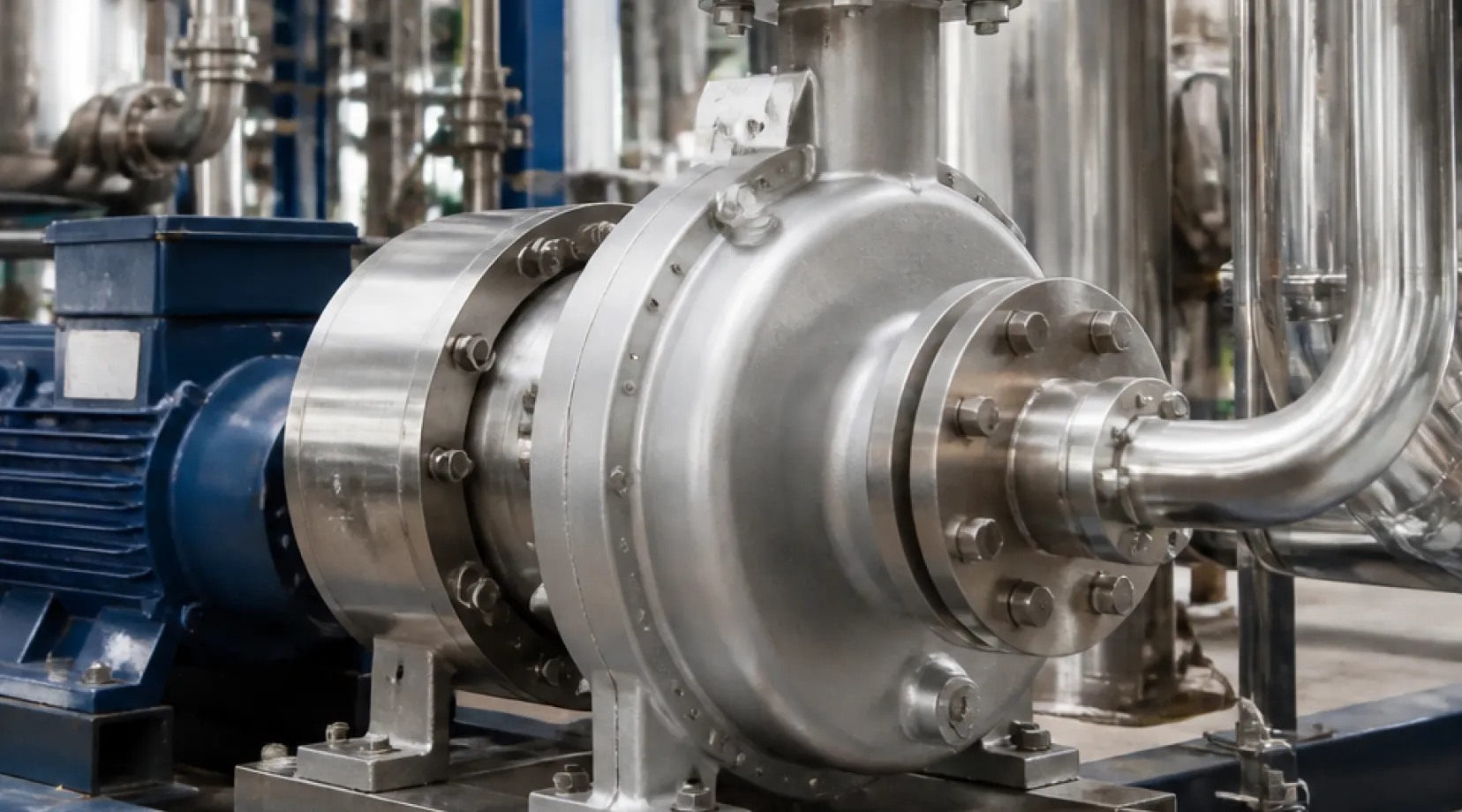
To eliminate seal flush support systems and achieve absolute environmental compliance, CCUS skid manufacturers are standardizing sealless magnetic drive architectures. A magnetic drive pump replaces the traditional dynamic shaft penetration with a static, hermetically sealed containment shell (isolation sleeve).
Torque is transmitted from the drive motor to the internal impeller rotor via permanent rare-earth magnets (Samarium Cobalt $SmCo$ for high-temperature lean amine service up to 250°C, or Neodymium $NdFeB$ for cooler rich amine duties). Because the process fluid is completely encapsulated within the static pressure boundary, fugitive emissions of volatile amines, ammonia degradation products, and nitrosamines are reduced to zero. Furthermore, eliminating complex dual-seal buffer tanks and nitrogen pressurization panels reduces the physical footprint of modular containerized CCUS units by up to 20%.
Metallurgical Selection: Resisting Carbonic Acid and HSS Attack
Pure, un-carbonated alkanolamines are alkaline (pH 10 to 12) and relatively non-corrosive to carbon steel at ambient temperatures. However, once the amine absorbs $CO_2$ and accumulates Heat Stable Salts at elevated temperatures, the fluid becomes intensely corrosive. Wet $CO_2$ forms carbonic acid ($H_2CO_3$), while HSS chelates iron ions directly from metal surfaces, stripping away passive oxide films.
- 316L Austenitic Stainless Steel: For lean amine circulation and moderate-temperature rich amine loops, low-carbon 316L stainless steel is the baseline metallurgy. Its molybdenum content resists pitting from trace flue gas chlorides, while low carbon content (<0.03%) prevents intergranular attack at weld seams.
- PFA / PTFE Fluoropolymer Linings: In rich amine loops with high $CO_2$ loading, elevated chloride levels (common in waste-to-energy and coastal plants), or acidic reclaimers, metallic alloys can suffer from high-velocity erosion-corrosion inside the pump volute. Specifying a ductile-iron-armored pump lined with virgin PTFE or PFA fluoropolymer provides total chemical inertness across all pH levels up to 150°C.
- Pressureless Sintered Silicon Carbide (SSiC) Bearings: Inside a sealless pump, the internal sleeve bearings are lubricated by the amine solution itself. Aulank utilizes pure alpha-grade SSiC bearings (containing zero free silicon), which are completely impervious to alkaline amines, organic acids, and abrasive Heat Stable Salt crystals.
Specifying Aulank Pumps for Carbon Capture & Decarbonization Projects
As global industrial decarbonization accelerates in late 2026, Aulank Pump provides EPC contractors and modular CCUS skid builders with a proven portfolio of fluid handling equipment:
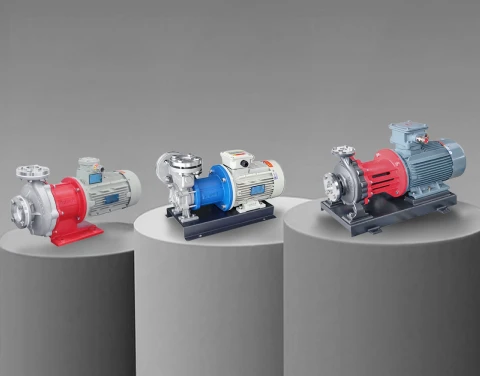
- AMC-L Chemical Process Magnetic Drive Pump: Engineered with heavy-wall 316L stainless steel castings, high-temperature $SmCo$ magnetic couplings, and SSiC internal bearings. Ideal for hot lean amine booster duties (120°C–135°C) and pressurized stripper circulation with zero fugitive emissions.
- AMC-F Chemical Standard PTFE-Lined Magnetic Drive Pump: Combines heavy ductile iron structural armor with a thick, permeation-resistant fluoropolymer lining. Specifically suited for corrosive rich amine transfer, acid wash sections, and thermal reclaimer bottoms containing concentrated Heat Stable Salts.
- CPS-L Stainless Steel High Flow Centrifugal Pump: Designed for high-volume, low-head flue gas pre-scrubbing and direct contact cooler (quench) towers, delivering high hydraulic efficiency and low NPSHr.
To review pump curves, NPSH calculations for boiling lean amine, or material compatibility for your proprietary carbon capture solvent, contact our engineering team directly.
