


Corrosion-Resistant Pump Market Hits Growth Phase as Chemical CAPEX Shifts to Asia-Pacific
The global chemical pump market is valued between USD 52 billion and USD 85 billion in 2026, depending on the scope of measurement, and is projected to grow at 4–6% CAGR through 2031. Within that market, corrosion-resistant pumps — built from stainless steel alloys, fluoropolymers, ceramics, and engineered plastics — are emerging as the fastest-growing segment. The reason is structural: chemical manufacturing is getting more complex, the fluids are getting more aggressive, and the regulatory tolerance for leaks and spills is getting lower.
Asia-Pacific is driving the bulk of this growth, accounting for 38–45% of global chemical pump demand in 2026.
Where the Money Is Going
Chemical plant capital expenditure in Asia-Pacific is expanding on two fronts. China and India continue building out bulk chemical and petrochemical capacity. At the same time, both countries — along with Taiwan, South Korea, and Southeast Asian nations — are investing heavily in specialty chemicals, pharmaceutical intermediates, and semiconductor-grade chemical production. These higher-value processes use more aggressive intermediates, exotic solvents, and require ultra-pure fluid handling. Standard cast iron or carbon steel pumps cannot survive in these services.
The Middle East is the other major growth region, driven by downstream petrochemical diversification in Saudi Arabia and the UAE, plus large-scale desalination projects that consume acid-resistant and brine-resistant pumps. Saudi Arabia's National Water Strategy alone directs USD 13 billion toward reverse-osmosis capacity through 2030.
In Europe, demand is more replacement-driven. Aging chemical plants are upgrading pump fleets to comply with the EU's emission control and energy efficiency directives. Germany, France, and the UK account for roughly 45% of the European pump market. The trend there is toward sealless magnetic drive designs and pumps with integrated IoT monitoring — driven partly by the Ecodesign framework and partly by the practical economics of reducing unplanned downtime.
Material Trends Shaping Pump Specifications
The shift in chemical pump materials tells the story clearly. In 2024, more than 10.6 million industrial pump units were manufactured using high-grade stainless steel, titanium, or duplex alloys — primarily for offshore, acid handling, and wastewater treatment applications. But the more interesting growth is in fluoropolymer-lined and engineered-plastic pumps, which are gaining share in chemical transfer, electroplating, and semiconductor wet bench applications.
| Material | Typical Application | Temperature Range | Key Advantage |
|---|---|---|---|
| 316L Stainless Steel | General chemical transfer, mild acids/alkalis | -196°C to +400°C | Broad compatibility, high pressure tolerance |
| Duplex / Super Duplex | Chloride-rich brine, offshore | -50°C to +300°C | Chloride stress cracking resistance |
| Hastelloy C-276 | Strong acids, oxidizing environments | Up to +350°C | Extreme corrosion resistance |
| PTFE / PFA Lining | HCl, HF, H2SO4, organic solvents | -20°C to +150°C | Near-universal chemical resistance |
| PEEK | High-temp chemical, semiconductor | Up to +260°C | Low particle generation, high purity |
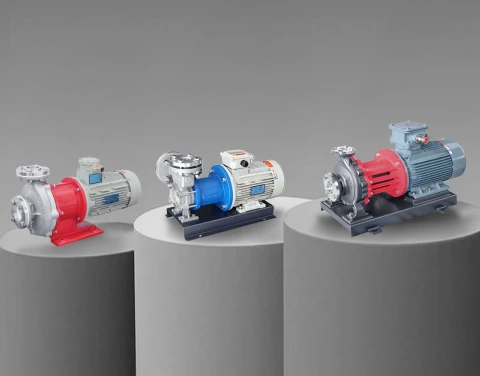
For chemical facilities handling strong acids, alkalis, and organic solvents, fluoropolymer-lined magnetic drive pumps (such as Aulank's AMC-F series) combine PTFE/PFA lining with sealless magnetic coupling, rated for media up to 150°C and pressures up to 15 bar. For broader chemical processing needs including high-temperature thermal fluid circulation, stainless steel magnetic drive models (MDH/MDW and AMC series) cover the range from cryogenic to +400°C service.
Competitive Landscape
The top five global pump suppliers — Flowserve, Grundfos, Xylem, KSB, and Sulzer — hold roughly 30–35% of market revenue collectively. Western manufacturers are shifting toward engineered-to-order niches with exotic metallurgy and digital service overlays. Flowserve reported a 12% year-on-year rise in magnetically driven pump orders for bioprocessing in its 2024 filings.
Chinese manufacturers have captured up to 20% share in municipal and light-industrial tenders by pricing 20–30% below Western competitors while matching warranty terms. This competitive dynamic is pushing the entire industry toward specialization: Western brands moving up-market into high-spec chemical and pharmaceutical pumps, Chinese manufacturers expanding globally with cost-competitive industrial-grade solutions.
For OEMs and system integrators sourcing chemical-resistant pumps for new plant construction or equipment platforms, the current market offers a wider range of material and design options than at any point in the past decade — at price points that continue to compress as manufacturing scale increases across Asia.
Sources
- Corrosion-Resistant Pumps Market Forecast to 2035 — IndexBox
- Pumps Market Size & Trends 2026–2031 — Mordor Intelligence
- Chemical Pump Global Market Insights 2026 — Market Publishers
- Industrial Pumps Market Size & Forecast to 2035 — Market Reports World
- Chemical Processing Plants Shift to Corrosion-Resistant Pumps — Pacer Pumps
- Europe Pumps Market Outlook — Grand View Research
