


Transferring cryogenic fluids such as liquid nitrogen (-196°C), liquid argon (-186°C), and liquid oxygen (-183°C) introduces severe mechanical and thermodynamic constraints on industrial pumping equipment. In these ultra-low temperature regimes, ambient heat acts as an aggressive contaminant, and mechanical components undergo extreme dimensional and structural changes. Traditional centrifugal pumps utilizing dynamic mechanical seals consistently fail in cryogenic service due to elastomer embrittlement, atmospheric moisture freezing at the seal faces, and inevitable fluid vaporization along the shaft boundary. The sealless magnetic drive architecture resolves these containment vulnerabilities by establishing a hermetic pressure boundary, entirely eliminating the rotating shaft penetration. However, adapting a magnetic drive pump for -196°C operation requires rigorous modifications in metallurgy, bearing clearances, and internal thermodynamics. This engineering guide details the design parameters required to stabilize cryogenic fluid transfer.
The Metallurgy of Cryogenic Pumping
The primary structural consideration in cryogenic pump design is the ductile-to-brittle transition temperature (DBTT). Standard carbon steels and many alloy steels lose their ductility at sub-zero temperatures, becoming highly susceptible to brittle fracture under mechanical stress or internal pressure.
To maintain structural integrity at -196°C, the pump casing, impeller, and containment shell must be constructed from austenitic stainless steels, specifically 304L or 316L grades. The face-centered cubic (FCC) atomic lattice of austenitic stainless steel does not exhibit a DBTT, allowing the metal to retain excellent fracture toughness and yield strength even at liquid nitrogen temperatures. The "L" designation indicates low carbon content (less than 0.03%), which prevents carbide precipitation at the grain boundaries during welding processes, thereby maintaining uniform mechanical properties and corrosion resistance across the entire pump volute.
For the isolation sleeve (containment shell), material selection must balance high tensile strength with specific electrical properties. Titanium alloys or high-nickel alloys like Hastelloy C-276 are frequently specified. These metals provide the necessary pressure containment while exhibiting higher electrical resistivity than standard stainless steels, a critical factor in managing internal heat generation.
Managing Differential Thermal Contraction
A cryogenic magnetic drive pump undergoes a massive temperature shift from ambient installation (e.g., +25°C) to operational state (-196°C). This gradient causes significant thermal contraction (shrinkage) across all internal components. Because the pump utilizes different materials—stainless steel for the rotor, specialized carbon-graphite or ceramics for the bearings, and samarium-cobalt or neodymium for the magnets—each component contracts at a distinct rate defined by its specific coefficient of thermal expansion (CTE).
If differential contraction is not precisely calculated during the engineering phase, the internal journal bearings will bind against the shaft, leading to immediate mechanical seizure upon startup. Conversely, if clearances are too loose, the hydrodynamic film fails to form, resulting in rotor instability and destructive vibration. Engineers utilize specialized carbon-graphite bearing composites for cryogenic duty. Carbon-graphite offers a low CTE and possesses inherent self-lubricating properties. This is vital because cryogenic fluids like liquid nitrogen possess extremely low viscosity (roughly one-tenth that of water), providing very poor lubricity. The self-lubricating nature of the carbon-graphite protects the bearing surfaces during the transient dry-running periods that occur during system cool-down.
Thermodynamics: Heat Leak and Eddy Current Mitigation
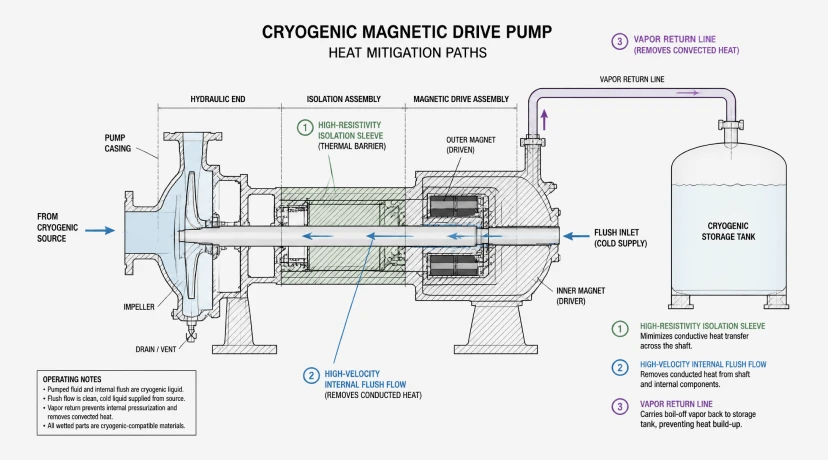
In cryogenic systems, heat is a contaminant. The primary challenge of utilizing a magnetic drive pump for liquid gases is managing the heat generated by the magnetic coupling itself. As the outer magnetic rotor spins, its magnetic field continuously cuts through the stationary metallic isolation sleeve, inducing electrical eddy currents. These currents generate localized heat directly adjacent to the pumped fluid.
Cryogenic fluids operate at or near their boiling points. Any introduction of heat into the fluid stream causes immediate vaporization (flashing). If the eddy current heat exceeds the fluid's latent heat of vaporization within the internal circulation path, gas bubbles form inside the containment shell. This localized flashing displaces the liquid lubricating the journal bearings, leading to dry running and catastrophic bearing failure.
To mitigate this, pump engineers employ three primary strategies:
- High-Resistivity Sleeves: Utilizing Titanium or specialized composite isolation sleeves to reduce the magnitude of the induced eddy currents.
- High-Velocity Flush Paths: Engineering the internal circulation circuit to force fluid through the bearing and sleeve gap at a high velocity. This rapid fluid exchange removes the eddy current heat before the fluid reaches its localized boiling point.
- Vapor Return Lines: In extreme applications, the pump casing is modified with a designated vapor return port routed back to the cryogenic storage dewar, allowing entrained gas to safely exit the pump volute without passing through the discharge line.
Net Positive Suction Head (NPSH) and Vortex Hydraulics
Pumping fluids at their boiling point requires meticulous management of Net Positive Suction Head available (NPSHa). If the localized pressure inside the pump impeller eye drops below the fluid's vapor pressure, cavitation occurs. The collapse of these vapor bubbles generates micro-jets that erode the internal metallurgy and destabilize the magnetic rotor.
Standard centrifugal pumps struggle heavily with two-phase flow (a mixture of liquid and gas). If the gas volume exceeds 3-5%, a centrifugal impeller becomes vapor-locked, spinning uselessly while fluid flow ceases. For applications requiring the continuous handling of highly volatile cryogenic fluids, engineers frequently specify the vortex pump architecture.
A vortex magnetic drive pump utilizes a regenerative peripheral impeller rotating within a tight-clearance channel. This design generates a continuous spiral motion, transferring kinetic energy to the fluid multiple times per revolution. Because of this hydraulic mechanism, a vortex pump can efficiently compress and expel entrained gases up to 20% by volume without vapor locking. This characteristic makes vortex hydraulics exceptionally resilient during the initial chill-down phase and during continuous operation where minor fluid flashing is unavoidable.
System Integration: The Chill-Down Protocol
A cryogenic magnetic drive pump cannot be started instantaneously. Subjecting a pump at ambient temperature to -196°C fluid at full rotational speed will cause violent thermal shock, catastrophic bearing fracture, and immediate system failure.
Operators must execute a strict cool-down (chill-down) protocol. Liquid nitrogen is slowly introduced into the pump volute, allowing the fluid to boil off as it absorbs heat from the austenitic steel casing and internal components. The resulting nitrogen gas is vented through the system. This process continues until the pump casing reaches uniform thermal equilibrium with the cryogenic fluid, indicated by the cessation of aggressive boiling and the presence of steady liquid at the vent valve. Only after thermal equilibrium is achieved, ensuring all components have fully contracted to their operational dimensions, is the electric motor energized.
Engineered Fluid Solutions with Aulank Pump
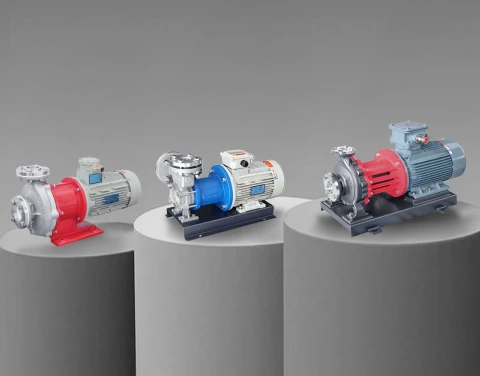
Aulank Pump engineers advanced sealless fluid handling equipment for the most rigorous industrial environments, spanning extreme thermal limits from -196°C to +400°C. Our magnetic drive architectures are explicitly designed to eliminate dynamic seal failures in critical chemical and thermal processes. For applications requiring precise low-flow, high-head performance with absolute zero-leakage containment, the MDP Permanent-Magnet Canned Vortex Magnetic Drive Pump provides stable hydraulic output and exceptional gas-handling capabilities. Whether configuring a high-temperature thermal oil loop or stabilizing a specialized liquid gas transfer system, Aulank’s engineering team delivers the metallurgical expertise and hydraulic precision required for continuous operation.
