


Every AI facility planning discussion lands on the same fork: direct-to-chip cold plates or full immersion. Both move heat with liquid, and both outperform air by an order of magnitude, yet they differ in almost everything that determines project success: how much of the server they cool, what the building must provide, how technicians service hardware, and what the fluid loop demands from its pumps. Vendor comparisons tend to favor whichever architecture the vendor sells. This guide compares the two on engineering terms, with the numbers that decide real projects and the pump and fluid-loop implications that most comparisons skip.
How Each Architecture Moves Heat
Direct-to-chip: targeted capture
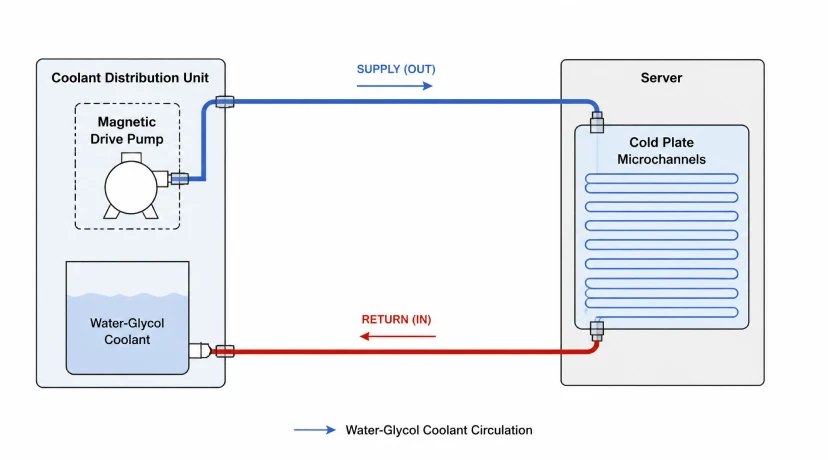
Direct-to-chip cooling mounts sealed cold plates on the highest heat-flux components, the CPUs and GPUs, and circulates water-glycol coolant through microchannels inside the plates at roughly 0.5 to 2 LPM per plate. Thermal resistance between the die and the coolant drops to 0.02 to 0.10°C/W, ten to twenty times better than an air heatsink. The loop runs through a coolant distribution unit that isolates the technology-side coolant from facility water and holds flow, temperature, and pressure at setpoint. Heat capture covers 60 to 80 percent of rack load; memory, power conversion, and storage still reject their heat to air, so the hall keeps a reduced air-cooling layer alongside the liquid loop.
Immersion: whole-server capture
Immersion removes the boundary entirely by submerging the server boards in dielectric fluid. Single-phase systems pump the fluid through a heat exchanger and back to the tank. Two-phase systems let the fluid boil on the hot components and condense on a coil above, moving heat through phase change with minimal pumping. Heat capture approaches 98 percent of IT load, server fans come out, and rack-equivalent densities reach 100 to 250 kW per tank. The trade is operational: servers require immersion-rated variants, maintenance involves lifting wet hardware out of fluid, and the facility gains a fluid management program it never had before.
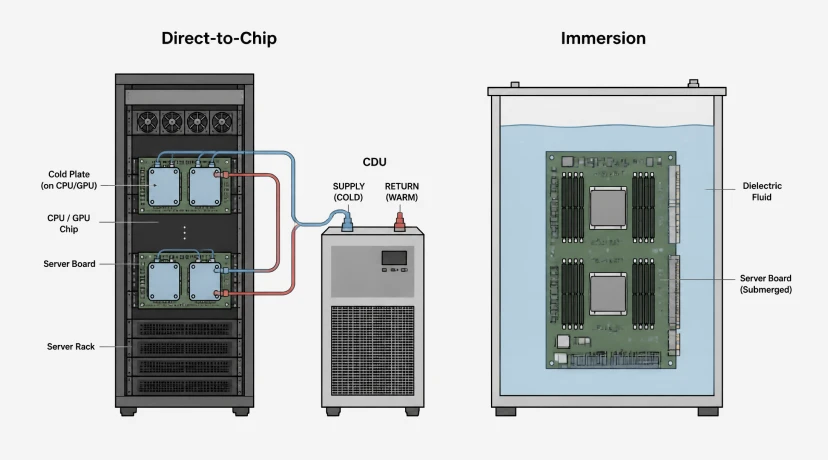
Head-to-Head: The Numbers That Decide Projects
| Criterion | Direct-to-chip | Single-phase immersion | Two-phase immersion |
|---|---|---|---|
| Practical rack density | 60 to 120 kW | 50 to 150 kW | 100 to 250+ kW |
| Heat capture share | 60 to 80% | ~98% | ~98% |
| Typical PUE | 1.05 to 1.15 | 1.02 to 1.10 | 1.01 to 1.08 |
| Server modification | Cold plates on standard chassis | Immersion-rated hardware | Immersion-rated, sealed-tank qualified |
| Service workflow | Standard rack hot-swap with quick disconnects | Tank access, fluid handling, drying procedures | Sealed tank, fluid loss control, specialist procedures |
| Coolant | Water-glycol, 20 to 35% | Dielectric hydrocarbon | Engineered boiling fluid |
| Retrofit fit | Strong, rack-by-rack rollout | Weak, dedicated pods or greenfield | Weakest, purpose-built facilities |
The Four Decision Axes
Density trajectory
Current-generation GPU racks run 40 to 120 kW, squarely inside direct-to-chip territory and a key reason OEM-recommended configurations for flagship AI systems ship with cold plates. Roadmaps pointing beyond 150 kW per rack strengthen the immersion case. Match the architecture to where your density will be in five years, with the caveat that a hybrid path lets you defer the extreme end.
Retrofit or greenfield
Direct-to-chip enters an existing hall row by row using standard racks, standard chassis, and a CDU per row or per rack. Immersion tanks bring floor loading, spill containment, fire strategy, and electrical rework that make them a poor retrofit and a strong greenfield choice. Most announced AI capacity through 2026 sits in existing or conventional-shell buildings, which explains why cold plate deployments dominate current installations.
Operations model
Cold plate maintenance looks like the maintenance teams already do: quick disconnects, hot-swap, familiar rack workflows. Immersion changes the operating culture around fluid cleanliness, compatibility testing, and lifting procedures. An architecture that matches the team you have will outrun a theoretically superior one that matches nobody on site.
Standards and warranty
Direct-to-chip rides mature standards work, including OCP ACS interface specifications and broad OEM cold plate options with intact warranties. Immersion hardware certification is improving yet remains vendor-specific, and warranty terms for submerged operation require case-by-case confirmation.
What Each Architecture Demands from Pumps and Fluid Loops
This is the comparison layer most articles omit, and the layer where failures actually happen.
Direct-to-chip: a precision water-glycol loop
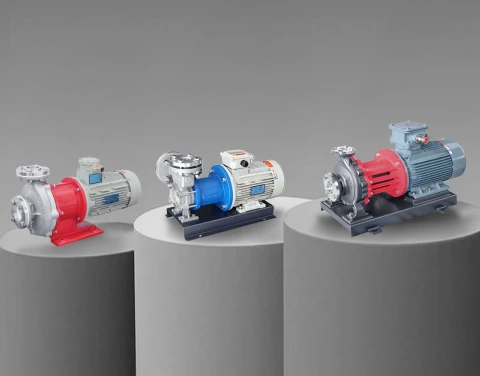
The technology cooling loop is a high-resistance circuit: cold plate microchannels, quick disconnects, and manifold networks stack pressure drop at moderate flow. Pumps run continuously at variable speed inside the CDU in N+1 arrangements, must hold stable pressure as filters load, and cannot leak into a data hall. Glycol viscosity at low temperature demands curve derating. Seal-less magnetic drive circulation pumps with stainless wetted paths fit this duty directly, as detailed in the AI data center liquid cooling pump selection guide; the MDW vortex magnetic pump covers the stable low-flow, zero-leakage requirement, and its forward/reverse capability simplifies loop filling and purging.
Single-phase immersion: dielectric circulation
Tank circulation pumps handle engineered dielectric fluids with low lubricity and specific material compatibility requirements. Leak containment matters less for electronics risk, since the fluid itself is non-conductive, and more for fluid cost and housekeeping. Seal materials and bearing construction must be confirmed against the exact fluid chemistry.
Two-phase immersion: minimal pumping
Boiling and condensation move the heat, so pump duty shrinks to makeup, filtration, and condensate handling. The engineering burden shifts to sealed-tank integrity and fluid loss control, particularly as the industry transitions away from PFAS-class fluids.
Efficiency Claims Deserve a Second Look
Published PUE figures favor immersion, and part of that advantage is real: removing server fans eliminates a genuine energy draw. Part of it is accounting. Fan energy disappears from the IT side of the PUE calculation and shifts the boundary, which flatters the architecture in a side-by-side comparison. Procurement-grade evaluation pairs PUE with water usage effectiveness and with the temperature grade of the rejected heat. Direct-to-chip loops running warm water unlock long free-cooling seasons and practical heat reuse at useful temperatures. Immersion loops reject heat at similar or higher grades with lower transport energy. The architecture with the lower PUE on a datasheet is not automatically the one with the lower annual energy bill at your site, climate, and load profile.
Heat rejection deserves the same scrutiny regardless of architecture. Liquid cooling transports heat; it does not destroy it. Dry coolers, cooling towers, or a heat reuse offtake must still absorb every kilowatt the loop collects, and a facility that plans the in-row technology carefully while leaving heat rejection as an afterthought ends up with an efficient loop connected to an undersized plant.
The Hybrid Reality
Large operators rarely choose one architecture for everything. A common layout keeps general compute on air, moves AI racks onto direct-to-chip rows, and reserves immersion pods for the densest training clusters. This staged path builds liquid cooling capability progressively, keeps procurement flexible across hardware generations, and spreads capital over time. The mixed environment also sets the pump agenda: each zone runs its own loop chemistry and hydraulic profile, so circulation equipment gets specified per zone against local pressure drop and fluid data, with no single pump duty covering the whole hall. Planning the shared infrastructure, facility water temperatures, heat rejection capacity, and spare CDU capacity, matters more than picking a winner between the two architectures.
Decision Checklist
- Peak rack density today and the credible five-year roadmap, per rack, not room average.
- Building constraints: floor loading, containment, piping routes, and available facility water temperatures.
- Operations capability: the maintenance team and workflows that will actually service the hardware.
- Hardware plan: OEM cold plate availability and warranty terms versus immersion-rated variants.
- Fluid program: glycol loop chemistry or dielectric lifecycle management, including end-of-life handling.
- Pump and loop engineering: pressure drop budgets, redundancy model, and leak containment for the chosen architecture.
Aulank Pump manufactures seal-less vortex magnetic drive circulation pumps for direct-to-chip technology loops and CDU duty, with zero-leakage containment and media ratings from −196°C to +400°C. Send us your loop flow and pressure drop data, and our engineering team will return a matched pump with the sizing calculation. Contact us for support on your liquid cooling project.