



Troubleshooting a sealless magnetic drive pump is not like troubleshooting a sealed one. There is no seal to weep, no gland to watch, and most of what goes wrong happens inside the containment shell where you cannot see it. One idea is worth holding onto: in a mag-drive pump, the liquid being pumped is also lubricating the bearings, cooling the magnets, and carrying away the heat the coupling generates. So the large majority of failures trace back to that liquid being interrupted, contaminated, too hot, or too thick. Get the fluid condition right and these pumps run for years.
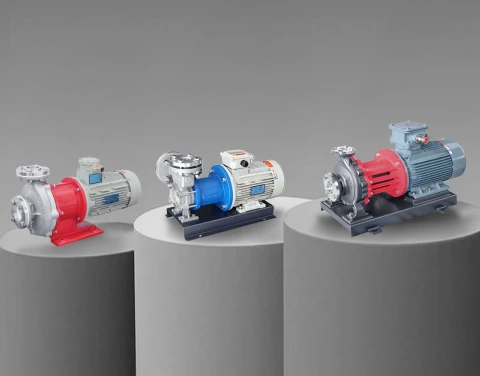
We design and build sealless magnetic-drive, magnetic gear, and vortex magnetic pumps, and we field plenty of “it stopped working” calls. The patterns repeat. What follows is a working diagnosis — a quick symptom-to-cause table to start from, then each failure mode in turn: what you see, what is actually happening inside the pump, what causes it, and how to put it right.
Start Here: Symptom-to-Cause Quick Reference
Match what the pump is doing to the likely causes, then jump to the section below that fits.
| Symptom | Likely cause | First thing to check |
| Motor runs, no flow or pressure | Not primed / gas-bound, wrong rotation, decoupled magnets, suction lift too high | Prime and vent; confirm rotation; listen for a whine |
| Flow falls off over time | Bearing or impeller wear, partial blockage, crystallization, internal recirculation | Strainer and suction line; bearing play |
| Sudden loss of flow with a whine | Magnet decoupling (slip-out) | Discharge valve open? Viscosity or temperature change? Overload? |
| Noise and vibration | Cavitation, bearing wear, misalignment, deadhead | Suction conditions / NPSH; feel the shaft by hand |
| Pump or magnet area overheating | Low-flow or deadhead running, dry running, blocked cooling path | Minimum flow held? Is there liquid in the pump? |
| Performance permanently down after an upset | Demagnetized magnets (over-temperature) | History: did it run dry or against a closed valve? |
| Rapid bearing failure | Solids in the fluid, dry run, crystallization, misalignment | Fluid cleanliness; temperature vs crystallization point |
| Liquid in the magnet / drive area | Cracked containment shell | Stop immediately and inspect the shell |
The Pump Runs but Moves No Liquid
Motor turning, nothing coming out, or pressure that will not build. This is the most common call, and a centrifugal mag-drive pump is not self-priming, which is the usual reason. If the casing holds air or vapour instead of liquid, the impeller spins in gas and cannot generate head — it is gas-bound. The same symptom comes from a few other causes: the motor running backwards after a rewire, the suction line pulling air through a loose fitting, a suction lift that is simply too high, or the magnets having decoupled (next section).
Fix it in order. Fill and vent the pump so the casing is full of liquid before start. Confirm the motor turns the way the arrow on the casing shows. Pressure-check the suction line for air leaks, raise the source level or lower the pump to cut the suction lift, and clear any blocked strainer. If it still will not pump and you hear a high-pitched whine, treat it as decoupling. Suction and NPSH sizing is covered in our magnetic drive pump selection guide.
Magnet Decoupling (Slip-Out)
The pump was running, then flow drops or stops, often with a high-pitched whine, while the motor keeps turning normally. That signature points to decoupling.
Here is what happens inside. Every magnetic coupling can only transmit so much torque. When the torque the impeller demands climbs past that limit, the inner magnet rotor can no longer stay in step with the outer rotor — it slips, or stops turning, while the outer rotor and motor carry on. The impeller stalls and flow collapses. Decoupling is partly a built-in safety feature: the coupling slips rather than stalling the motor or shearing a shaft.
It happens because the duty exceeded the coupling rating. Usual triggers: starting or running against a closed or throttled discharge valve, a jump in viscosity (a fluid that thickened as it cooled, or a recipe change), a blocked line that raises the load, a sudden pressure spike, or a coupling that was undersized for the job. Cold starts are a classic case — a fluid that is thin at running temperature can be far more viscous at start-up, so the pump slips on the first attempt and pulls fine once warm.
Stop the pump and clear the overload before you restart, because running on in the slipped state heats the magnets fast (see the next section). Open the discharge valve before starting and do not deadhead. If viscosity has shifted by more than about 20%, recalculate head and power before you trust the old duty point. Fit a power or current monitor so an overload trips the pump early instead of cooking the magnets. Chronic decoupling means the coupling is under-margined for the duty and the pump needs re-rating — our magnetic drive pump selection guide covers decoupling-torque margin, and picking the right model from the Chemical Pump Series for the actual fluid stops the repeat.
Demagnetization, and Why It Is Not the Same as Decoupling
After some upset the pump never makes its old flow or head again, and it draws more power for less output. The giveaway: unlike decoupling, this does not recover when you remove the load.
The magnets have permanently lost strength. Rare-earth magnets hold their field only up to an upper temperature limit; heat them past it and the loss is permanent, so the coupling can no longer transmit its rated torque. This is a different failure from decoupling. Decoupling is a temporary torque event that recovers the moment the overload is gone; demagnetization is permanent heat damage that does not. The two are linked, though: a pump left running in the slipped state heats up quickly, dry running heats it faster still, and either can push the magnets past their limit.
Any sustained over-temperature does it — dry running, a long deadhead or low-flow spell, prolonged slipping, or a process temperature above the pump's rating. Demagnetized magnets do not come back, so the rotor assembly has to be replaced. Prevention is temperature discipline: never run dry, never deadhead, hold minimum flow, and specify magnet material rated comfortably above your maximum operating temperature — a margin of roughly 15–30°C is normal practice. For genuinely hot duty, a higher-temperature magnet grade such as samarium-cobalt and the right high-temperature pump solutions are the answer rather than pushing a standard pump past its limit.
Dry Running: the Fastest Way to Kill a Sealless Pump
Overheating, then noise, then a seized or failed pump — sometimes within minutes. Dry running is the single most damaging thing you can do to a mag-drive pump, and it is worth understanding why it is so unforgiving.
In a mag-drive pump the pumped liquid does three jobs beyond being the product. It lubricates the silicon-carbide sleeve bearings, it cools the inner magnet rotor, and it carries away the eddy-current heat that a metal containment shell generates. Run the pump with no liquid and all three stop at once. The silicon-carbide bearings rely on a liquid film, so they run dry and overheat or crack; the magnet chamber heats with nowhere to send the heat, and the magnets can demagnetize in minutes.
The causes are simple: an empty suction line because the tank ran out, a lost prime, gas-binding, a closed suction valve, or starting before the pump is filled. The rule is just as simple — never run a mag-drive pump dry, even briefly. Fill and vent before every start. Where the supply can empty or the line can gas-bind, fit dry-run protection: a power or current monitor, or a liquid-presence switch that trips the pump before damage. It is the most valuable single protection on a sealless installation. For bearing and wear-part context, see our chemical pump parts lifespan and maintenance guide.
Bearing Wear and Seizure
Noise, vibration, a gradual drop in performance, and a shaft that feels rough or sticks when you turn it by hand. The sleeve bearings are the part to suspect.
Those bearings — silicon carbide or silicon nitride — are lubricated only by the process fluid. Anything that breaks a clean liquid film wears them: dry running, solid particles in the fluid, a medium that crystallizes inside the pump, or misalignment between the inner and outer rotors that loads the bearing unevenly. Because the bearings sit in the pumped fluid, they have none of the protection a conventional pump's oil-bath bearings enjoy.
Fit a suction strainer for any fluid that can carry solids; mag-drive pumps do not tolerate grit. Keep a crystallizing medium above its crystallization temperature with heat tracing or jacketing, and flush the pump after running it. Keep liquid flowing and avoid dead-low-flow operation. On a rebuild, check rotor coaxiality and replace bearings as a set rather than singly. If the duty is genuinely abrasive or solids-heavy, a sealless pump is the wrong tool for it — that load belongs on a progressive-cavity or other pump from the Positive Displacement Pump Series.
Cavitation
Violent vibration, a rattling or gravel-in-the-pump noise, fluctuating flow, and bearings and impeller wearing faster than they should. Cavitation is the cause, and in a mag-drive pump the vibration is especially hard on the sleeve bearings.
When suction-side pressure falls below the fluid's vapour pressure, vapour bubbles form, then collapse violently as they reach the higher-pressure impeller region. The collapse is erosive — it hammers impeller and bearing surfaces and shakes the whole pump. It comes from too little net positive suction head: a suction lift that is too high, a clogged or undersized suction line, a hot fluid sitting near its boiling point, or a fluid carrying dissolved gas. The fixes raise the available suction head — lower the pump relative to the source, shorten and widen the suction line, clean the strainers, and cool a fluid that runs near boiling. We work through the calculation and the remedies on our preventing pump cavitation page.
Overheating, Low Flow, and Baked-On Deposits
The pump body or magnet area runs hot, and on temperature-sensitive fluids you may find baked deposits on the impeller hub when you open it up. Both trace to the same problem: not enough flow to carry heat away.
A mag-drive pump needs a minimum throughput to move heat out of the bearings and the magnet chamber, including the eddy-current heat that a metal containment shell produces. Run it at very low flow or against a closed valve and that heat has nowhere to go, so the liquid trapped in the chamber overheats. With a temperature-sensitive fluid the heat can bake process constituents onto the impeller magnet hub, building a deposit that eventually jams the rotor.
Hold the manufacturer's minimum continuous flow, and add a bypass or recirculation line if process demand drops below it. Never run against a closed discharge valve. For temperature-sensitive or fouling fluids, keep the flow up and consider a non-metallic containment shell, which removes eddy-current heating altogether. Overheating that persists at normal flow points to an undersized cooling path or a selection mismatch worth reviewing.
Containment Shell Damage and Ferromagnetic Contamination
Two distinct problems share this section. The serious one is liquid appearing in the magnet or drive area — that means the zero-leakage barrier is breached. The other is sudden coupling roughness and lost torque from debris in the magnetic gap.
The containment shell is the static barrier that keeps the fluid sealed inside the wet end. Corrosion, cavitation erosion, or scratches from solids can crack or perforate it and let process fluid into the magnet chamber. Separately, ferromagnetic debris — iron filings, rust, weld scale off new piping — gets pulled into the magnetic gap, where it grinds the gap faces and damages the coupling. Stop the pump at once if you find fluid in the drive area, because a breached shell can release the very fluid the sealless design was chosen to contain. Match the shell and wetted materials to the fluid: for chlorides, strong acids, or HF-forming media that means the right alloy or a fluoropolymer-lined build from our corrosion-resistant pump solutions, with leak-proof pump solutions on the containment side. Flush new pipework before commissioning and fit a magnetic trap or strainer to catch ferromagnetic particles before they reach the gap.
A Short Preventive Checklist
Most mag-drive failures are preventable with a handful of habits:
● Prime and vent before every start; never run the pump dry.
● Open the discharge valve before starting; never deadhead against a closed valve.
● Hold minimum continuous flow; add a bypass if the process turns down.
● Fit dry-run protection — a power/current monitor or a liquid-presence switch.
● Strain the fluid and flush new pipework to keep solids and ferromagnetic debris out.
● Keep crystallizing fluids hot, and flush the pump after running them.
● Match wetted and shell materials to the fluid; re-check the duty if viscosity or temperature shifts by more than about 20%.
● Record temperature, motor current, and vibration so a slow drift shows up before it becomes a failure.
When to Stop and Call the Manufacturer
Some findings mean stop now, not “monitor and see.” Fluid in the drive area means a breached containment shell. A permanent drop in head and flow after an over-temperature event means demagnetized magnets. Repeated decoupling points to a coupling under-margined for the duty. None of these are field-adjustment problems — they need a teardown, the right replacement parts, or a pump re-rated to the real operating conditions. If you are choosing between a sealless mag-drive, a magnetic gear, or a vortex magnetic pump for the duty, or weighing a canned motor pump technology build instead, that is a selection question worth working through before the next failure rather than after it.
Talk to Aulank About a Mag-Drive Problem or Replacement
Whether you are diagnosing a failure, planning a rebuild, or re-rating a pump that keeps decoupling, our engineering team can match the right sealless magnetic-drive, magnetic gear, or vortex magnetic pump — and the right materials — to your duty. Send us the pump model, the fluid with its temperature and viscosity, and what changed before the failure.
Talk to our team: Contact Aulank | WhatsApp: +86 13773157367 | Email: info@aulankpump.com
Related reading: magnetic drive pump selection guide · Chemical Pump Series