



Semiconductor Fab Expansion Is Creating Massive Demand for High-Purity Chemical Pumps
The global semiconductor industry is expected to hit USD 975 billion in annual sales in 2026, according to Deloitte. Behind that number is a physical infrastructure buildout that few outside the chip industry fully appreciate: hundreds of billions of dollars flowing into new fabrication plants across the US, Europe, Japan, and Southeast Asia. Each of those fabs needs thousands of chemical pumps — for acid delivery, slurry transfer, ultrapure water circulation, and chemical mechanical planarization (CMP) processes.
For pump manufacturers and industrial buyers, this is one of the largest sustained demand drivers in the chemical pump market right now.
The Scale of the Buildout
TSMC alone is spending an estimated USD 50 billion in capital expenditure in 2026, with six fabs planned or under construction in Arizona and continued expansion in Taiwan, Japan, and Germany. Its first Arizona fab entered high-volume 4nm production in late 2024. The second fab will begin equipment installation in Q3 2026 for 3nm production. A third fab broke ground in April 2025 for 2nm chips.
TSMC is far from alone. Samsung, Intel, Micron, GlobalFoundries, and Rapidus all have active fab projects. The US CHIPS Act has allocated over USD 52 billion to incentivize domestic chip production. The EU Chips Act has launched pilot lines and approved hundreds of millions in funding for fabs in Germany, Czech Republic, and Austria. In total, over 170 notable chip industry facility investments were announced globally in 2025 alone.
Each fab requires a complete surrounding ecosystem of specialty gas suppliers, chemical companies, and equipment vendors. TSMC evaluates supply chain risks for more than 2,000 chipmaking materials and chemicals, including photoresists, etchants, cleaning agents, and specialized substrates.
Why Semiconductor Fabs Need Specialized Pumps
Semiconductor manufacturing involves aggressive chemicals at nearly every step. Hydrofluoric acid, sulfuric acid, hydrogen peroxide mixtures, ammonium hydroxide, and various organic solvents are standard in wafer cleaning, etching, and surface preparation. These chemicals attack most metals on contact. Any particle or ion contamination from pump components can ruin an entire wafer batch.
This creates a set of pump requirements that are unusually strict:
- Wetted parts must be made from ultra-clean, chemically inert materials — typically high-purity PTFE, PVDF, or ceramic
- Zero leakage is mandatory; even trace amounts of process chemical escaping into the cleanroom environment is unacceptable
- Pumps must generate zero metallic contamination — ruling out most conventional stainless steel designs for direct chemical contact
- Temperature control loops for process tools often require pumps rated for both sub-zero and high-temperature thermal fluids
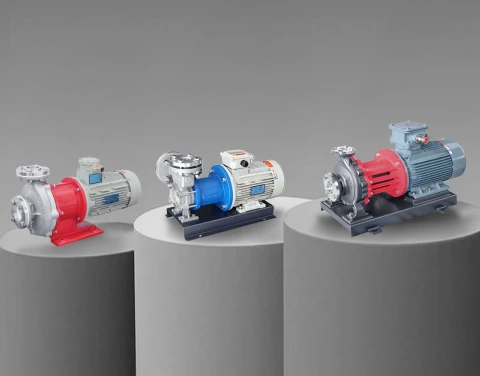
Magnetic drive pumps are the dominant technology in semiconductor chemical delivery systems. The sealless design eliminates the mechanical seal — the primary contamination and leak source in conventional pumps. For temperature control units (TCUs) used in lithography, deposition, and etch tools, magnetic drive vortex pumps with stainless steel or ceramic internals handle thermal fluids from -196°C to +400°C without dynamic seals.
Market Impact on Chemical Pump Demand
The semiconductor equipment supply chain is tightly coupled to fab construction timelines. When TSMC announces equipment installation for Q3 2026, the pump orders need to be placed months earlier. The current wave of fab construction is creating a pull-through effect across the entire fluid handling supply chain.
Specific pump categories seeing increased demand from the semiconductor sector include high-purity fluoropolymer-lined magnetic drive pumps for acid and solvent delivery, precision metering pumps for chemical dosing, and compact magnetic drive circulation pumps for TCU and chiller systems. For TCU applications in semiconductor precision temperature control, pumps like Aulank's MDH series magnetic drive vortex pumps — rated for media temperatures from -196°C to +400°C with SiC ceramic bearings and PEEK isolation sleeves — are used in cleanroom-grade thermal management systems.
The semiconductor buildout is not a one-year event. With TSMC planning fabs through the end of the decade and CHIPS Act funding still being deployed, chemical pump demand from this sector will remain elevated for years.
