


A water or wastewater treatment plant moves a lot of plain water, but the pumps that decide whether the plant runs reliably are the ones handling chemicals. Sodium hypochlorite for disinfection, ferric chloride and alum for coagulation, polymer for flocculation, lime and caustic or acid for pH control — these are corrosive, some are toxic, and several have to be dosed to a tight setpoint or the process drifts. The bulk-water pumps are usually centrifugal or submersible and well understood. The chemical-handling pumps are where plants hit recurring trouble: seals failing on hypochlorite, metering pumps gas-binding on off-gassing bleach, and coagulant lines corroding through. This guide is about that second group.
We have supplied magnetic-drive and magnetic gear pumps into municipal and industrial water treatment plants for over a decade. This guide covers how to select pumps for the chemical duties on a water or wastewater plant — disinfection dosing, coagulant and flocculant dosing, pH adjustment, and corrosive-chemical transfer — with the material compatibility, gas-handling, and dosing-accuracy requirements that separate chemical-handling pump duty from plain water movement.
1. The Chemical-Handling Stations in a Water Treatment Plant
Set aside the raw-water and clean-water transfer duties, which are conventional centrifugal territory. The chemical side of a treatment plant has these pump duties, each with a different fluid and accuracy requirement:
● Disinfection dosing — metering sodium hypochlorite (and sometimes other oxidants) into the water stream at a controlled residual.
● Coagulant dosing — metering ferric chloride, aluminium sulfate (alum), or poly-aluminium chloride (PAC) to neutralize particle charge so solids cluster.
● Flocculant dosing — metering polymer/polyelectrolyte solution at low flow with smooth, pulsation-free output so the floc forms properly.
● pH adjustment dosing — metering lime or caustic to raise pH, or sulfuric acid to lower it, both corrosive.
● Corrosive-chemical bulk transfer — moving hypochlorite, ferric chloride, and acid from bulk storage and delivery tankers to day tanks.
● Sludge and treatment chemistry — dosing into thickening, dewatering, and sludge-conditioning steps on the wastewater side.
Four constraints cut across these: material compatibility with strongly oxidizing and acidic chemicals, the ability to handle off-gassing fluids like sodium hypochlorite without gas-binding, dosing accuracy that holds the process setpoint, and zero leakage of toxic, corrosive chemistry. These points decide the pump choice at each station.
2. Sodium Hypochlorite: The Hardest Common Duty
Sodium hypochlorite (NaOCl) at industrial strength, usually 5–15%, is the most demanding routine chemical on the plant. It is strongly oxidizing, corrodes most metals, and — the point that catches plants out — it off-gasses. Two failure modes dominate, and they need addressing together:
● Material attack. Hypochlorite corrodes aluminium, cast iron, and standard stainless steel. The wetted path needs to be non-metallic or fluoropolymer-lined — PVDF, PTFE, ETFE, or PFA — with silicon-carbide bearings and samarium-cobalt magnets that resist the chemistry. A common durable configuration is a cast-iron body with a thick ETFE or PTFE lining: metallic strength with an inert wetted surface. Specifying bare metal here guarantees a short pump life.
● Off-gassing and gas-binding. Hypochlorite slowly decomposes and releases gas. In a conventional diaphragm metering pump, that gas collects in the pump head and the pump ends up compressing a gas bubble instead of moving liquid — it runs but stops dosing. This gas-binding is widely regarded as the most aggravating problem in chlorination. The fix is a pump that tolerates entrained gas. Regenerative-turbine vortex hydraulics handle 10–15% entrained gas without losing prime, which is exactly the property hypochlorite needs and the reason vortex-style sealless pumps suit this duty better than a plain diaphragm metering pump on off-gassing bleach.
For hypochlorite dosing and transfer, our AMC-F PTFE-lined magnetic drive pump gives the fluoropolymer-lined, sealless, gas-tolerant combination this duty needs. The regenerative-turbine background is in our industrial vortex pump selection guide, and the wider material framework on our corrosion-resistant pump solutions page.
3. Coagulant Dosing: Ferric Chloride, Alum, and PAC
Coagulants neutralize the charge on fine suspended particles so they cluster and can be removed. The common ones — ferric chloride, aluminium sulfate, poly-aluminium chloride — are corrosive and, in the case of ferric chloride, also a strong acid and mildly abrasive. Two requirements:
● Material compatibility. Ferric chloride is corrosive and toxic and attacks most metals; PVDF, PTFE, or PVC-class non-metallic and lined construction is required. Alum and PAC are likewise handled in non-metallic or lined wetted paths. The fluoropolymer-lined magnetic-drive pump covers the aggressive end of this range.
● Accurate, repeatable dose. Coagulant dose is tuned to incoming turbidity and flow. Over-dose wastes chemical and shifts pH; under-dose lets solids through. Volumetric repeatability matters, which favours positive-displacement dosing for the metered duty and a sealless lined pump for bulk transfer.
For coagulant transfer, the AMC-F PTFE-lined pump handles ferric chloride and the more aggressive coagulants. For metered coagulant addition, the MDC-K magnetic gear pump gives repeatable volumetric output, and where stainless is compatible the MDW stainless steel vortex magnetic pump is a lower-cost transfer option. Ferric chloride is also used as a PCB etchant, so the same pump logic appears in our electroplating and PCB pump selection guide.
4. Flocculant Dosing: Low-Flow, Pulsation-Free Polymer Metering
After coagulation, a polymer flocculant bridges the small clusters into larger, settleable floc. Polymer dosing is a different problem from coagulant dosing: the flow is low, the polymer solution is viscous and shear-sensitive, and the dose must be steady. Three points:
● Smooth, pulsation-free flow. A pulsing dose breaks up forming floc and gives inconsistent results. Steady low-pulsation output lets the floc build properly. This favours pump types with continuous rather than reciprocating delivery.
● Low shear. Polymer chains are long and shear-sensitive; over-shearing degrades the polymer and ruins its bridging action. Gentle handling preserves flocculant performance, so pump speed and hydraulics matter.
● Accurate low-flow metering. Polymer is dosed at low flow with tight accuracy. Magnetic gear pumps give repeatable low-flow volumetric output with no seal to leak. For small-volume polymer and additive dosing, our MDC-M micro mini magnetic gear pump suits the duty, with the MDC-K for higher polymer flows. The positive-displacement principle behind accurate metering is in our positive displacement pump working principle and selection guide.
5. pH Adjustment and Corrosive-Chemical Transfer
pH control protects the plant and meets discharge limits. Lime and caustic raise pH; sulfuric acid lowers it. The acids and concentrated caustic are corrosive enough that the dosing and transfer pumps need careful material selection:
● Acid dosing. Sulfuric acid for pH reduction attacks most metals and needs PVDF, PTFE, or PFA-class wetted parts. A sealless lined pump removes both the corrosion and the seal-leak risk on a hazardous acid.
● Caustic and lime handling. Caustic soda is compatible with 316L within limits but is safer in fluoropolymer-lined construction at higher concentration and temperature. Lime slurry is abrasive and needs abrasion-tolerant wetted parts and solids handling.
● Bulk transfer from delivery to day tank. Hypochlorite, ferric chloride, and acid arrive by tanker and move to day tanks — a continuous transfer duty where the sealless lined pump again fits, keeping the corrosive fluid contained. For continuous duty where even a static O-ring exposure path is undesirable, the PWH/PWD/PWM canned vortex pump series is the canned-motor alternative.
The leak-containment logic across all these corrosive duties is set out on our leak-proof pump solutions page.
6. Dosing Control, Priming, and System Integration
A correctly specified chemical pump still underperforms if the surrounding system is wrong. A few integration points decide whether a dosing pump holds its setpoint in service:
● Flow- and signal-paced dosing. Chemical dose is usually paced to water flow or trimmed by an online sensor — turbidity, pH, or chlorine residual. The pump needs speed control, typically a variable-frequency drive, so the dose tracks demand rather than running fixed. This matters most on disinfection and coagulant dosing where the incoming load varies.
● Priming and air handling. When a chemical day tank empties, the suction line fills with air and the pump loses prime. A self-priming or gas-tolerant pump recovers without a manual bleed, which avoids the call-out and the dosing gap a non-self-priming metering pump creates. On off-gassing hypochlorite this is a recurring real-world issue, not an edge case.
● Calibration and verification. Dosing systems need a way to confirm actual delivered volume — a calibration column or flow verification. Repeatable volumetric pumps make this calibration stable over time, where a worn or gas-bound pump drifts and forces frequent re-checks.
● Containment and bunding. Chemical pumps sit inside bunded areas with their tanks. Sealless construction reduces the leak risk that the bund is there to catch, lowering the chance of a reportable spill in the first place.
These points sit at the system level, and confirming them at selection avoids the common case where a sound pump choice underperforms because the dosing control or priming was not specified.
7. A Pump Selection Matrix for Water Treatment Chemical Duties
The table below condenses our typical recommendations across the chemical-handling stations. These are starting points; the actual chemical concentration, flow, and accuracy target always need validating against the real process:
| Station | Chemical | Key requirement | Recommended pump |
| Disinfection dosing | Sodium hypochlorite 5–15% | Inert lining + gas tolerance | AMC-F PTFE-lined magnetic drive |
| Hypochlorite bulk transfer | Sodium hypochlorite | Inert, sealless, gas-tolerant | AMC-F PTFE-lined magnetic drive |
| Coagulant dosing | Ferric chloride / alum / PAC | Corrosion resistance, accuracy | MDC-K magnetic gear; AMC-F for transfer |
| Flocculant dosing | Polymer / polyelectrolyte | Low-flow, pulsation-free, low shear | MDC-M micro magnetic gear pump |
| Acid pH dosing | Sulfuric acid | Inert lining, zero leak | AMC-F PTFE-lined magnetic drive |
| Caustic / lime handling | NaOH, lime slurry | 316L or lined, abrasion tolerance | MDW 316L or AMC-F lined |
| Corrosive bulk transfer | Hypochlorite, FeCl₃, acid | Continuous, contained | AMC-F or PWH canned vortex |
| Sludge conditioning dosing | Polymer, treatment chemistry | Metered, repeatable | MDC magnetic gear family |
8. Why Sealless and Gas-Tolerant Pumps Fit Water Treatment
Water treatment chemical duty rewards two pump properties in particular — sealless construction and gas tolerance. Four reasons they matter here:
● Toxic, corrosive chemistry needs containment. Hypochlorite, ferric chloride, and acid are hazardous to handle and regulated to discharge. A mechanical-seal leak is a safety and compliance event. Sealless magnetic-drive and canned-motor pumps remove the dynamic-seal leak path.
● Off-gassing fluids defeat ordinary metering pumps. Sodium hypochlorite gas-binds conventional diaphragm metering pumps. A gas-tolerant regenerative-turbine pump keeps dosing through the off-gassing, which removes the most common chlorination-system failure.
● Plants run many small pumps unattended. Treatment plants run continuously, often with minimal staffing. Pumps that fail on seals or gas-binding create call-outs and out-of-spec water. Sealless, gas-tolerant pumps reduce unplanned intervention. The maintenance economics are in our chemical pump parts lifespan and maintenance guide.
● Dosing accuracy protects the process and the chemical bill. Chemical is a running cost and over-dosing wastes it while shifting water chemistry. Repeatable volumetric dosing holds the setpoint and controls spend. This demand is part of the broader Indian and global water-infrastructure build-out we covered in our note on India pump market demand.
9. Aulank Water Treatment Chemical Pump Portfolio
We have supplied sealless pumps into municipal and industrial water and wastewater plants for 17+ years. The portfolio we typically recommend for the chemical-handling side:
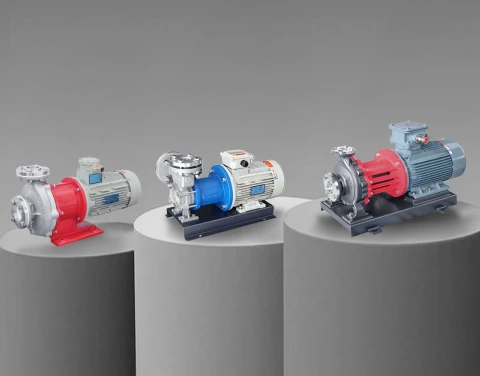
● AMC-F PTFE-lined magnetic drive pump — the core unit for hypochlorite, ferric chloride, acid, and corrosive transfer, with fluoropolymer wetted parts, sealless containment, and gas tolerance for off-gassing bleach.
● MDC-M micro mini magnetic gear pump and MDC-K magnetic gear pump — low-flow polymer flocculant dosing, coagulant metering, and treatment-chemical dosing with repeatable volumetric output.
● MDW stainless steel vortex magnetic pump and MDH stainless steel vortex magnetic drive pump — lower-cost 316L transfer within stainless compatibility, such as caustic within limits and neutral-chemistry circulation.
● PWH/PWD/PWM canned vortex pump series — canned-motor variant for continuous corrosive transfer where the tightest containment is wanted.
What a water treatment plant or system integrator gets from us specifically:
● Material matched to each chemical — PTFE, PFA, ETFE lining and 316L options selected per duty, including thick-lined construction for hypochlorite.
● Gas-tolerant vortex hydraulics — handling the entrained gas that gas-binds conventional metering pumps on hypochlorite.
● Silicon-carbide bearings and samarium-cobalt magnets — chemically resistant internals for oxidizing and acidic service.
● Magnetic gear sizing for accurate low-flow dosing — pulsation-free, low-shear output for polymer and coagulant metering.
● Documented quality control — ISO 9001, TÜV CE on magnetic drive vortex pumps, individual parameter test records, and 50+ patents on the synchronous permanent-magnet drive structure and shielded vortex hydraulics.
If you are sourcing pumps for a drinking-water plant, a municipal or industrial wastewater plant, an effluent treatment plant, or a packaged dosing system, send us your chemical, concentration, flow, and accuracy requirements and we will return a recommended portfolio with material specifications and quotes within two business days.
Get a Custom Water Treatment Pump Configuration
Whether you operate a municipal water or wastewater plant, run an industrial effluent treatment plant, or build dosing and disinfection systems as an OEM, our engineering team can match the right sealless magnetic-drive or magnetic gear pump to each chemical-handling station in your plant.
Talk to our team: Contact Aulank | WhatsApp: +86 13773157367 | Email: info@aulankpump.com
Browse the relevant product and solution pages:
● Positive Displacement Pump Series