


The global acceleration of green hydrogen production is overwhelmingly driven by Alkaline Water Electrolysis (AWE) technology. At the thermodynamic core of these gigawatt-scale electrolyzer plants is the continuous circulation of a highly concentrated alkaline electrolyte, predominantly a 25% to 30% aqueous solution of Potassium Hydroxide (KOH) operating at temperatures between 80°C and 100°C. Pumping this hot lye solution presents a severe, multi-faceted engineering challenge. KOH is aggressively caustic, causing severe chemical burns upon contact, and exhibits a strong tendency to crystallize when exposed to atmospheric carbon dioxide. Furthermore, the circulating electrolyte is continuously supersaturated with evolved Hydrogen (H2) and Oxygen (O2) gases. Traditional centrifugal pumps utilizing dynamic mechanical seals structurally fail in this environment; the caustic fluid crystallizes at the seal faces causing rapid abrasive destruction, while the entrained gases accumulate in the impeller eye, leading to catastrophic vapor lock and thermal runaway within the electrolyzer stack. This engineering guide details the structural transition toward sealless fluid containment in hydrogen production, examining how specific magnetic drive architectures, including the MDW and MDH series, eliminate lye crystallization, process severe two-phase gas-liquid flows, and guarantee the high-purity, zero-leakage fluid transfer required for continuous electrolysis.
KOH Crystallization and Seal Face Destruction
The primary vulnerability in pumping alkaline electrolytes lies in the chemical reactivity of Potassium Hydroxide with the ambient atmosphere. While KOH remains a highly conductive liquid within the closed-loop system, it reacts violently upon exposure to air. When the electrolyte contacts atmospheric Carbon Dioxide (CO2), an immediate neutralization reaction occurs, converting the liquid KOH into solid Potassium Carbonate (K2CO3) and water.
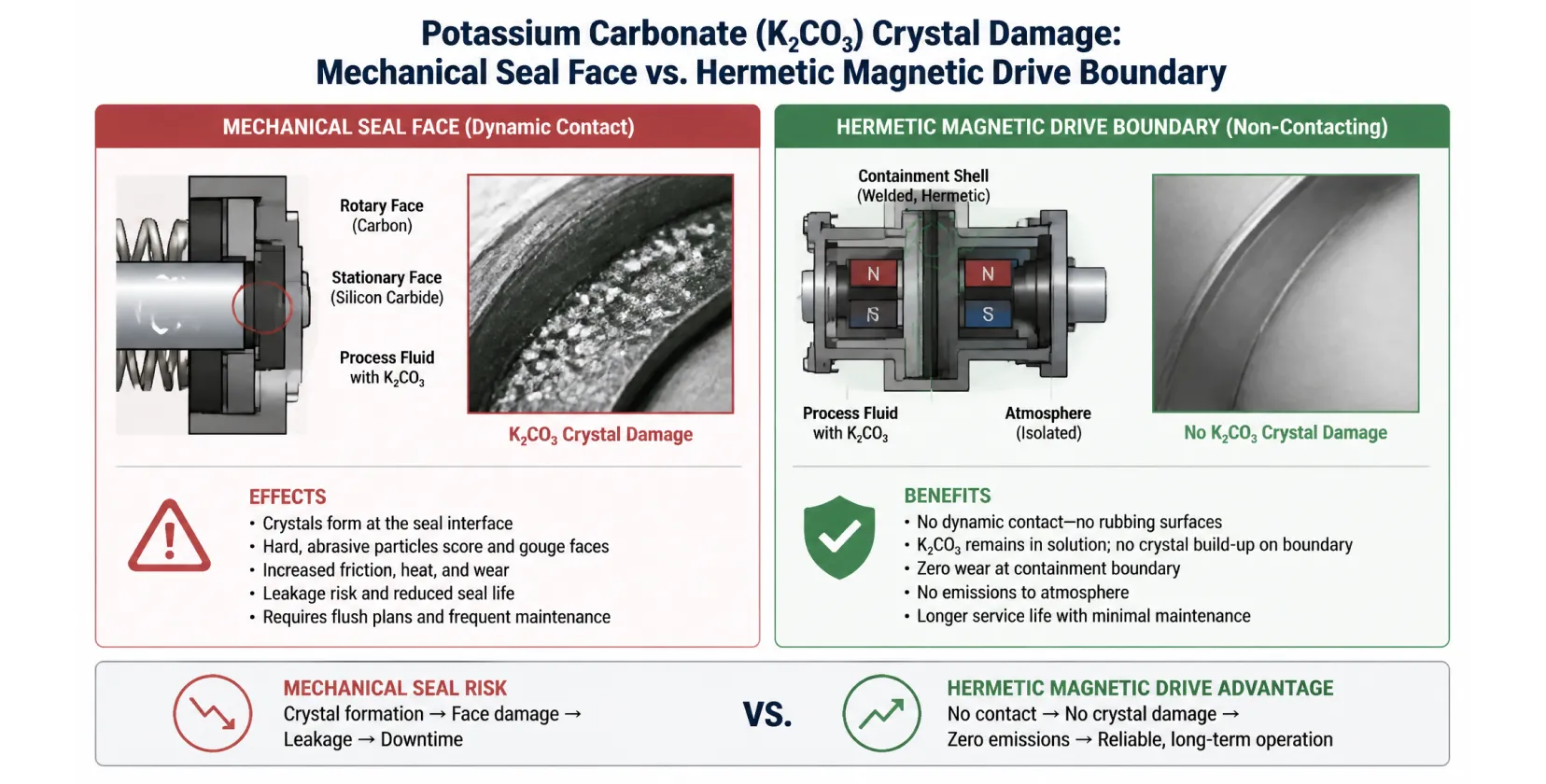
Standard industrial pumps rely on dynamic mechanical seals to prevent fluid from escaping along the rotating drive shaft. These seals require a microscopic film of the pumped KOH to lubricate the rotating carbon and stationary silicon carbide faces. As this fluid film migrates to the atmospheric side of the seal, it reacts with ambient CO2. The resulting Potassium Carbonate forms dense, abrasive crystalline deposits directly on the seal boundary. As the pump shaft rotates, these hardened crystals act as an aggressive lapping paste, physically grinding and scoring the precision-polished seal faces. This abrasive wear destroys the hydrodynamic geometry in a matter of hours, leading to continuous, hazardous leakage of boiling caustic lye onto the plant floor and surrounding equipment.
Establishing the Hermetic Caustic Boundary
The definitive structural solution to lye crystallization and hazardous emissions is the absolute elimination of the dynamic shaft penetration. Sealless magnetic drive architectures replace the physical drive shaft with a synchronized magnetic coupling separated by a stationary containment shell (isolation sleeve).
Manufactured from heavy-walled 316L stainless steel, this isolation sleeve establishes a permanent, static pressure boundary between the internal electrolyte and the external environment. Because there are no dynamic seals intersecting the fluid envelope, there is zero pathway for atmospheric CO2 to interact with the KOH, completely arresting the formation of potassium carbonate crystals. The hot caustic lye remains entirely isolated within the pump volute, ensuring absolute zero-leakage continuous operation and eliminating the risk of chemical burns to plant operators.
Entrained Hydrogen Gas and Centrifugal Vapor Lock
Within the electrolyzer stack, electrical current splits the water molecules into Hydrogen and Oxygen gases. The circulating KOH electrolyte acts as the transport medium, carrying massive volumes of these entrained micro-bubbles back to the gas-liquid separation vessels. Consequently, the pumps drawing from these vessels must process a constant two-phase (liquid and gas) flow.
Standard centrifugal pumps are engineered strictly for incompressible liquids. Because hydrogen gas possesses an extremely low density, centrifugal acceleration forces the heavier liquid KOH to the outer perimeter of the volute, trapping the lighter hydrogen gas at the center of the impeller (the low-pressure suction eye). When the volume of entrained gas exceeds roughly 3% to 5%, the vapor pocket displaces the liquid entirely. The impeller spins in a dry pocket of gas, instantly ceasing fluid delivery—a condition known as vapor lock (or gas binding). If the circulation pump vapor locks, the electrolyzer stack is starved of cooling and electrolyte, leading to immediate thermal shutdown and potential membrane damage.
Vortex Hydraulics for Two-Phase Flow Processing
To resolve the persistent threat of vapor lock in green hydrogen systems, engineers specify the vortex pump architecture for electrolyte circulation. A vortex (regenerative peripheral) pump operates on an entirely different fluid dynamic principle than standard centrifugal units.
The vortex impeller features dozens of radial vanes rotating within a symmetrical annular channel. This geometry imparts kinetic energy continuously, creating an intense, high-velocity spiraling motion. Rather than allowing the hydrogen and oxygen bubbles to coalesce at the impeller eye, this violent internal turbulence aggressively chops and compresses the entrained gas, keeping it fully suspended and homogenized within the KOH liquid phase. The pump forcibly sweeps this two-phase mixture out through the discharge port. This hydraulic mechanism enables the vortex magnetic drive pump to continuously process up to 20% entrained gas by volume without losing prime, guaranteeing uninterrupted electrolyte flow to the electrolyzer stack.
Metallurgical Passivation and Membrane Protection
Alkaline electrolyzers rely on highly sensitive diaphragms and advanced zero-gap ion exchange membranes to separate the hydrogen and oxygen gases. These membranes are extremely vulnerable to transition metal poisoning. If the circulating pump sheds Iron (Fe), Copper (Cu), or Zinc (Zn) ions into the electrolyte, these metals precipitate onto the membrane, drastically increasing ohmic resistance, lowering cell efficiency, and catalyzing unwanted side reactions.
Pump metallurgy must adhere to strict ultra-pure standards. Magnetic drive pumps deployed in electrolyzer skids are constructed from ultra-low carbon 316L stainless steel. Following precision machining, all wetted components undergo rigorous chemical passivation to remove free surface iron and force the creation of a dense, stable chromium oxide layer. This inert passive layer prevents the hot, caustic KOH from leaching metallic ions out of the steel matrix, ensuring the electrolyte remains pure and the membrane lifespan is maximized.
Tribology in Alkaline Media: SSiC Bearings
In a sealless magnetic drive pump, the inner magnetic rotor is fully submerged and must be supported by internal journal bearings lubricated solely by the process fluid. Hot KOH lye is a low-viscosity, non-lubricating fluid. Standard bearing materials, such as carbon-graphite, will rapidly degrade due to alkaline attack and mechanical wear.
Process engineers mandate Sintered Silicon Carbide (SSiC) for all internal wetted bearings and thrust washers. SSiC provides absolute chemical inertness against boiling caustics and extreme mechanical hardness (ranking just below diamond). Its highly polished surface finish establishes a remarkably low coefficient of friction, allowing it to maintain a stable hydrodynamic fluid film even in low-viscosity lye. This ensures the rotor is fully supported against the high radial loads of continuous electrolyzer operation without generating particulate contamination or suffering bearing seizure.
Conclusion
The aggressive chemistry and two-phase fluid dynamics of Alkaline Water Electrolysis fundamentally exceed the capabilities of mechanically sealed pumps. Operating with boiling, gas-entrained Potassium Hydroxide guarantees rapid seal crystallization, extreme caustic leakage, and chronic vapor lock. By transitioning to sealless magnetic drive architectures equipped with passivated 316L stainless steel, SSiC tribology, and regenerative vortex hydraulics, hydrogen plant engineers establish an indestructible, zero-leakage fluid boundary. This structural integration ensures continuous gas-liquid processing, protects sensitive electrolyzer membranes, and maximizes the uptime of gigawatt-scale green hydrogen infrastructure.
Engineered Fluid Solutions with Aulank Pump
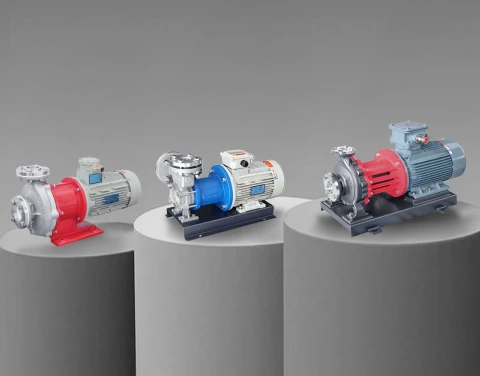
Aulank Pump designs specialized sealless fluid transfer equipment explicitly engineered for the renewable energy, chemical processing, and green hydrogen sectors. Our high-performance magnetic drive pumps provide the absolute hermetic containment required to safely circulate hot, caustic electrolytes and highly volatile liquid gases. By combining ultra-pure passivated metallurgy with advanced regenerative vortex hydraulics, as seen in our MDP Permanent-Magnet Canned Vortex Magnetic Drive Pump, Aulank delivers exceptional gas-handling capabilities and zero-leakage reliability under severe systemic stress. Consult our engineering team for precise two-phase flow analysis, material compatibility validation, and system integration support for your advanced alkaline electrolyzer skids.
