


Gas is the fluid property most pump specs leave out, and it is the one that stops a pump cold. A liquid that carries gas — as free bubbles entrained in the flow, as dissolved gas that breaks out when suction pressure drops, or as gas the fluid makes on its own by off-gassing — behaves nothing like the clean liquid a pump curve assumes. Condensate coming off a steam system near its boiling point, refrigerant under its own vapour pressure, LPG and light fuels, a volatile solvent at its flash point, sodium hypochlorite decomposing to oxygen in the tank: all of them reach the pump suction carrying gas. Run that through a standard centrifugal pump and the gas gathers in the impeller eye, the pump loses head, and past a few percent by volume it gas-locks and stops delivering. This page covers how Aulank's regenerative peripheral (vortex) and sealless magnetic-drive pumps move gassy, off-gassing, and two-phase fluids without losing prime — and is straight about the two ends of the range, micro-dosing and true multiphase, where a different pump does the job.
Why Gassy, Off-Gassing, and Two-Phase Fluids Defeat Standard Pumps
A centrifugal pump is built to move a continuous, gas-free liquid, and gas undoes it in a specific way. It helps to separate the problem into its parts:
● Entrained, dissolved, and off-gassed gas are three different sources. Entrained gas is free bubbles already carried in the liquid — from a leaking suction line, a vortexing tank, or a process step that whips air in. Dissolved gas stays invisible until pressure falls at the suction and it comes out of solution, the way CO2 leaves a soda. Off-gassing is gas the fluid generates itself: sodium hypochlorite and hydrogen peroxide decompose over time and release oxygen, and the warmer and more concentrated they are, the faster they gas off. The pump sees the same end result from all three — gas where it expected liquid.
● Gas collects in the impeller eye and locks the pump. The spinning impeller throws the denser liquid outward and the lighter gas migrates to the low-pressure centre. A standard impeller tolerates only a few percent gas by volume before performance drops; corrections are needed from around two percent, and once the gas pocket at the eye grows into roughly the four-to-ten percent range the pump gas-locks — the bubble blocks liquid from entering and flow stops.
● Lost head and efficiency long before it locks. Gas is compressible, so even below the locking point every percent of gas means less head and less flow than the curve promises. On a duty already running near its limit, a little entrained gas is enough to miss the target.
● This is not the same as cavitation. Cavitation forms vapour bubbles when suction pressure drops below the fluid's vapour pressure, and those bubbles implode as pressure recovers inside the pump, eroding the impeller. Entrained gas is non-condensable — it does not collapse, so it does not hammer the metal the way cavitation does, but it still robs head and gas-locks the pump. A volatile fluid near its boiling point can do both at once, which is why we check vapour pressure and NPSH together; our cavitation guide covers those margins.
● Loss of prime and dry-running risk. When a pump gas-locks it stops moving liquid, and a pump left running against a gas lock can run dry and overheat. On a hazardous fluid the operator is then forced to bleed the pump head by hand — a routine, unpleasant chore on a bleach line.
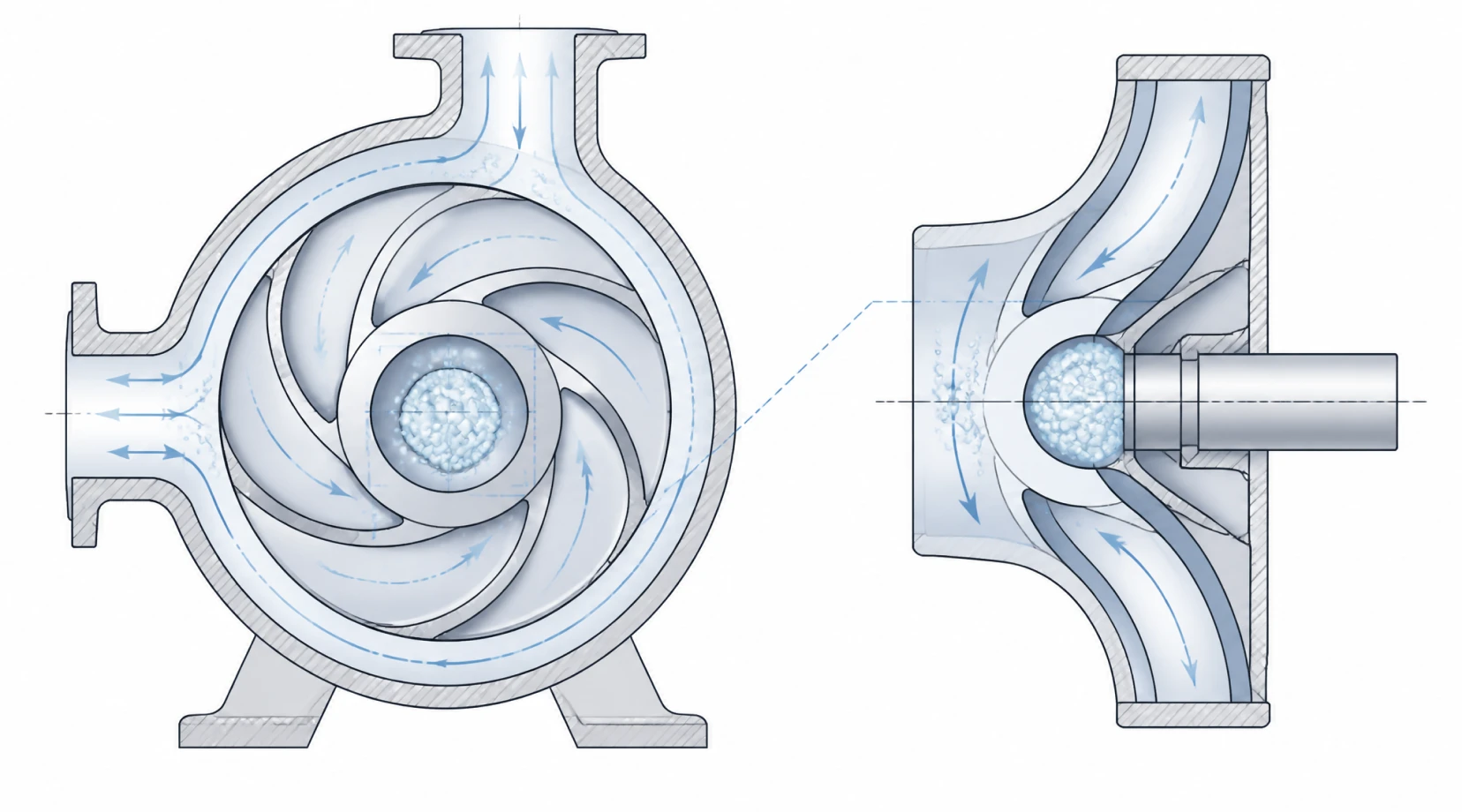
The Aulank Approach: Regenerative Peripheral Hydraulics and Sealless Containment
Our answer to a gassy fluid is to choose a pumping principle that carries gas through with the liquid instead of separating it out, and to seal the pump hermetically when the fluid is also hazardous. That is the job our vortex pumps are built for:
● Regenerative peripheral hydraulics carry gas through. A regenerative (peripheral) impeller circulates the liquid repeatedly between its vanes and a side channel as it travels around the casing, and that recirculating action keeps entrained gas mixed into the liquid and moves it through the pump rather than letting it separate and pocket at the eye. This pump class carries a far larger gas fraction than a plain centrifugal — regenerative turbine and side-channel designs handle entrained gas well, up toward half by volume in the right build — so it keeps pumping where a standard impeller would lock.
● Self-priming and low NPSH. The same recirculating action makes the pump self-priming: it clears gas out of the suction line and lifts the liquid without hand-priming every start, and it runs at a low NPSH, so it can draw a volatile fluid close to its boiling point, or pull a tank down to a low level, without cavitating. That is exactly what condensate, refrigerants, and fluids under their own vapour pressure need.
● High head at low-to-moderate flow. A regenerative peripheral pump delivers high head at modest flow from a single stage, which is the duty most gassy transfer and circulation jobs actually call for — a steady, high-pressure delivery of a moderate volume rather than bulk throughput.
● Sealless containment where it is hazardous. Off-gassing chemicals like hypochlorite are corrosive, and volatile solvents, LPG, and light fuels are flammable — none of them should leak. Our magnetic vortex pumps and canned vortex pumps drive the impeller through a static containment shell with no shaft seal, so there is no seal for a gassy, aggressive fluid to attack and no leak path. This is the same zero-leak principle behind our leak-proof pumps, applied to fluids that carry gas.
The boundaries are worth stating plainly. Very low-flow injection of an off-gassing disinfectant — a few gallons a day of sodium hypochlorite into a water main — is metering-pump territory, where a peristaltic or auto-degassing diaphragm dosing pump holds prime through the gas at flows a transfer pump cannot. A genuine high-gas multiphase flow, the kind an oil well produces, needs equipment built for multiphase service. And a very cold liquefied gas such as liquid nitrogen is a cryogenic duty of its own. Aulank supplies vortex and magnetic-drive pumps for transferring and circulating gassy, off-gassing, and near-boiling fluids; a micro-dose, a true multiphase well, or a cryogenic gas calls for a different pump.
Pump Types and Working Principles
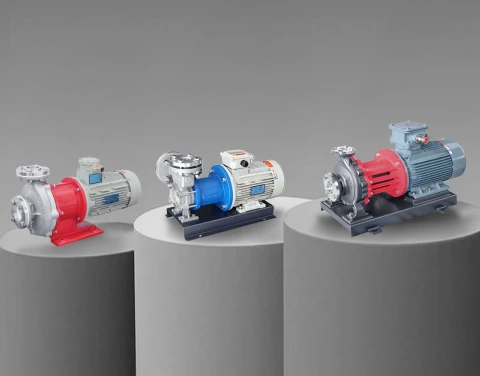
Magnetic Vortex Pumps (MDW, MDH, MDS) — gassy hazardous and volatile fluids
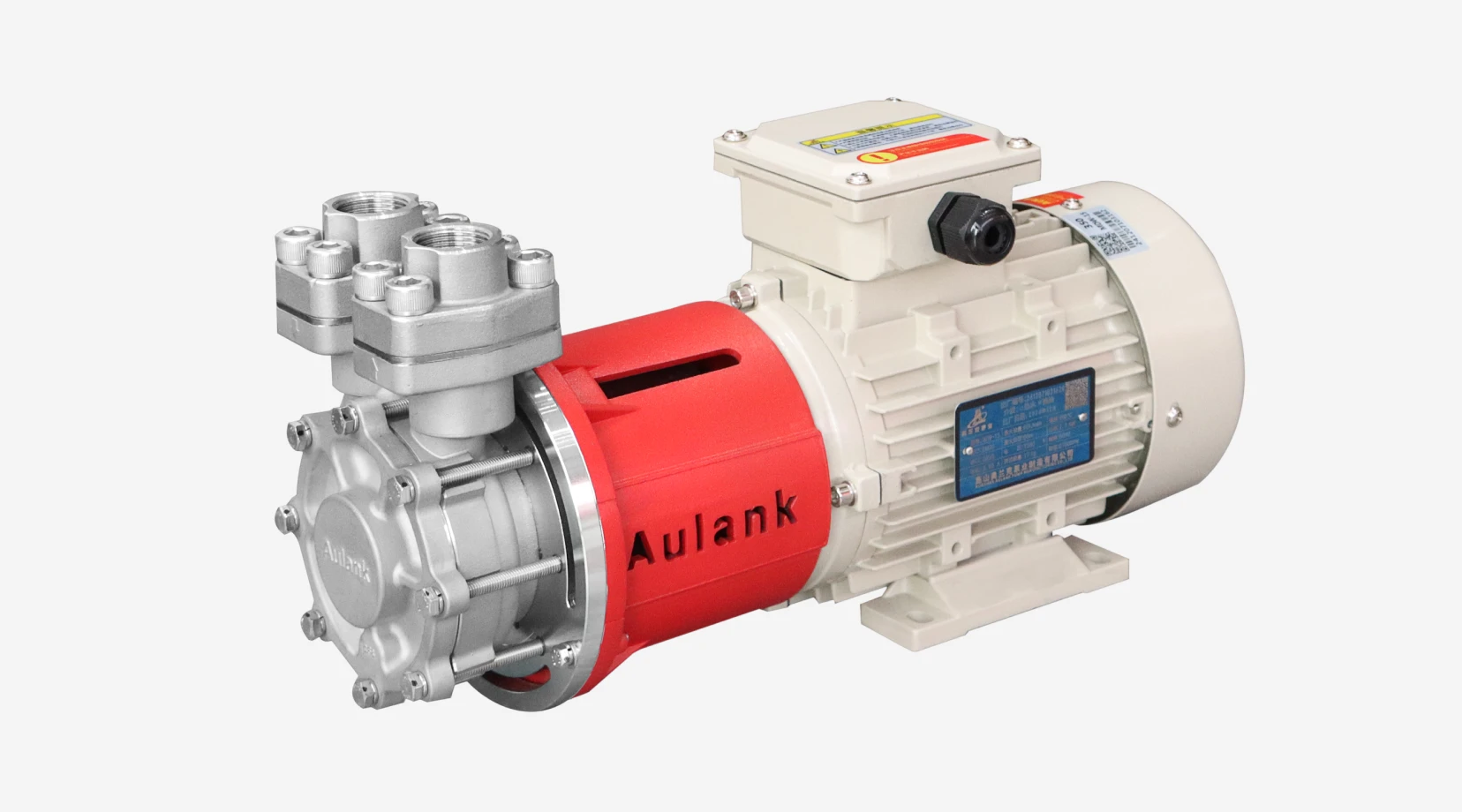
When the gassy fluid is corrosive, toxic, or flammable, containment comes first. The MDW, MDH, and MDS magnetic vortex pumps pair the gas-carrying, self-priming regenerative hydraulics with a sealless magnetic drive — no shaft penetration, no seal to leak. They are the pump for transferring or circulating an off-gassing chemical, a volatile solvent, or a refrigerant where the fluid has to stay inside the casing. The MDW series is the one Aulank has supplied into semiconductor low-temperature fluorinated-liquid and chiller duties, where a volatile coolant has to move without a leak path.
Canned Vortex Pumps (PWH-PWD-PWM, MDP) — sealed high-head circulation
The PWH-PWD-PWM canned vortex pumps and the MDP permanent-magnet canned vortex pump put the same regenerative hydraulics in a canned-motor construction, with the rotor running inside the pumped fluid and the motor sealed from atmosphere. This is a compact, fully-contained package for high-head circulation of a gassy or volatile fluid in a closed loop — thermal-control, coolant, and light-chemical circuits where space is tight and zero leakage is required.
Where Vane and Gear Pumps Fit
A positive-displacement pump carries a fixed volume per revolution and can move a fluid with some entrained gas without losing prime, so a vane or magnetic-drive gear pump is an option where the gassy fluid is also low in lubricity or has to be delivered at a steady, pressure-independent rate — a volatile solvent or a light fuel, for instance. For the full picture on thin and volatile fluids, our low-viscosity fluid page covers that range; where zero fugitive emission is the whole point, the leak-proof page covers containment directly. Type and material options span the positive-displacement pump line.
The Honest Limit — Micro-Dosing and True Multiphase
For very low-flow chemical injection that off-gasses — dosing sodium hypochlorite or hydrogen peroxide into a water stream at a few gallons a day — a peristaltic or auto-degassing diaphragm metering pump is the correct choice, because it holds prime through the gas at metering flows a transfer pump cannot. A high gas-volume-fraction multiphase flow needs equipment designed for multiphase service. Aulank will tell you plainly when a duty sits in one of these two zones rather than sell a pump that will not hold prime.
Where Gas-Handling Pumping Solves a Real Problem
Gassy, off-gassing, and near-boiling fluids run through a wide slice of the process industries:
● Condensate recovery and return. Pulling hot condensate off a steam system, where the liquid sits near its boiling point and flashes the moment suction pressure dips — a low-NPSH, gas-tolerant pump holds prime where a standard centrifugal vapour-locks.
● Refrigerant circulation. Moving refrigerants and other volatile heat-transfer fluids that run close to their boiling point and carry vapour, where the pump has to tolerate gas without stalling.
● LPG and light-fuel transfer. Transferring LPG, propane, and light fuels under their own vapour pressure, where the fluid flashes as soon as suction pressure drops and a self-priming, low-NPSH pump keeps it moving.
● Volatile solvent transfer. Handling acetone, alcohols, and thinners near their flash point — thin and volatile, with entrained vapour and the need for zero leakage both in play.
● Off-gassing chemical transfer. Transferring sodium hypochlorite, hydrogen peroxide, and similar chemicals that decompose and release gas in the line — a sealless, gas-carrying pump moves them at transfer flow without the constant bleeding a mismatched pump needs.
● Tank draining and emptying. Pulling a volatile fluid down to a low tank level, where the falling level draws gas into the suction and an ordinary pump loses prime before the tank is empty.
Matching the Pump to the Gassy or Two-Phase Duty
As a starting point, the fluid's gas behaviour and the emission requirement point to the pump — including the honest cases that fall outside a vortex pump's range:
| Fluid or duty | Fluid character | Key requirement | Recommended pump |
| Condensate / near-boiling transfer | High vapour pressure, flashes at suction | Low NPSH, holds prime, carries vapour | Magnetic or canned vortex pump |
| Refrigerant / volatile heat-transfer circulation | Volatile, entrained vapour, must not leak | Gas tolerance + sealless containment | MDW / MDH / MDS magnetic vortex |
| LPG / light-fuel transfer | Thin, under its own vapour pressure | Self-priming, low NPSH, gas handling | Regenerative peripheral (vortex) pump |
| Off-gassing chemical transfer (hypochlorite, peroxide) | Corrosive, generates gas over time | Sealless containment + gas carrying | Magnetic / canned vortex pump |
| Low-flow off-gassing dosing | Off-gasses at metering flow | Holds prime at very low flow | Peristaltic / auto-degassing diaphragm metering pump (outside vortex range) |
| High gas-fraction multiphase flow | Very high GVF, true two-phase | Multiphase handling | Specialised multiphase equipment (outside vortex range) |
The table points to a first choice; the final selection turns on the gas volume fraction, the vapour pressure against the suction head available, whether the gas is entrained, dissolved, or generated by off-gassing, and whether the fluid has to be contained.
Key Selection Considerations
When you specify a pump for a gassy or two-phase fluid, the parameters that decide whether it runs and holds prime are:
● Gas volume fraction (GVF). How much gas the flow actually carries, since that sets whether a standard centrifugal is even viable, whether a gas-handling vortex pump fits, or whether the duty is a multiphase job.
● Source of the gas. Whether the gas is entrained, dissolved and breaking out at the suction, or generated by off-gassing — off-gassing worsens with temperature and concentration and keeps making gas in the line, so the pump has to carry gas continuously, not just clear one initial pocket.
● Vapour pressure and NPSH. The fluid's vapour pressure against the suction pressure available, which decides how much flashing and gas break-out to expect and how low the pump's NPSH has to be. Where cavitation is the governing risk, see our cavitation guide.
● Containment. Whether the fluid is corrosive, toxic, or flammable enough to require a sealless magnetic-drive or canned pump, or whether a sealed pump covers the duty.
● Transfer versus micro-dosing. Whether the job is transferring or circulating a real flow — where a vortex pump fits — or injecting a trickle that off-gasses, where a metering pump belongs.
● Temperature. Whether the fluid is hot condensate or a cold refrigerant, since the pump platform and materials have to suit the temperature as well as the gas.
● Abrasives and dry-running. Whether the fluid carries solids, which rule out a regenerative peripheral pump's tight running clearances, and whether the duty can pull the suction dry — a self-priming pump clears gas but still relies on liquid to cool it, so a dry-running risk needs low-level protection.
Get a Gas-Handling Pump Configuration for Your Process
Tell us the fluid and whether it carries entrained gas, breaks out dissolved gas at the suction, or off-gasses in the line; its vapour pressure and the suction head you have; the flow and pressure you need; and whether it has to be contained. Our engineering team will configure a vortex or magnetic-drive pump for the duty — or tell you plainly when a metering pump or multiphase equipment is the right answer instead. Type and material options span the vortex pump and positive-displacement pump ranges.
Talk to our team: Contact Aulank | WhatsApp: +86 13773157367 | Email: info@aulankpump.com
Related reading: leak-proof · low-viscosity fluid · preventing cavitation