



High purity is a different pumping problem from corrosion or leakage, and it is easy to conflate the three. A corrosion-resistant pump solutions pump is built so the fluid does not attack the pump. A leak-proof pump solutions pump is built so the fluid does not escape the pump. A high-purity pump has to satisfy a third, quieter requirement: the fluid must leave the pump exactly as pure as it entered. That means the pump itself must add nothing — no particles worn off a seal, no metal ions leached from a wetted surface, no organic carbon, no lubricant, no flush water. In semiconductor, electronics, pharmaceutical, and fine-chemical processes, a contribution measured in parts per billion is enough to scrap product. At that level, purity is not a nice-to-have — it is the product specification, and a pump that quietly adds contamination can cost a batch of wafers or a lot of pharmaceutical intermediate far more than the pump is worth. This page covers how Aulank's sealless and fluoropolymer-lined pumps keep high-purity and ultrapure fluids uncontaminated, and is clear about where the most demanding wafer-fab duties call for specialised equipment.
Why High Purity Defeats Standard Pumps
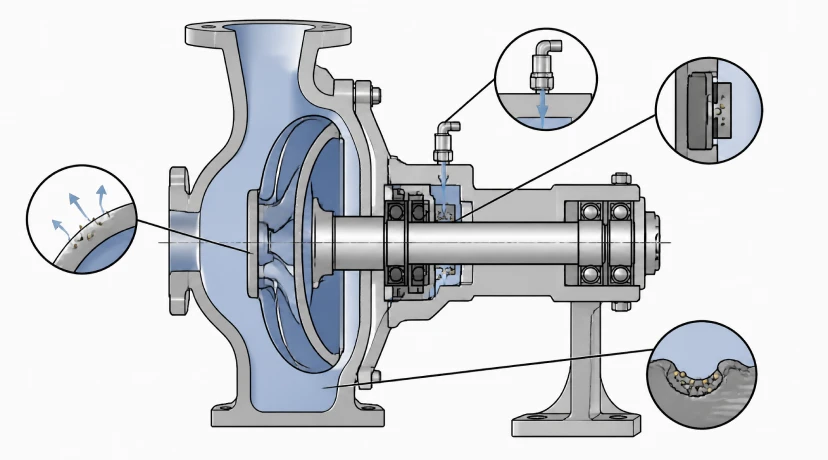
A conventional pump is designed to move fluid, not to keep it pristine, and several of its ordinary features are contamination sources. The purity problem is about what the pump gives to the fluid:
● Mechanical-seal wear particles. A mechanical seal runs two faces against each other, and that contact sheds fine particles into the fluid. It is also a small leak path across the faces. For a cleanroom fluid, even the trace that crosses a working seal is usually too much — the seal is both a leak point and a particle generator.
● Seal flush and barrier fluid. Sealed pumps on demanding duties inject a flush or barrier fluid at the seal. In a high-purity system that flush is a direct route for foreign liquid to mix into the product.
● Metal-ion and metallic leaching. Metal wetted parts can release ions — sodium, potassium, calcium, iron — into aggressive ultrapure chemicals and deionised water. Those ions cause electrical defects on wafers and can etch or alter semiconductor devices; metallic contamination changes their electrical properties outright.
● Organic carbon and lubricant ingress. Total organic carbon (TOC) affects silicon oxidation, etch uniformity, and gate-oxide breakdown voltage, so any organic contribution matters. Grease- or oil-lubricated bearings are a source of exactly this kind of contamination.
● Permeation and outgassing. Aggressive chemicals can absorb into the wrong wetted material and slowly release again, causing cross-contamination and process-recipe drift, while organic contaminants can outgas into the fluid or the cleanroom.
● Rough surfaces and dead legs. A rough internal finish traps particles and gives bacteria somewhere to grow in ultrapure water, and stagnant zones inside a pump hold contamination that bleeds back into the stream.
● Carry-over between fluids. When a pump handles more than one chemistry, liquid held up in pockets and absorbed into a permeable wetted surface carries over into the next fluid, blurring one batch into the next and shifting the process recipe.
The Aulank Approach: Sealless and Fluoropolymer, Nothing Added
Aulank's answer to purity is to remove the two biggest contamination sources — the dynamic seal and reactive wetted metal — and to keep the wetted path inert and smooth:
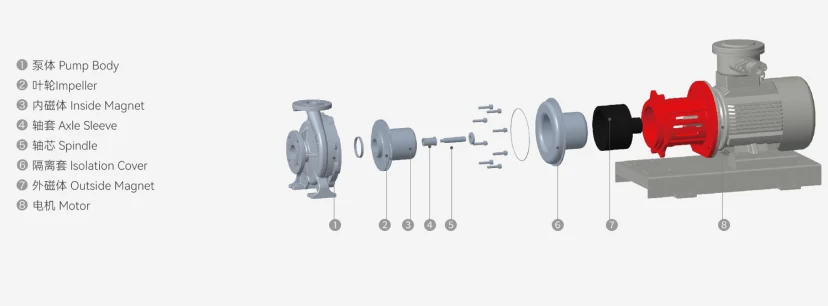
● No seal, so no seal particles or flush. A sealless magnetic-drive pump transmits torque through a static containment shell, so there is no rubbing seal face to shed particles and no flush fluid to inject. Removing the seal removes both the particle source and the leak path in one step — the same sealless principle behind our leak-proof pump solutions, applied here to protect the product rather than the surroundings.
● Fluoropolymer wetted surfaces. A PTFE or PFA lining gives an inert, non-reactive wetted surface with very low extractables, so it does not leach metal ions or organic carbon into the fluid. Fluoropolymers resist the full range of wet-process chemistry — acids, bases, oxidisers, and solvents — and their low permeability limits absorption and cross-contamination. The two differ in use: PTFE is the general-purpose fluoropolymer lining for aggressive high-purity chemistry, while PFA offers a smoother, less permeable surface with the mechanical strength to take higher pressure and temperature, which is why it is favoured where the high-purity fluid is also hot or where extractables must be pushed to the lowest level.
● Product-lubricated bearings. Silicon-carbide bearings are lubricated by the pumped fluid itself, so there is no grease or oil to migrate into a high-purity stream.
● High-purity stainless where fluoropolymer is not needed. For ultrapure and deionised water, a smooth, high-purity stainless wetted path resists the particle entrapment and bacterial growth that a rough surface invites.
● Smooth, drainable hydraulics. A clean internal geometry limits the stagnant zones where contamination would otherwise collect and bleed back into the fluid.
The honest boundary is important. The most stringent semiconductor duties — ultra-high-purity chemical distribution certified to single-digit parts-per-billion extractables, with full particle and metals testing — are a specialised field, and abrasive slurries such as CMP are not a magnetic-drive duty at all, because the solids wear the running clearances. Aulank supplies high-purity-capable sealless and fluoropolymer-lined pumps for high-purity chemical transfer, dosing, and circulation; the most demanding wafer-fab certifications and abrasive slurry service call for equipment built specifically for them.
Pump Types and Working Principles
AMC-F PTFE-Lined Magnetic Drive Pump (high-purity aggressive chemicals)
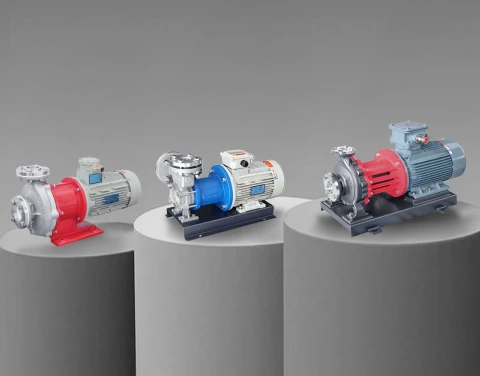
The AMC-F PTFE-lined magnetic drive pump is the core high-purity pump for aggressive chemistry. Every wetted surface is PTFE fluoropolymer over a structural casing, and the drive is fully sealless, so the fluid contacts only an inert, low-extractable surface with no seal to shed particles. It suits high-purity acids, oxidisers, and solvents where both chemical inertness and cleanliness are required — the combination of a fluoropolymer wetted path and a hermetic magnetic drive.
AMC-L Chemical Process Magnetic Drive Pump (high-purity process and circulation)
For high-purity chemical process and circulation duties, the AMC-L chemical process magnetic drive pump pairs the sealless magnetic drive with process-grade wetted materials selected for the fluid. It is the choice for continuous high-purity circulation loops where the pump has to run for years without introducing contamination or requiring a seal rebuild. The wider Chemical Pump Series covers the material options for different chemistries.
Sealless Stainless Pumps for Ultrapure and DI Water
Ultrapure and deionised water is a different purity duty: the concern is particles, TOC, and bacterial growth rather than aggressive attack. Here a smooth, high-purity stainless sealless pump fits — the CPS-L stainless high-flow centrifugal pump for higher-flow circulation loops, and the Magnetic Vortex Pump Series where the duty needs high head at lower flow. Ultrapure-water systems are usually kept continuously recirculating to hold resistivity and suppress bacterial growth, so the pump runs around the clock; a sealless design with a smooth wetted path suits that duty because it adds no particles to the loop and gives no rough surface for a biofilm to take hold.
Where High-Purity Pumping Solves a Real Problem
The purity requirement shows up across the industries that live or die on contamination control:
● Semiconductor wet chemicals. Transferring and dosing the acids, bases, oxidisers, and solvents used in wafer cleaning and etching — hydrofluoric acid, sulphuric-peroxide mixtures, ammonia and hydrochloric cleaning chemistries — where a leached ion or a shed particle lands on a wafer and becomes a defect that shows up as lost yield. Aulank's role in this sector is covered in our note on semiconductor fab chemical pump demand.
● Ultrapure and DI water. Circulating ultrapure water in electronics and pharmaceutical systems, where surface roughness and dead legs would seed particles and microbial growth.
● Electronics-grade and fine chemicals. Handling high-purity process chemicals and electronic-grade solvents where metal-ion pickup or organic contamination would move the product out of specification.
● Pharmaceutical high-purity fluids. Transferring high-purity solvents and process liquids where contamination control and zero leakage both apply — within the limits of the specific hygienic certification a given duty demands.
● High-purity battery materials. Moving and dosing high-purity electrolytes and solvents in battery-material production, where trace contamination degrades electrochemical performance.
● Display and photovoltaic chemistry. Circulating and transferring electronics-grade etchants, developers, and cleaning chemicals in flat-panel display and solar-cell lines, where the same particle and ionic limits as wafer processing apply over much larger substrate areas.
Matching the Pump to the Purity Duty
As a starting point, the fluid and the purity requirement point to the pump — including the honest case where the duty is outside a magnetic-drive pump's range:
| Purity duty | Fluid | Key requirement | Recommended pump |
| High-purity aggressive chemical transfer | HF, acids, oxidisers, solvents | Inert fluoropolymer, sealless, no leaching | AMC-F PTFE-lined magnetic drive |
| High-purity chemical process and circulation | Electronics-grade chemicals | Sealless, clean wetted path, no particles | AMC-L magnetic drive |
| Ultrapure / DI water circulation | UPW, deionised water | Smooth high-purity stainless, sealless, low TOC | CPS-L stainless / vortex magnetic |
| High-purity dosing and metering | Clean additives, reagents | Pulsation-free, leak-free, no contamination | MDC-K magnetic gear |
| CMP slurry or certified UHP wafer duty | Abrasive slurry / UHP-certified | Abrasion handling or sub-ppb certification | Specialised equipment (outside Aulank range) |
The table is a first cut. The real selection turns on the wetted-material and cleanliness detail below, and on the certification level the duty actually requires. For the engineering behind the sealless drive, see our magnetic drive pump selection guide.
Key Selection Considerations
When you specify a high-purity pump, the parameters that decide whether the fluid stays clean are:
● Wetted materials. Fluoropolymer lining (PTFE or PFA) for aggressive high-purity chemistry, or high-purity stainless for ultrapure water — matched to both the chemistry and the extractable limit.
● Extractables and leaching limit. How clean the fluid has to stay, expressed as the ionic, metallic, and organic contribution the pump is allowed to make, which sets the material and finish.
● Particle generation. Whether the design avoids particle sources — a sealless drive removes the seal, and the bearing choice governs wear-particle generation.
● Surface finish and cleanability. A smooth wetted surface and a drainable geometry to avoid particle traps, dead legs, and bacterial growth in water systems.
● Temperature. Whether the high-purity fluid is hot, since PFA holds up better than PTFE where both purity and higher temperature apply.
● Duty point. Flow and head for a transfer or circulation loop, or the metered volume and turndown for a dosing duty.
● Certification level. The purity standard the duty must meet — and an honest check of whether a high-purity industrial pump satisfies it or a specialised certified pump is required.
Get a High-Purity Pump Configuration for Your Process
Tell us the fluid and its purity requirement, the temperature, the flow and head or the metered dose, and the extractable or cleanliness limit you have to meet, and our engineering team will configure a sealless, fluoropolymer-lined or high-purity stainless pump for the duty — or tell you plainly when a specialised certified pump is the right call. Material options span the Chemical Pump Series.
Talk to our team: Contact Aulank | WhatsApp: +86 13773157367 | Email: info@aulankpump.com
Related reading: corrosion-resistant pump solutions · magnetic drive pump selection guide