


Cold fluids break the assumptions most pumps are built on. A liquid sitting close to its boiling point has almost no pressure margin to spare, ordinary seal materials go brittle and crack, and any small leak in a cryogenic line flashes straight to gas. Pumping liquid nitrogen at −196 °C, a semiconductor coolant at −60 °C, or a battery-test loop cycled below freezing is a different job from moving water, and a pump chosen for ambient service fails quickly on all three. Aulank builds pumps for continuous operation from −196 °C to +400 °C, and our low-temperature solutions are designed around containment, material toughness, and suction stability. This page covers why cold service is hard, how we solve it, which pumps fit which cold duty, and where low-temperature pumping shows up in real production. Getting the pump wrong shows up as a cavitated impeller, a frosted-over leak, or a batch of cryogen lost to boil-off, so the cost of a poor choice is measured in downtime, not just parts.
Why Cold Fluids Defeat Standard Pumps
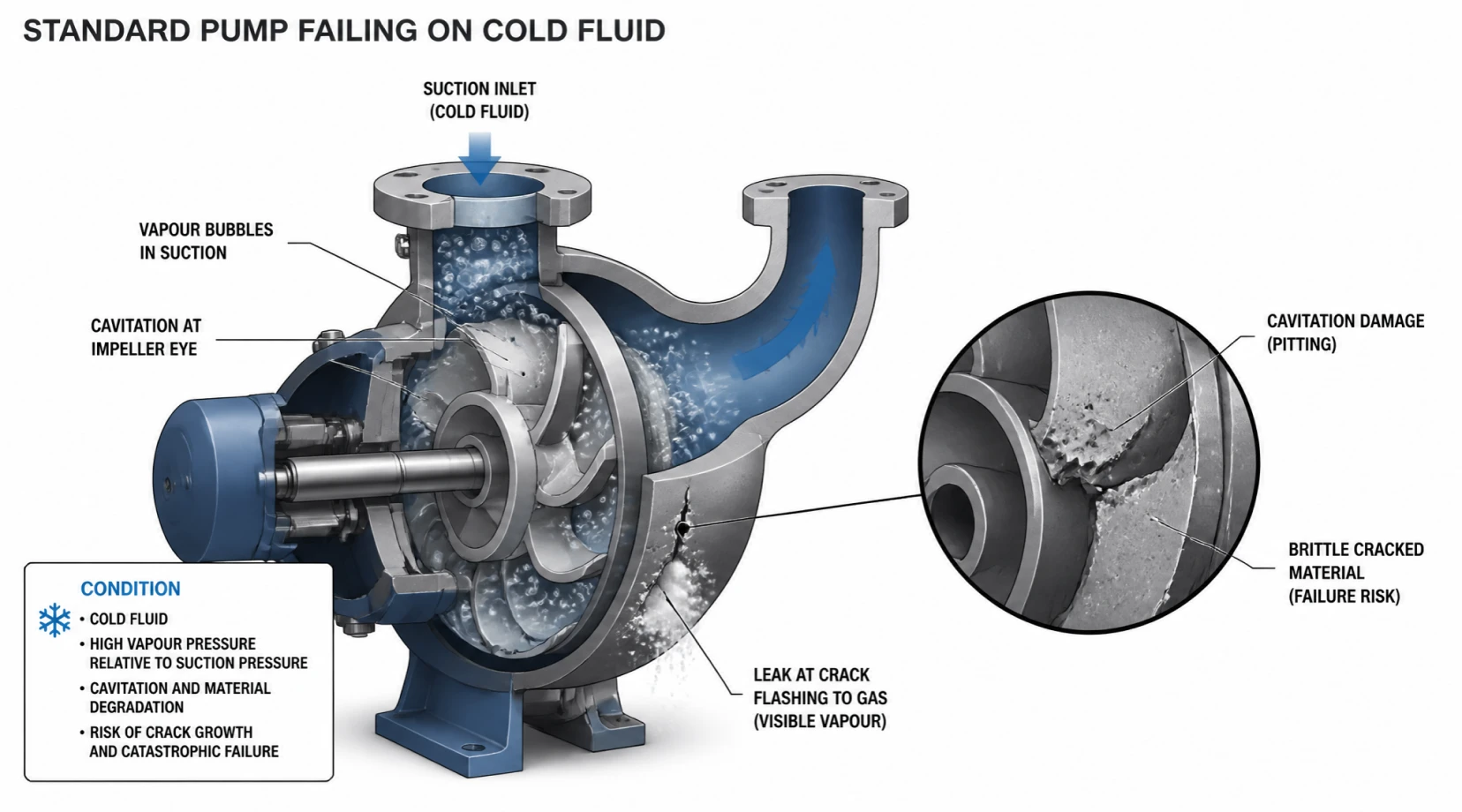
Low-temperature and cryogenic fluids fail a standard pump in four ways at once.
● Almost no suction margin. Cryogens and cold liquefied gases sit near their boiling point and have low density, so the available NPSH is small. A slight pressure drop at the impeller eye flashes the liquid to vapour, and the bubbles collapse and cavitate, tearing the impeller and killing the head.
● Materials turn brittle. Carbon steel and many plastics lose toughness and crack at cryogenic temperatures. Cold service needs austenitic stainless steel, and elastomers that stay flexible are hard to find, so a standard seal cracks and leaks.
● A leak becomes a gas cloud. A liquefied gas escaping through a worn shaft seal flashes to many times its liquid volume as vapour, which is a safety, oxygen-displacement, or flammability hazard. Sealing a boiling, volatile fluid with a rubbing face is a poor bet. One volume of liquid nitrogen becomes roughly seven hundred volumes of gas as it warms, so even a small weep fills a space fast.
● Heat leak and thermal shock. Heat leaking in boils off the cryogen and adds vapour to the suction, and cooling the pump down too fast can crack the casing. Cold pumps have to be insulated and pre-cooled slowly.
The Aulank Approach: Sealless Containment, Cold-Rated Materials
Our low-temperature pumps remove the leak path and match every wetted part to the cold.
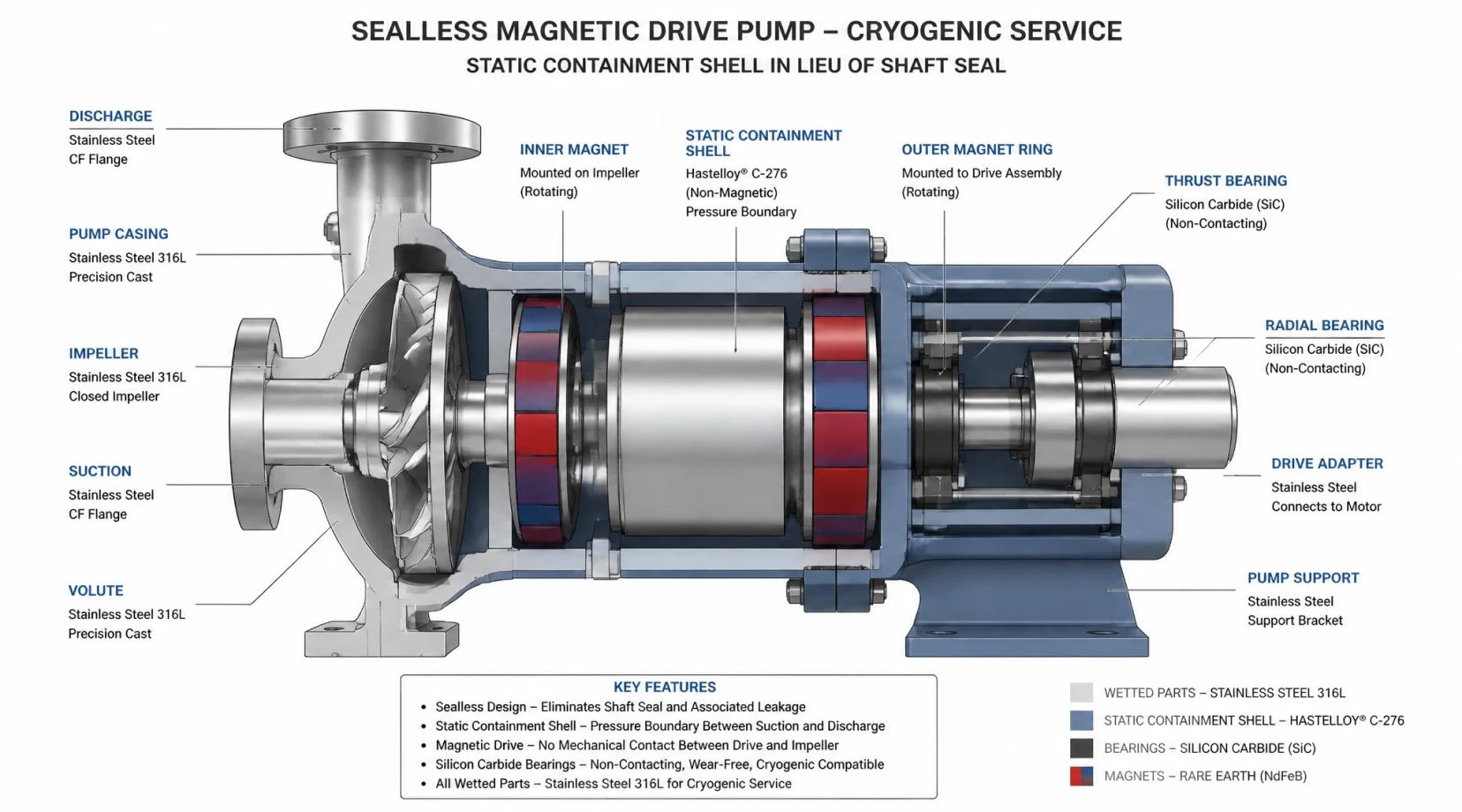
● Sealless magnetic drive. The impeller is driven through a static containment shell, so there is no dynamic shaft seal to crack or weep. For a fluid that flashes to gas on the smallest leak, deleting the seal removes the main failure mode. See our magnetic-drive vortex pumps and sealless chemical pumps.
● Cold-tough wetted materials. Austenitic stainless bodies and impellers keep their toughness at low temperature, and bearing and containment materials are selected to survive thermal cycling. Aggressive cold chemicals run in a fluoropolymer-lined wetted path.
● Suction stability. We size for the low NPSH of cold service, keep internal clearances and flow paths clean, and support flooded-suction and speed-controlled starts so the fluid stays liquid all the way through the pump.
● One engineered temperature range. Because the same platform is built from −196 °C to +400 °C, the magnet grades, clearances, and materials are chosen for the real duty rather than pushed past a standard limit.
Pump Types and Working Principles
Cold duties split by media and flow. These are the platforms we match to them.
AYDH Magnetic Liquid Nitrogen Pump (cryogenic, −196 °C class)
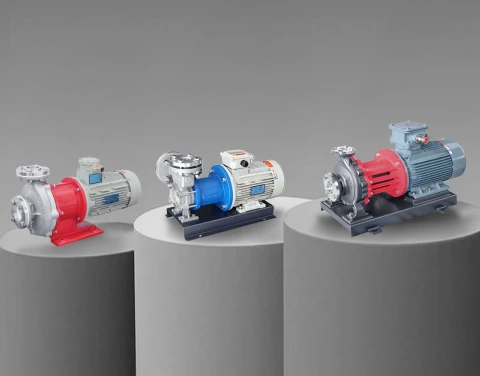
A sealless magnetic-drive pump built for liquid nitrogen and similar cryogens. The hermetic containment shell gives zero-leak transfer of a fluid that flashes to gas, and the wetted parts are rated for cryogenic temperature and thermal cycling. Removing the shaft seal also removes a common cold-service failure, since there is no face to freeze, crack, or ice up. See the AYDH magnetic liquid nitrogen pump.
MDW and MDH Stainless Magnetic-Drive Vortex Pumps (low-temperature coolants and fluorinated liquids)
High-head, low-flow, sealless stainless vortex pumps for cold coolant loops and semiconductor fluorinated liquids. The vortex (regenerative) design delivers head at low flow in a compact, contained body, which suits precise circulation rather than bulk transfer. That fits chiller and test-rig loops, where the duty is steady flow at a set temperature rather than large throughput. See the MDW and MDH within the vortex pump range.
Sealless Stainless Centrifugal Pumps (higher-flow cold transfer)
For larger cold-transfer flows, a sealless stainless centrifugal pump moves volume while keeping the fluid contained, with impeller and suction designs suited to low available NPSH. Where a vortex pump handles head at low flow, the centrifugal handles the reverse, so the two cover most cold duties between them. See the centrifugal pump range.
Where Low-Temperature Pumping Solves a Real Problem
Cold pumping shows up across new-energy, semiconductor, and process production.
● Semiconductor low-temperature coolants. Chillers and test equipment circulate fluorinated heat-transfer fluids well below zero, and the pump has to stay contained and compatible with the fluid across the whole temperature range. Aulank supplies MDW-series pumps into semiconductor low-temperature fluorinated-liquid duty.
● Battery low-temperature testing. EV cells are validated across temperature, with coolant loops driven below −40 °C. The pump faces thermal cycling and must not leak near live cells, which favours a sealless stainless design.
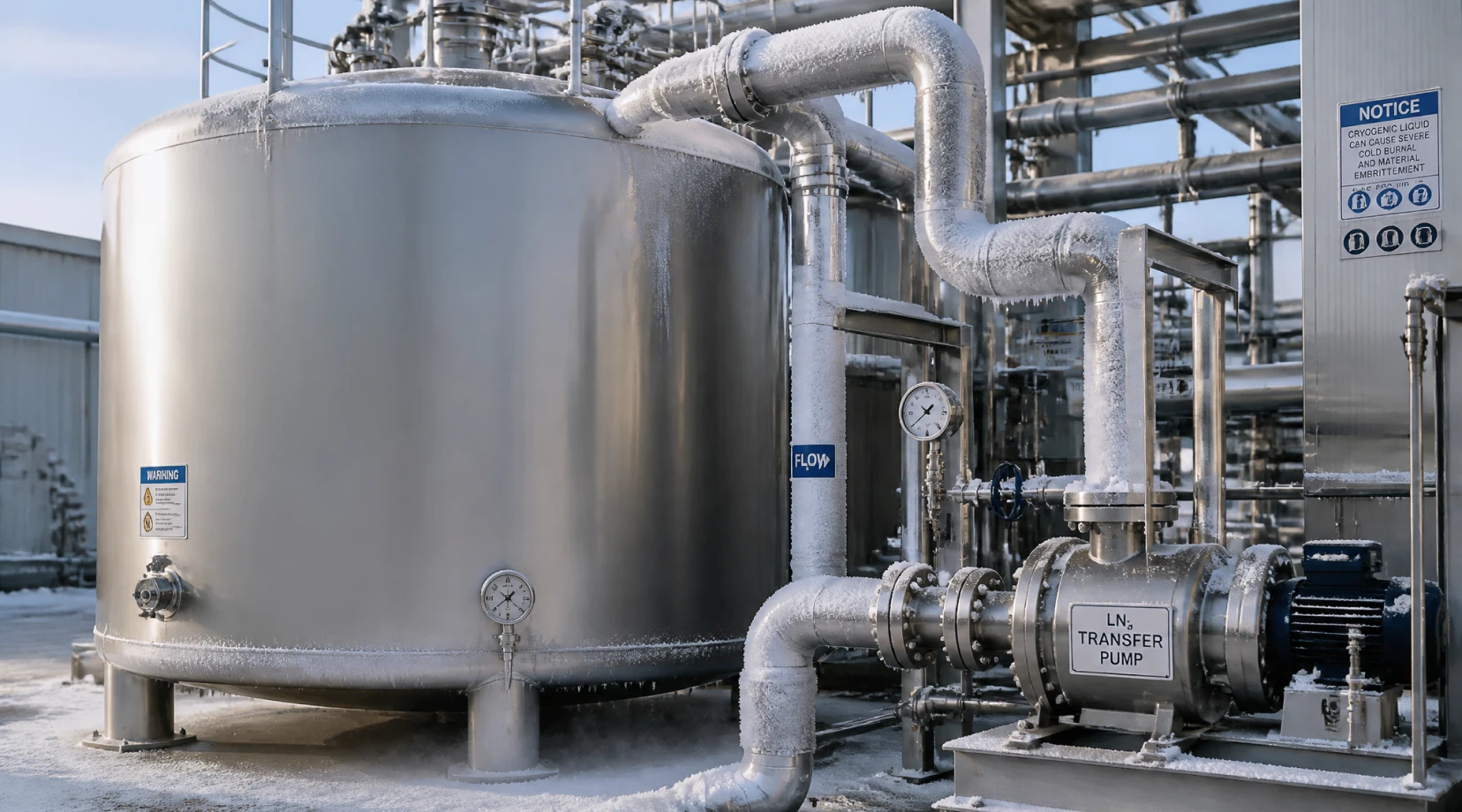
● Liquefied gas and LNG handling. Liquid nitrogen, oxygen, argon, and LNG move from storage to process, where zero-leak containment and low-NPSH suction are the priorities. Liquid oxygen adds oxygen-clean material and cleaning rules on top of the cold.
● Cold and low-temperature chemical process. Reactions and crystallisation run cold. Sealless, fluoropolymer-lined pumps such as the AMC-L magnetic drive pump keep aggressive cold chemicals contained.
● Cryogenic sample and lab transfer. Small, precise cold transfers where leakage and boil-off both have to stay low.
Matching the Pump to the Cold Duty
A quick map of cold duties to pump choice:
| Cold duty / media | Typical temperature | Main challenge | Aulank fit |
| Liquid nitrogen transfer | −196 °C | Boil-off, embrittlement, zero-leak | AYDH magnetic LN2 pump |
| Semiconductor fluorinated coolant | −40 to −80 °C | Purity, low temp, compatibility | MDW / MDH sealless vortex |
| Battery test coolant loop | −40 °C and below | Thermal cycling, no leak near cells | Sealless stainless vortex / centrifugal |
| LNG / liquefied gas | −162 to −186 °C | Low NPSH, flash-to-gas, cold toughness | Sealless stainless, flooded suction |
| Cold aggressive chemical | −20 to −60 °C | Corrosion plus low temperature | AMC PTFE-lined magnetic drive |
Key Selection Considerations
Before we quote a cold-service pump, these are the points that decide the design:
● Fluid and temperature at suction. Name the exact media and its coldest temperature, including start-up excursions. That fixes the material and safety requirements; liquid oxygen, for instance, needs oxygen-clean materials and cleaning to avoid ignition.
● NPSH and submergence. Give the available NPSH. Cold service often needs a flooded suction, the pump mounted below the tank, or a subcooled feed to stay clear of cavitation.
● Material toughness. Wetted parts in austenitic stainless or lined fluoropolymer, and no materials that go brittle when cold.
● Containment over sealing. For volatile cold fluids a sealless design is the safer default, and any static seals still need cold-rated elastomers.
● Cool-down and thermal shock. Plan a slow pre-cool. Rapid cooling stresses and can crack the casing before the pump is even in service.
● Insulation and boil-off. Insulate the pump and lines and manage vented vapour so it does not gas-lock the suction.
● Drive and speed control. Speed control eases low-NPSH starts and low-flow running, and special voltage, frequency, and explosion-proof options are available for the site.
Get a Low-Temperature Pump Configuration for Your Process
Aulank engineers cold-service pumps across one platform, from −196 °C to +400 °C, so the recommendation follows your fluid and duty. Send us the media, its coldest temperature, the flow, the available NPSH, and the duty cycle, and our engineers will match the design and materials to the job. See the full industrial pump range or contact Aulank to work through a cold-duty selection.