
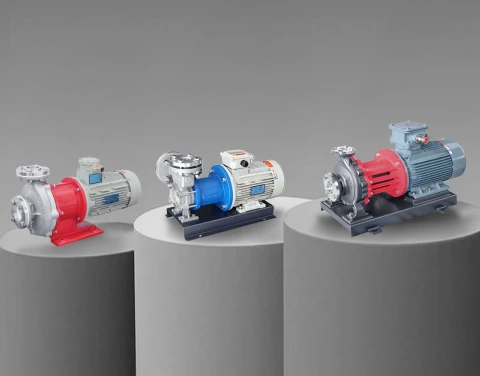





Semiconductor processes run on temperature margins that most industrial plants never see. A CMP platen that drifts 5°C changes removal rate by double digits. An etch chamber whose wall temperature wanders shifts selectivity and critical dimensions. A thermal chuck in a test handler that ramps slowly costs throughput on every device. Behind each of these control points sits a circulation loop, and inside every loop sits a pump that decides whether the temperature controller can actually hold its setpoint. Controllers get the attention in most specifications, yet the pump determines the flow stability, pressure margin, and leak integrity the controller depends on. This guide covers the engineering of circulation pumps for semiconductor temperature control loops: what the process demands, how to match pump hydraulics to high-resistance circuits, and the material and sealing choices that keep a cleanroom tool running for years.
Why Temperature Stability at the Tool Is a Yield Variable
CMP: friction heat and removal-rate drift
Chemical mechanical planarization generates heat at the pad-wafer interface, with frictional heating in the range of 200 to 300 W in typical copper processes. The polyurethane pad conducts heat poorly, so the heat accumulates at the surface where slurry chemistry is most sensitive to temperature. Process data across oxide and copper CMP shows that a 5°C rise in slurry temperature can increase removal rate by 10 to 15 percent, and elevated pad temperatures correlate directly with dishing and erosion defects. Production tools therefore hold slurry and platen coolant within ±1°C of setpoint, a stability target that only holds if the circulation pump delivers steady, pulsation-free flow through the conditioning circuit.
Etch and deposition: chamber and chuck temperature
Plasma etch rate and selectivity shift with chamber wall and electrode temperature, which is why etch tools circulate heat transfer fluid through chamber liners, domes, and electrostatic chucks. Deposition tools face the same physics from the other direction: CVD and PVD chambers need stable wall temperatures to keep film uniformity and particle performance within specification. Commercial temperature control units for these tools set coolant temperature in 0.1°C increments, circulate perfluorocarbon or glycol-based fluids in closed loops, and are helium leak checked as standard. The circulation pump inside the TCU or on the tool skid carries the full stability burden between the refrigeration circuit and the chamber.
Test and packaging: thermal chucks and handlers
Back-end test handlers cycle devices across wide temperature ranges to validate performance at specification extremes. Thermal chucks and thermal stream systems depend on circulation loops that ramp fast and hold steady at each test point. Slow ramping extends test time per device; overshoot corrupts the measurement. Both failure modes trace back to circulation flow that varies with circuit conditions.
What the Temperature Control Loop Demands from the Circulation Pump
Low flow against high circuit resistance
Semiconductor cooling circuits push fluid through narrow channels: microchannel cold plates, compact brazed-plate heat exchangers, small-bore manifolds, and quick-disconnect fittings. Each element adds pressure drop, and the total circuit resistance is high relative to the modest flows involved, typically 0.5 to 12 m³/h. A standard centrifugal pump reaches its steep curve region in this duty and loses head rapidly as resistance rises, which starves the loop exactly when the tool needs flow most. The pump hydraulic must hold pressure at low flow without oscillation.
Wide fluid temperature range
A single fab operates loops at very different temperatures: chilled glycol near freezing for etch cooling, tempered water for CMP, and thermal oil above 200°C in high-temperature test and conditioning equipment. Pumps specified across these duties must tolerate the media temperature extremes without seal degradation, bearing failure, or loss of prime. Designs rated from −196°C to +400°C cover the full fab envelope with margin.
Zero leakage and zero contamination in a cleanroom
Every dynamic shaft seal is a wear component with a leak path, and in a cleanroom a leaking seal releases fluid vapor and particles directly into the controlled environment. Seal wear also sheds debris into the fluid itself, which then carries contamination to cold plates and heat exchangers. Semiconductor tool builders expect helium leak-checked containment and wetted materials that shed nothing into the loop. This requirement eliminates conventional mechanically sealed pumps from most temperature control positions.
Engineering the Pump for Semiconductor TCU Loops
Vortex hydraulics for stable low-flow head
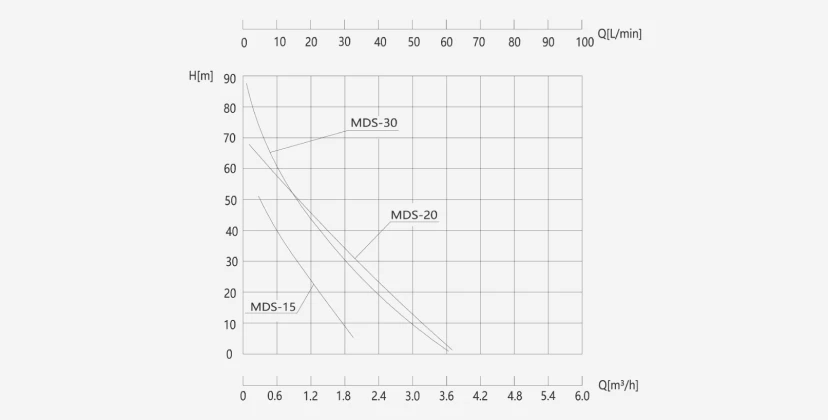
Vortex (regenerative) pump hydraulics develop high head at low flow through repeated energy addition in the peripheral channel, producing a steep, stable curve that matches high-resistance circuits. Where a comparably sized centrifugal pump delivers 30 to 40 m, a vortex stage reaches heads of 100 to 220 m at the flows typical of TCU loops. The flat operating region at low flow keeps circulation constant as filters load and valves modulate, which is the condition temperature controllers assume when they compute their response.
Static sealing and a clean stainless wetted path
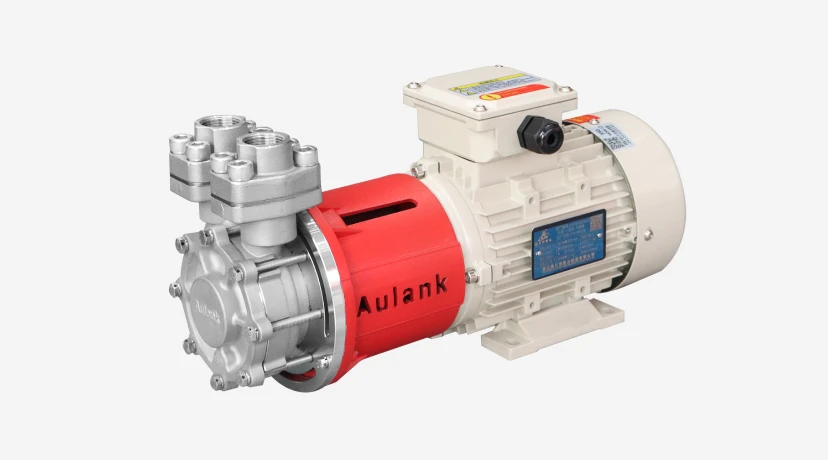
Magnetic drive construction replaces the dynamic shaft seal with a static isolation sleeve, converting the leak path into a fully contained pressure boundary. With stainless steel wetted parts and helium leak-tested assembly, the pump introduces no wear debris and no vapor escape into the cleanroom. Silicon carbide bearings and PEEK isolation sleeves handle the media temperatures without the thermal limits of elastomer-sealed alternatives. The MDS stainless steel vortex magnetic drive pump is built on exactly this architecture for semiconductor temperature control duty, in a compact envelope sized for OEM tool integration.
Commissioning and maintenance operations
Temperature control loops need filling, draining, and purging at installation and after every fluid change. Loops that trap air lose heat transfer capacity and develop hot spots that no controller can compensate. A pump capable of forward and reverse transfer, such as the MDW series, performs fill-and-drain operations from a single connection, cutting commissioning time and simplifying the skid layout by removing dedicated drain hardware.
Heat Transfer Fluid Selection and Pump Compatibility
The fluid defines the pump's material, viscosity, and temperature envelope. Three fluid families cover semiconductor temperature control:
| Fluid | Typical loop duty | Pump specification notes |
|---|---|---|
| Water-glycol mixtures | Etch and deposition cooling, −20°C to +90°C | Stainless wetted path; verify viscosity at minimum temperature for head derating |
| Thermal oil | High-temperature test and conditioning, up to +350°C | High-temperature magnetic drive with SiC bearings; see the MDH series for high-temperature configurations |
| Dielectric and fluorinated fluids | Direct-contact electronics cooling and specialized TCUs | Confirm density and compatibility; low lubricity demands hard bearing materials |
Application Map Across the Fab
Temperature control circulation pumps appear at more points in a fab than most equipment lists suggest:
- CMP conditioning: slurry temperature control within ±1°C and platen coolant circulation against pad friction heat.
- Etch systems: chamber wall, dome, and electrostatic chuck cooling loops through TCUs set in 0.1°C increments.
- Deposition equipment: CVD and PVD chamber temperature stabilization for film uniformity.
- Polishing and cleaning lines: wafer cleaning bath temperature control and DI water loop circulation.
- Packaging and test: thermal chucks, thermal stream systems, and handler conditioning across wide ramp ranges.
- Optical and inspection tools: lens and stage temperature stabilization where drift translates directly into measurement error.
The full hydraulic case for vortex designs in these duties is covered in the vortex pump technology page, and the selection logic for coolant service is detailed in the semiconductor coolant pump selection guide.
Specification Protocol: Data Your Pump Supplier Needs
A circulation pump for semiconductor temperature control can only be matched correctly from complete loop data. Prepare the following before requesting a proposal:
- Fluid type, concentration, and viscosity at the minimum and maximum operating temperatures.
- Required flow at the tool connection and the full circuit pressure drop at that flow, including filters, exchangers, and fittings.
- Temperature range of the media and the ramp rate the loop must support.
- Cleanroom and safety requirements: helium leak test documentation, SEMI S2 alignment, and material certifications.
- Duty profile: continuous operation hours, start-stop frequency, and any fill-drain-purge operations the pump must perform.
- Envelope and connection constraints inside the tool or TCU skid.
Aulank Pump manufactures stainless steel vortex magnetic drive pumps for semiconductor temperature control, covering −196°C to +400°C media, heads to 220 m at low flow, and helium leak-tested static containment across the MDH, MDW, and MDS series. Send us your loop schematic and fluid data, and our engineering team will return a matched pump with the sizing calculation. Contact us for a review of your tool, TCU, or retrofit project.