



Wet cleaning accounts for roughly a quarter of all process steps in a modern fab, and every one of those steps depends on fluid moving correctly through the tool. Recirculation loops keep cleaning chemistries filtered and at concentration. Hot DI water systems deliver rinse water at temperature without wasting energy. Temperature control circuits hold baths and spray manifolds at the setpoint the recipe demands. Inside each of these circuits, the pump decides flow stability, contamination integrity, and service life. A recirculation pump that loses head as the filter loads changes the chemistry delivery rate mid-recipe. A pump that sheds wear particles defeats the point of cleaning wafers in the first place. This guide covers pump engineering for semiconductor wet cleaning systems: the pump positions inside the tool, the material boundary between stainless steel and fluoropolymer construction, and the specification data that produces a correct match.
The Three Pump Positions Inside a Wet Cleaning Tool
Chemical recirculation through filtration
Batch wet benches recirculate cleaning chemistries continuously through sub-micron filters to hold particle counts at specification. The pump drives the full loop: bath, filter housing, heater or heat exchanger, and back. Filter media loads progressively during bath life, so circuit resistance climbs from day one to bath change-out. Research on wafer cleaning circulation systems confirms that low-flow conditions in these loops degrade filtration performance and allow particle accumulation, which makes stable flow under rising pressure drop the central hydraulic requirement of this position.
Hot DI water circulation
Rinse steps consume ultrapure water at temperatures up to 95°C, and fabs increasingly recover and recirculate hot DI water to cut heater energy. Published fab cases show modular hot DI water circulation retrofits saving hundreds of thousands of kilowatt-hours per year per tool set. These loops run hot, clean, and continuously, with 18.2 MΩ·cm water that is chemically aggressive toward elastomers and offers poor lubrication to bearing surfaces. Pump construction here must tolerate near-boiling low-lubricity water without seal leakage or material degradation.
Bath and spray temperature control
Cleaning chemistry performance is temperature-dependent. SPM strips organics at 120 to 150°C. SC1 particle removal efficiency and etch rates shift measurably with a few degrees of bath drift. Single-wafer spray tools condition chemistry and rinse water before dispense. Each control point is a circulation loop with a heater or exchanger, and the pump in that loop must hold constant flow while the media temperature swings across the full recipe range.
Ozonated water and chemistry conditioning
Ozonated DI water has become a standard cleaning agent for organic removal and oxide growth, generated at point of use and delivered at controlled concentration. Delivery systems recirculate DI water through the ozone contactor to hold concentration constant against varying demand, with closed-loop control keeping the dispense stable across multi-chamber tools. The recirculation pump in these skids runs continuously on ultrapure water with dissolved ozone, an oxidizing environment that degrades elastomers and ordinary seal faces within months. Static-sealed stainless construction with ozone-compatible bearing materials keeps the loop integrity intact over the service intervals fabs actually run.
The Material Boundary: Stainless Steel and Fluoropolymer
Wet cleaning chemistry is too aggressive for a single pump material family, and honest specification starts with the boundary between them:
| Circuit | Media | Pump construction |
|---|---|---|
| Direct HF and strong acid contact | Dilute HF, SPM concentrate, SC2 | Fluoropolymer (PTFE/PFA) wetted construction required |
| Hot DI water and rinse loops | Ultrapure water to 95°C | Stainless steel magnetic drive, static sealing |
| Temperature control circuits | Water-glycol, thermal fluid, tempered water | Stainless steel magnetic drive, wide temperature rating |
| Ultrasonic and precision cleaning skids | Detergent solutions, rinse water, mild chemistries | Stainless steel magnetic drive, compact OEM envelope |
Fluoropolymer pumps own the direct acid contact positions. Stainless steel magnetic drive pumps serve everything around them: the hot water plant, the temperature control loops, and the auxiliary cleaning skids where corrosion exposure is moderate and cleanliness requirements remain absolute. Specifying stainless pumps into HF contact is a classic failure; specifying fluoropolymer pumps into hot water service wastes budget and gives up the pressure capability the loop needs. The chemical pump range covers the corrosion-resistant constructions for the moderate-chemistry positions.
Engineering the Recirculation and Temperature Loops
Stable head as filters load
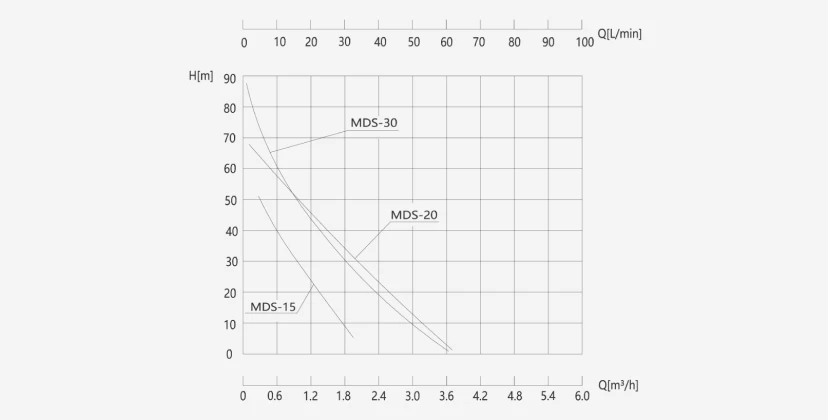
A recirculation loop sized on a clean-filter pressure drop will underflow within days if the pump curve falls steeply with rising resistance. Vortex hydraulics address this directly: the MDS series develops 20 to 100 m of head at 0.5 to 8 m³/h on a stable curve, holding circulation flow nearly constant as filter differential pressure climbs. That stability keeps filtration effective through full bath life and extends the interval between filter change-outs.
Zero contamination contribution
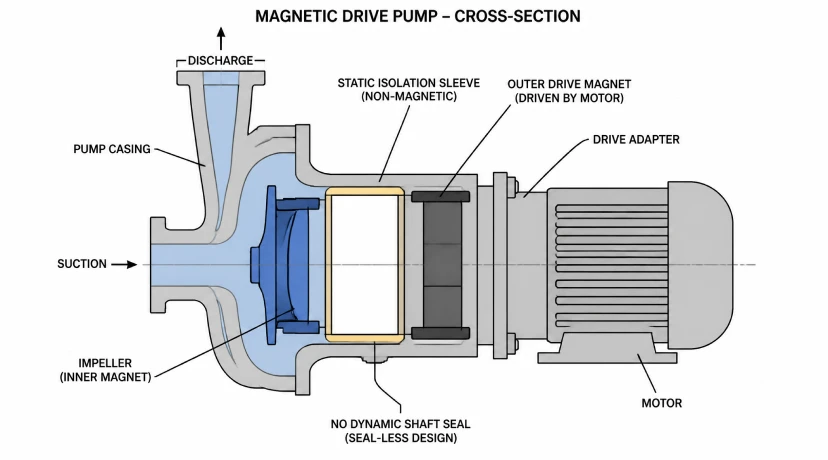
Every wear component inside the pump is a particle source feeding the loop. Magnetic drive construction removes the dynamic shaft seal and its wear debris entirely, replacing it with a static isolation sleeve rated and helium leak-tested as a full pressure boundary. Stainless steel wetted surfaces with controlled surface finish shed nothing into 18.2 MΩ·cm water. For the cleanest positions, this architecture is the baseline expectation, detailed further in the leak-proof pump solutions page.
High-temperature margin for hot water and thermal duty
Hot DI water at 95°C sits close enough to boiling that NPSH margin and seal temperature limits decide reliability. Pumps rated far beyond the duty point remove both constraints from the design discussion. The Aulank vortex magnetic drive platform covers media from −196°C to +400°C, which places 95°C ultrapure water and 200°C-plus thermal conditioning loops inside the same product family with margin to spare. High-temperature configurations are documented in the MDH series.
Repeatability Comes from Flow and Temperature Together
Cleaning recipes assume constant chemistry delivery. Spray processors meter ozonated water at fixed flow to hold dissolved ozone concentration stable; bath systems depend on turnover rate to keep temperature and concentration uniform wall to wall. Flow variation converts directly into process variation: under-delivery lengthens effective exposure time per wafer, over-delivery wastes chemistry and shifts thermal balance. Pairing a stable-curve pump with closed-loop flow measurement removes the pump as a source of recipe drift, and leaves the temperature controller working against a constant hydraulic baseline. The same circulation engineering applies to the temperature control loops covered in the semiconductor coolant pump selection guide.
Application Map Across Wet Process Equipment
- Batch wet benches: recirculation pumps for filtered chemical baths and rinse tank temperature control loops.
- Single-wafer cleaning tools: conditioning loops for chemistry and rinse water ahead of the dispense manifold.
- Hot DI water systems: circulation and recovery loops serving rinse stations at up to 95°C.
- Ultrasonic cleaning equipment: tank circulation and temperature control on precision cleaning skids, a standard duty for the MDS compact platform.
- Mask and reticle cleaning: low-particle circulation for optical surface preparation.
- Scrubber and utility skids: tempered water circulation supporting tool environmental systems.
Specification Protocol for Equipment Builders
Wet process pump positions are small in cost and large in consequence. A complete specification package removes the guesswork from matching:
- Media identity and concentration for each loop, with the full temperature range including ramp and idle states.
- Clean and end-of-life pressure drop: filter differential at change-out, exchanger, tubing, and fittings at design flow.
- Required flow and the acceptable flow variation band over the filter life cycle.
- Water quality where applicable: resistivity, temperature, and any dissolved gas content such as ozonated DI water.
- Contamination documentation: helium leak test requirements, wetted material certificates, and surface finish specifications.
- Envelope, port orientation, and control integration inside the tool frame.
Aulank Pump manufactures stainless steel vortex magnetic drive pumps for semiconductor wet process support duty: hot DI water circulation, temperature control loops, and precision cleaning skids, with zero-leakage static containment and media ratings from −196°C to +400°C. Send us your loop schematic and media list, and our engineering team will return a matched pump with sizing and material confirmation. Contact us for a review of your wet bench, cleaning skid, or utility retrofit project.