


Industrial Sodium Hypochlorite (NaOCl), commercially utilized in concentrations ranging from 12.5% to 15%, is a ubiquitous and powerful oxidizing agent driving municipal water treatment, paper pulp bleaching, and chemical synthesis. However, fluid transfer of high-concentration NaOCl is notoriously destructive to standard pumping equipment. The chemical presents a triad of severe engineering challenges: it is highly corrosive, thermodynamically unstable, and prone to rapid crystallization. Traditional centrifugal pumps equipped with dynamic mechanical seals structurally fail in NaOCl service. The fluid's continuous degradation releases Oxygen (O2) gas, guaranteeing chronic vapor lock in standard impellers. Simultaneously, microscopic fluid leakage at the mechanical seal boundary evaporates, leaving behind abrasive Sodium Chloride (NaCl) crystals that rapidly obliterate the sealing faces. Furthermore, the aggressive hypochlorite ion induces severe pitting and crevice corrosion in standard stainless steels. This engineering guide details the structural mandate for sealless fluid containment in Sodium Hypochlorite processing, examining how specific magnetic drive architectures, including the MDW and MDH series, neutralize oxygen outgassing, eradicate salt crystallization, and ensure decades of zero-leakage operation through strict metallurgical selection.
Thermodynamic Instability and Oxygen Outgassing
The primary hydraulic obstacle in pumping Sodium Hypochlorite is the fluid's inherent thermodynamic instability. NaOCl solutions naturally degrade over time into Sodium Chloride (salt) and Sodium Chlorate, a reaction that continuously evolves Oxygen (O2) gas. This decomposition rate accelerates exponentially when exposed to UV light, elevated temperatures, or metallic impurities (such as iron or copper) within the piping system.
In a fluid transfer loop, this continuous off-gassing creates a persistent two-phase (liquid and gas) flow environment. As the fluid enters the low-pressure suction zone of a pump, localized pressure drops trigger accelerated gas evolution. Standard centrifugal pumps are engineered exclusively for incompressible liquids. Because gases are significantly lighter than liquids, centrifugal force drives the heavier liquid to the outer perimeter of the volute, trapping the evolved oxygen bubbles at the center of the impeller (the eye). When this entrained gas volume exceeds approximately 3% to 5%, the vapor pocket displaces the liquid entirely, causing the pump to lose prime and spin in a dry pocket of gas. This condition, known as vapor lock or gas binding, halts chemical dosing completely and causes internal bearings to overheat rapidly due to fluid starvation.
Vortex Hydraulics for Two-Phase Flow Processing
To resolve the persistent threat of oxygen vapor lock in NaOCl transfer, process engineers specify the vortex pump architecture. A vortex (regenerative peripheral) pump operates on a fluid dynamic principle fundamentally distinct from standard centrifugal units.
The vortex impeller features dozens of radial vanes rotating within a perfectly symmetrical annular channel. Instead of allowing the evolved oxygen bubbles to coalesce and accumulate at a central suction eye, the impeller transfers kinetic energy continuously in an intense, high-velocity spiraling motion. This violent internal turbulence aggressively chops and compresses the entrained gas, keeping it fully suspended and homogenized within the liquid phase. The pump forcibly sweeps this two-phase mixture out through the discharge port. This specialized hydraulic mechanism enables the vortex magnetic drive pump to continuously process up to 20% entrained gas by volume without losing prime, guaranteeing uninterrupted NaOCl dosing even during severe outgassing events.
Seal Face Crystallization and Mechanical Destruction
While outgassing disrupts centrifugal hydraulics, the chemical breakdown of NaOCl actively destroys dynamic mechanical seals. Mechanical seals maintain fluid separation by pressing a rotating face against a stationary face, utilizing a microscopic film of the pumped fluid to provide hydrodynamic lubrication.
When pumping Sodium Hypochlorite, this fluid film invariably migrates to the atmospheric edge of the seal. Upon contact with ambient air, the water in the solution evaporates. This leaves behind solid, abrasive Sodium Chloride (NaCl) crystals. These salt crystals rapidly accumulate and wedge between the precision-lapped carbon and silicon carbide seal faces. As the shaft rotates, the crystals act as an aggressive lapping paste, physically grinding, scoring, and destroying the seal geometry. This abrasive wear leads to immediate seal failure, releasing highly corrosive bleach onto the motor shaft, bearing housing, and concrete plant floor, causing massive secondary infrastructural damage.
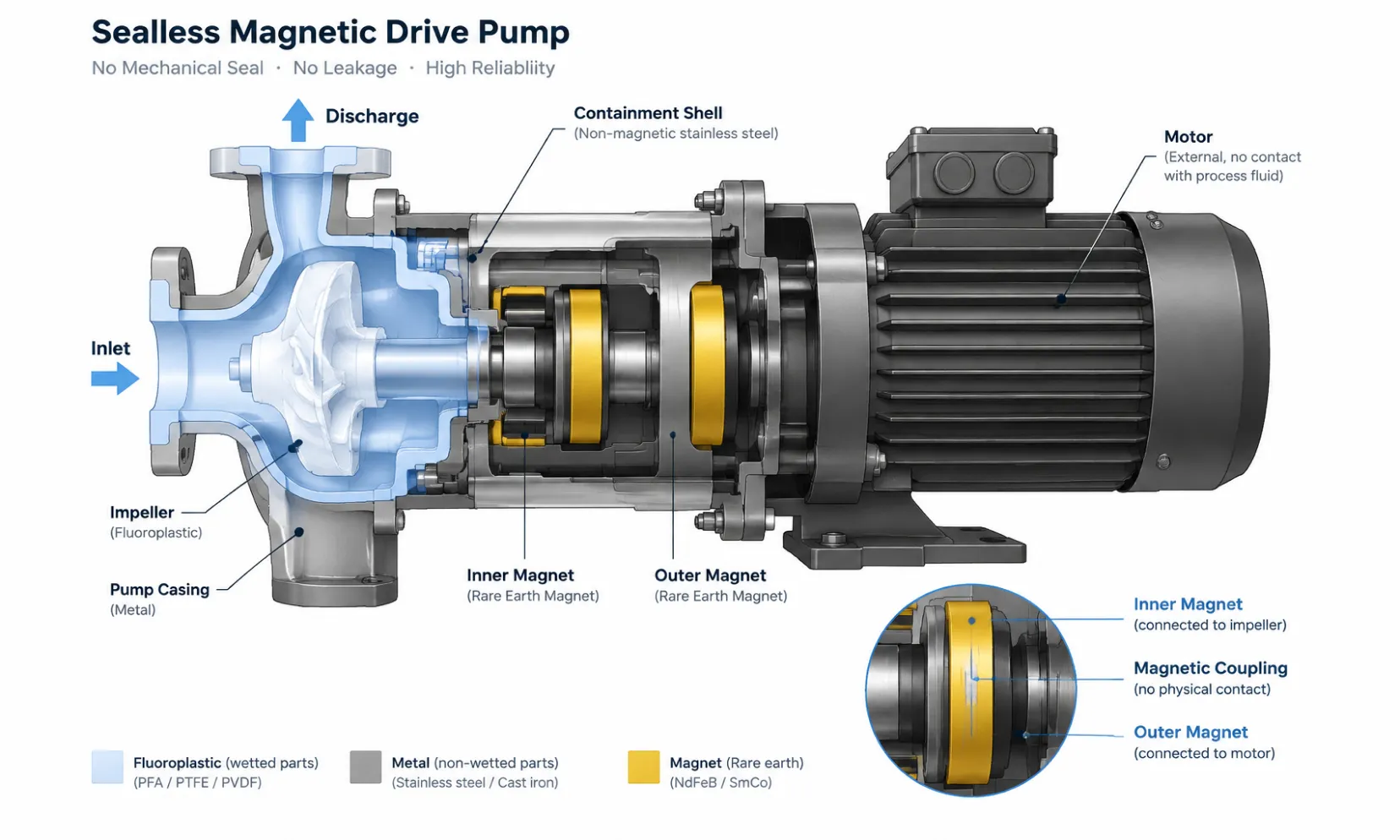
Establishing the Hermetic Magnetic Drive Boundary
The absolute structural solution to seal face crystallization and corrosive leakage is the complete elimination of the dynamic shaft penetration. Sealless magnetic drive architectures replace the physical drive shaft with a synchronized magnetic coupling separated by a stationary containment shell (isolation sleeve).
By removing the rotating seal entirely, the pump establishes a permanent, static pressure boundary. There is absolutely no pathway for microscopic fluid weeping to the atmosphere, and therefore zero possibility for salt crystallization to occur. The NaOCl remains hermetically isolated within the pump volute. This structural evolution completely eradicates the primary failure mode of hypochlorite pumps, ensuring absolute zero-leakage continuous operation and protecting facility infrastructure from corrosive degradation.
Metallurgical Strictures: The Failure of Stainless Steel
Sodium Hypochlorite is a highly aggressive oxidizing agent that generates elevated levels of free chloride ions. Standard austenitic stainless steels, including 304, 316L, and even duplex grades, are structurally incompatible with industrial NaOCl. The hypochlorite ion rapidly breaks down the passive chromium oxide layer of stainless steel, inducing severe pitting, crevice corrosion, and stress corrosion cracking (SCC) within days of operation. Even high-nickel superalloys like Hastelloy C-276 experience unacceptable corrosion rates in 15% NaOCl.
To guarantee the structural integrity of the high-pressure boundary, engineers must specify Grade 2 Titanium or heavy-walled engineered fluoropolymers (such as ETFE or PFA linings) for all wetted components and containment shells. Titanium reacts with the oxygen in the bleach to form a highly stable, tightly adhering Titanium Dioxide (TiO2) passive layer that is completely immune to chloride attack. For non-metallic applications, fluoropolymer-lined magnetic drive pumps provide total chemical inertness, ensuring the hermetic boundary remains impenetrable over decades of severe dosing duty.
Tribology in Oxidizing Environments: SSiC Bearings
In a sealless magnetic drive pump, the inner rotor assembly operates fully submerged and must be supported by internal journal bearings lubricated solely by the process fluid. Pumping a strong oxidizer laden with potential suspended salt particulates dictates strict tribological selection.
Standard bearing materials, such as carbon-graphite, will rapidly oxidize, pit, and erode when exposed to 15% NaOCl. Process engineers explicitly mandate Sintered Silicon Carbide (SSiC) for all internal wetted bearings and thrust washers. SSiC is a single-phase ceramic offering extreme mechanical hardness and absolute chemical inertness against powerful oxidizers. Its exceptional hardness makes it completely impervious to abrasive scoring, guaranteeing that if trace salt crystals or pipeline debris enter the pump, the bearings will not suffer mechanical wear or seizure.
Conclusion
The aggressive outgassing, corrosive chloride attack, and rapid salt crystallization associated with Sodium Hypochlorite transfer dictate that standard mechanically sealed pumps are fundamentally obsolete for this service. Operating with dynamic seals guarantees abrasive failure and chronic vapor lock. By transitioning to sealless magnetic drive architectures constructed from Grade 2 Titanium or PFA, and equipped with SSiC tribology and regenerative vortex hydraulics, water treatment and chemical operators establish an indestructible fluid boundary. This integration completely neutralizes oxygen outgassing, eliminates seal crystallization, and guarantees zero-leakage compliance for one of industry's most challenging fluids.
Engineered Fluid Solutions with Aulank Pump
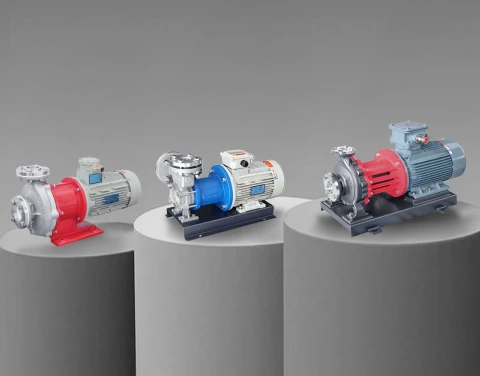
Aulank Pump designs specialized sealless fluid transfer equipment explicitly engineered for extreme hazardous material processing and aggressive municipal water treatment. Our high-performance magnetic drive pumps provide the absolute hermetic containment required to safely process highly corrosive, outgassing chemicals like Sodium Hypochlorite. By combining advanced Titanium and fluoropolymer metallurgy with regenerative vortex hydraulics, as seen in our MDP Permanent-Magnet Canned Vortex Magnetic Drive Pump, Aulank delivers exceptional gas-handling capabilities and zero-leakage reliability under severe systemic stress. Consult our engineering team for precise two-phase flow analysis, metallurgical validation, and system integration support for your advanced chemical dosing facility.
