


Titanium Tetrachloride (TiCl4) is the central chemical precursor in the production of aerospace-grade titanium sponge (the Kroll process), ultra-pure Titanium Dioxide (TiO2) pigment (the chloride process), and Ziegler-Natta catalysts for polyolefin manufacturing. Despite its ubiquitous industrial application, pumping liquid TiCl4 is a severe mechanical and metallurgical challenge. It is a highly toxic, fuming, heavy liquid with a specific gravity of 1.73 that reacts violently with microscopic amounts of water. Traditional centrifugal pumps utilizing dynamic mechanical seals consistently fail in TiCl4 service. The dynamic fluid boundary inevitably exposes the chemical to atmospheric humidity, triggering a rapid hydrolysis reaction that generates solid, abrasive TiO2 crystals and highly corrosive Hydrochloric Acid (HCl) gas. This chemical transformation instantly destroys mechanical seal faces and rapidly corrodes surrounding infrastructure. This engineering guide details the structural necessity of sealless fluid containment in titanium chloride processing, examining how specific magnetic drive architectures, including the MDW and MDH series, eradicate moisture-induced crystallization, neutralize heavy-liquid radial thrust, and deliver the zero-leakage reliability required for hazardous halogenated fluid transfer.
The Hydrolysis Reaction and Seal Destruction
The primary failure mode of TiCl4 transfer pumps is dictated by the chemical's extreme affinity for water. Mechanical seals require a microscopic liquid film of the pumped fluid to migrate between the rotating and stationary faces to provide hydrodynamic lubrication.
When pumping TiCl4, this fluid film invariably contacts ambient atmospheric humidity at the outer edge of the seal. This exposure instantly triggers a violent hydrolysis reaction (TiCl4 + 2H2O → TiO2 + 4HCl). The reaction yields two highly destructive byproducts. The first is Titanium Dioxide (TiO2), which precipitates as a dense, solid crystalline structure (rutile or anatase). These crystals are extraordinarily hard and abrasive. They immediately pack into the seal clearances, acting as an aggressive lapping paste that grinds, scores, and obliterates the precision-polished carbon and silicon carbide seal faces.
Hydrochloric Acid Corrosion at the Fluid Boundary
The second byproduct of TiCl4 hydrolysis is Hydrochloric Acid (HCl) gas, which rapidly dissolves into ambient moisture to form highly concentrated, fuming liquid HCl. While pure, anhydrous TiCl4 is relatively non-corrosive to standard carbon steel and 316L stainless steel, the localized generation of HCl at the mechanical seal boundary changes the metallurgical reality entirely.
The concentrated acid aggressively attacks the pump's external shaft sleeve, destroys secondary elastomeric O-rings (such as FKM or EPDM), and corrodes the seal gland. This combined mechanical abrasion (from the solid TiO2) and severe chemical corrosion (from the HCl) ensures that dynamically sealed pumps in TiCl4 service suffer chronic, catastrophic leakage, releasing toxic, fuming acid clouds into the manufacturing facility and triggering strict environmental code violations.
Establishing the Anhydrous Hermetic Boundary
The absolute structural solution to TiCl4 hydrolysis is the complete elimination of the dynamic shaft penetration. Sealless magnetic drive architectures replace the physical drive shaft with a synchronized magnetic coupling separated by a stationary containment shell (isolation sleeve).
By removing the rotating seal entirely, the pump establishes a permanent, static pressure boundary. There is absolutely no pathway for atmospheric moisture to enter the pump casing, and zero pathway for the fuming TiCl4 to escape. The chemical remains hermetically isolated in a strictly anhydrous environment. This structural evolution completely eradicates the formation of abrasive TiO2 crystals and corrosive HCl gas, ensuring tens of thousands of hours of continuous, zero-leakage operation without chemical degradation.
High Specific Gravity and Radial Thrust Neutralization
Liquid TiCl4 is exceptionally dense, possessing a specific gravity of approximately 1.73. In standard centrifugal pumps operating away from their Best Efficiency Point (BEP), uneven pressure distribution within the volute generates a hydrodynamic force known as radial thrust. This force is directly proportional to the fluid's specific gravity.
Pumping TiCl4 magnifies this radial thrust by 73% compared to pumping water. In conventional centrifugal designs, this continuous, severe side-load violently deflects the rotating shaft, crushing internal bearings and destabilizing the magnetic coupling. To structurally neutralize this force, engineers specify the vortex pump architecture for heavy halogenated fluids. A vortex (regenerative peripheral) impeller transfers kinetic energy continuously in a balanced, spiraling motion around a perfectly symmetrical annular channel. This 360-degree hydraulic symmetry completely eliminates asymmetric pressure distribution, neutralizing radial thrust regardless of the fluid's high density or the downstream backpressure.
Tribology in Heavy Halogens: SSiC Bearings
In a sealless magnetic drive pump, the inner rotor assembly is fully submerged and must be supported by internal journal bearings. Pumping a fluid with an SG of 1.73 places extreme radial and axial loads on these bearings, while the low kinematic viscosity of TiCl4 provides poor hydrodynamic lubricity.
Process engineers strictly mandate Sintered Silicon Carbide (SSiC) for all internal wetted bearings and thrust washers. SSiC provides extreme mechanical hardness and superior load-bearing capacity, ensuring the bearing tolerances do not crush under the massive weight of the rotating assembly. Furthermore, SSiC is completely impervious to abrasive scoring, guaranteeing that if trace TiO2 particulates enter from upstream pipeline reactions, the bearings will not suffer mechanical wear or seizure.
Metallurgical Strictures and Hastelloy Containment
While the bulk volute of a TiCl4 pump can often be constructed from 316L stainless steel or even heavy-duty carbon steel in strictly anhydrous systems, the isolation sleeve (containment shell) represents the most critical pressure boundary.
To account for transient system upsets—such as trace moisture inadvertently entering the closed-loop piping during nitrogen purging or maintenance—the containment shell is frequently upgraded to Nickel Alloy C-276 (Hastelloy). Hastelloy C-276 provides exceptional resistance to chloride-induced stress corrosion cracking (SCC) and localized pitting. This high-nickel superalloy ensures that even if transient HCl is generated internally, the hermetic magnetic boundary remains completely impenetrable, protecting the external electric motor and the surrounding facility from corrosive attack.
Conclusion
The extreme reactivity of Titanium Tetrachloride with atmospheric moisture dictates that standard mechanical seals are fundamentally unsuited for TiCl4 transfer. Operating with dynamically sealed pumps guarantees TiO2 crystallization, HCl acid corrosion, and lethal fuming leaks. By transitioning to sealless magnetic drive architectures equipped with heavy-walled Hastelloy containment shells, high-load SSiC tribology, and regenerative vortex hydraulics, chemical operators establish an indestructible, anhydrous fluid boundary. This integration neutralizes heavy-fluid radial thrust, eradicates moisture ingress, and ensures absolute environmental compliance in heavy halogen processing.
Engineered Fluid Solutions with Aulank Pump
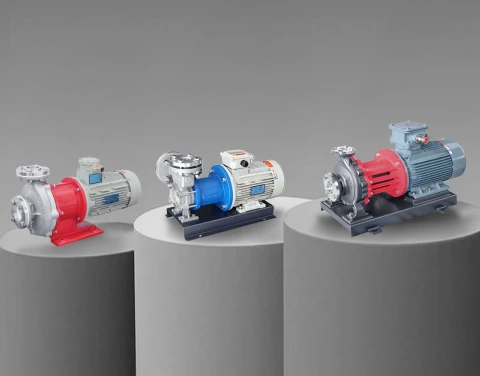
Aulank Pump designs specialized sealless fluid transfer equipment explicitly engineered for extreme hazardous material processing and heavy chemical synthesis. Our high-performance magnetic drive pumps provide the absolute hermetic containment required to safely process highly toxic, reactive, and dense fluids like Titanium Tetrachloride. By combining advanced superalloy metallurgy with regenerative vortex hydraulics, as seen in our MDP Permanent-Magnet Canned Vortex Magnetic Drive Pump, Aulank delivers exceptional high-head stability and zero-leakage reliability under severe systemic stress. Consult our engineering team for precise specific gravity torque calculations, metallurgical validation, and system integration support for your advanced titanium or pigment synthesis facility.
