


Ammonium hydroxide earns its reputation as an easy chemical: it is alkaline where the headline corrosives are acidic, it ships at moderate concentrations, and its specific gravity runs below water. Plants that specify its transfer equipment on that reputation discover the actual personality of the fluid within the first summer. Aqueous ammonia fumes at ambient temperature, so every open connection is an exposure event. Its vapor pressure rivals that of the light solvents, so a warm suction line cavitates a pump sized for water. And it attacks copper alloys with speed that surprises engineers trained on its mild reputation toward steel. This guide lays out the properties that drive pump selection for ammonium hydroxide service, the material and containment decisions that follow, and the sealless configurations that production teams standardize on for this duty.
Fluid profile: what aqueous ammonia does to a pump
| Property | 10% solution | 25% solution | 29-30% solution |
|---|---|---|---|
| Specific gravity (20 °C) | 0.96 | 0.91 | 0.90 |
| Vapor pressure (20 °C) | ~7 kPa | ~48-50 kPa | ~60 kPa |
| Approximate boiling point | ~98 °C | ~38 °C | ~33 °C |
| Primary engineering concern | Dosing accuracy, mild fumes | Vapor management, fuming | Severe vapor management, heavy fuming |
The concentration rows read in one direction: as ammonia content climbs, vapor pressure climbs with it and the boiling point falls toward ordinary summer temperatures. A 25 percent solution in a suction tank on a 35 °C afternoon sits within a few degrees of boiling, and the pressure drop through a long suction line or a strainer is enough to flash vapor at the impeller eye. The same vapor pressure means the fluid releases ammonia gas wherever it meets atmosphere, which is why the containment question dominates this service. The specific gravity works in the pump's favor: at 0.90 to 0.91 for commercial concentrations, the motor load runs about ten percent below the same duty on water. Applications driving this duty include flue gas denitrification reagent feed, water treatment pH adjustment, fertilizer blending and chemical processing, and the transfer and dosing requirements differ enough to cover separately.
Vapor pressure and NPSH: the summer problem
The sizing error that recurs in ammonia service is an NPSH calculation performed at 20 °C against a fluid that will spend the summer at 30 to 35 °C. At 35 °C a 25 percent solution carries vapor pressure approaching 90 kPa, and the atmospheric head available to push fluid into the pump has already spent most of itself on vapor pressure before the suction line loses a meter to friction. The remedies follow the physics: minimize suction line length and fittings, keep the tank level high or the vessel lightly pressurized and blanketed, shade outdoor tanks, and select hydraulics with low required NPSH at the duty point. The full methodology for running these numbers appears in our guide on how to size a pump for flow, head and NPSH, and the gas-handling side of the problem connects directly to pump solutions for gas-entrained and off-gassing fluids. A pump that primes cleanly in commissioning weather and cavitates in August has been sized to the datasheet instead of the site.
Material selection: the copper rule and everything after it
Material selection for aqueous ammonia starts with an exclusion. Copper and its alloys, including brass and bronze, suffer rapid corrosion and stress corrosion cracking in ammonia service, and they must be eliminated from the entire wetted path: impellers, wear rings, bearing hardware, fittings, instrumentation wetted parts and the coupling area. This prohibition reaches components that other services take for granted, since many general-duty pumps carry bronze wear parts as standard. With copper excluded, the selection becomes comfortable. Type 316L stainless steel is fully suitable for ammonium hydroxide across commercial concentrations and temperatures, and carbon steel serves in storage vessels. Elastomers need attention: EPDM and PTFE perform reliably, while NBR degrades and natural rubber has no place here. Zinc and galvanized surfaces corrode in ammonia vapor spaces as well, so vents and fittings above the liquid line follow the same discipline. Fluoropolymer-lined construction remains a valid option where the feedstock is mixed or its composition is uncertain.
Fuming, exposure limits and the case for sealless transfer
Ammonia announces itself. The odor threshold sits below most exposure limits, and occupational exposure limits for ammonia sit in the tens of parts per million, so a weeping seal on ammonium hydroxide duty is a detectable, reportable event that clears the area around the pump. The standard response in water treatment and reagent handling plants is to engineer the release path away: closed tanks vented to absorption or safe location, and pumps with no atmospheric leakage path at the shaft. A magnetic drive pump replaces the dynamic shaft seal with a static containment shell, removing the failure sequence at its origin. This is the operational logic behind leak-proof pump solutions for hazardous chemicals, and ammonium hydroxide belongs squarely in that category despite its alkaline mildness toward steel. The recorded outcome in reagent handling installations is that sealless pumps on ammonia service run for years without a containment intervention, while sealed equivalents measure packing and seal life in months.
Off-gassing inside the pump: priming and restart behavior
Ammonium hydroxide releases gas whenever its pressure falls or its temperature rises, and both happen inside an idle pump on a warm day. The practical consequence is restart behavior: a pump that sat through a hot weekend may hold a vapor pocket at the impeller eye and fail to prime on Monday. Design around it. Keep the pump below the tank liquid level so static head maintains the casing flooded, slope suction lines without high points where vapor collects, and provide a vent path back to the tank vapor space where the installation allows. Where duty cycles are intermittent, a brief recirculation before the main transfer purges accumulated vapor. These are inexpensive measures at design stage and persistent nuisance at operating stage, which is why they belong in the specification conversation, well before they can reach the maintenance log.
Hydraulic selection: transfer duty versus dosing duty
Transfer duty and dosing duty want different machines. Bulk transfer from delivery to storage and from storage to process runs at flows of several to several hundred cubic meters per hour against moderate heads, and single-stage centrifugal hydraulics cover this envelope efficiently at the low specific gravities involved. Dosing duty for pH control and reagent injection runs at fractions of a cubic meter per hour with tight accuracy requirements, and that territory belongs to metering designs; the selection methodology for that service class is covered in our water treatment chemical dosing pump selection guide. For transfer duty, one hydraulic note carries weight: because the fluid is lighter than water, a pump curve developed on water overstates the discharge pressure the installation will see, and the duty point should be confirmed in pressure terms at the actual specific gravity. Motor sizing otherwise stays uneventful, with the ten percent density credit as a modest energy saving.
Recommended configurations for ammonium hydroxide service
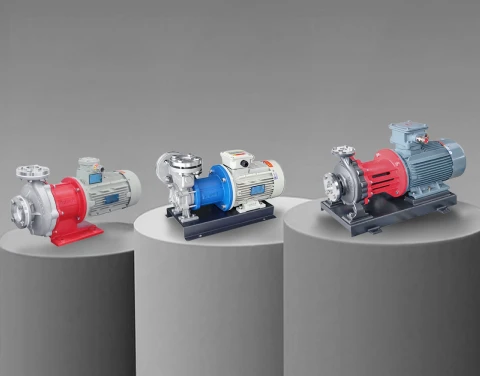
For transfer and circulation of aqueous ammonia, the AMC(L) chemical process magnetic drive pump in 316L construction is the standard configuration: a wetted path fully compatible with commercial ammonium hydroxide, pressureless sintered silicon carbide bearings tolerant of the fluid's modest lubricity, HG/T2730 standard dimensions, and a sealless envelope covering flows to 200 m3/h and heads to 80 m with explosion-rated drive options where classification requires. Where the feedstock is a mixed alkaline waste, carries contamination, or arrives with uncertain composition, the AMC-F fluoropolymer-lined magnetic drive pump provides a chemically immune wetted path over 3.6 to 100 m3/h. Both lines share the containment architecture that this fuming fluid rewards.
Send your ammonium hydroxide duty for engineering review
Pump selection for aqueous ammonia converges on five inputs: the concentration range actually delivered to site, the warmest credible fluid temperature across the year, the suction arrangement with line lengths and elevations, the duty points for each transfer or circulation operation, and whether any dosing service shares the specification. With those, NPSH margin, hydraulic selection, materials and drive rating can be confirmed in one engineering pass. Send your concentration, temperatures and duty points through our contact page, and the engineering team will return a configured selection with curves, materials confirmation and installation notes.
