


Few chemicals punish an incorrect pump selection as quickly as sulfuric acid. It is produced in greater tonnage than any other industrial chemical, it is loaded, unloaded, circulated and dosed in plants from fertilizer complexes to battery recycling lines, and it behaves like three different fluids depending on concentration: a moderately aggressive electrolyte below 10 percent, a vicious metal-eater in the mid-range, and an almost benign, passivating liquid above 93 percent at ambient temperature. Add a specific gravity of 1.84, a tendency to freeze in winter lines at high concentration, and a violent heat release on contact with water, and the pump specification becomes an engineering exercise instead of a catalogue pick. This guide walks through the decisions that matter when selecting a sulfuric acid transfer pump: materials by concentration and temperature, motor sizing for density and viscosity, suction design, freeze and dilution management, and the containment options that keep acid off the plant floor.
Why Concentration, Not the Chemical Name, Drives the Specification
Sulfuric acid corrosion is famously non-linear. Carbon steel and cast iron handle 93 to 98 percent acid at ambient temperature because a protective sulfate film forms on the metal surface, which is why concentrated acid ships in steel tank cars. That same steel dissolves rapidly once the concentration drops below roughly 90 percent, because the film can no longer regenerate. Stainless steels show the opposite weakness: 316L survives concentrated acid at low velocity and resists very dilute acid at low temperature, but the 10 to 90 percent mid-range attacks it aggressively, especially as temperature rises. The practical consequence is that a pump specified for "sulfuric acid" without a stated concentration, temperature and duty point is not specified at all. Every material decision in this guide is therefore stated against a concentration band and a temperature limit.
Material Selection Across the Concentration Range
The table below summarises the common wetted-material choices for stationary transfer service at near-ambient temperature. It is a starting point for discussion with the pump manufacturer, not a substitute for corrosion data on your exact stream.
| Concentration band | Typical service | Suitable wetted materials | Materials to avoid |
|---|---|---|---|
| Below 10% | Scrubber recycle, spent acid return | PTFE/PFA lining, PVDF, 316L (cool, low velocity) | Carbon steel, cast iron |
| 10–90% | Process dosing, dilution loops | PTFE/PFA lining, high-silicon iron, Alloy 20 | Carbon steel, 316L, cast iron |
| 93–98% | Product transfer, tanker loading | PTFE/PFA lining, carbon steel (velocity-limited), Alloy 20 | 316L at elevated temperature, copper alloys |
| Oleum / fuming | Specialty chemical feed | Carbon steel with strict velocity and dryness control | Most elastomers, PTFE-lined pumps with permeation risk |
Two observations fall out of the table. First, fluoropolymer-lined construction is the only single material family that covers the entire concentration range from 0 to 100 percent, which is why lined magnetic drive pumps have become the default choice for mixed or uncertain duties. Second, carbon steel's acceptability for concentrated acid comes with a velocity ceiling, generally around 1 m/s in piping and correspondingly low speeds at impeller peripheries, because flow strips the passive film. A steel pump running fast is worse than no steel pump at all.
Density, Viscosity and the Motor-Sizing Trap
At 98 percent concentration and 20 deg C, sulfuric acid has a specific gravity of about 1.84 and a viscosity near 25 cP, roughly twenty-five times that of water. Both properties push shaft power upward: power scales directly with specific gravity, and viscosity adds disc friction while trimming head and efficiency. A pump that draws 7.5 kW on water can demand well over 13 kW on concentrated acid at the same duty point. Specifying the motor from a water curve is one of the most common commissioning failures in acid plants, typically discovered when the breaker trips on the first cold morning. The correct approach is to size the motor from the end-of-curve power at the actual specific gravity, then add a service margin of at least 15 percent. A structured walkthrough of the hydraulic side of this calculation appears in our guide to sizing a pump for flow, head and NPSH.
Freezing, Water Ingress and Dilution Heat
Concentrated sulfuric acid freezes far sooner than operators expect: 98 percent acid crystallises at about 0 deg C and 100 percent acid at 10 deg C, while 93 percent stays liquid to roughly minus 29 deg C. Plants in cold climates commonly specify 93 percent product for winter handling precisely to avoid trace-heated lines. Where 98 percent must be pumped, electric tracing on suction and discharge lines, plus a drained-idle procedure for standby pumps, prevents the split casings and seized impellers that follow a freeze-thaw cycle. Water ingress is the opposite hazard. Concentrated acid is hygroscopic, and dilution is violently exothermic: adding water to acid can flash the mixture to boiling. Dilution systems should always add acid to water under agitation, with interlocked flow sequencing, and pump suction lines should be arranged so wash water cannot drain back into a concentrated acid pump. A pump that sits in a dilution loop also sees concentration swings across the corrosive mid-range with every cycle, one more reason lined construction is preferred there.
Suction Design and NPSH
Sulfuric acid's viscosity raises friction losses in suction piping, and its density raises the static head that a flooded suction must overcome during priming. Keep suction lines short, one size larger than the pump nozzle, and free of high points where vapour or off-gassing hydrogen can collect. Hydrogen deserves a specific mention: wherever acid contacts carbon steel below the passivation threshold, or contacts zinc, aluminium or other active metals in fittings, hydrogen gas evolves. Accumulated hydrogen in a pump casing creates both a gas-lock risk and an explosion hazard, so vent and drain arrangements on acid pumps should be piped to a safe location, never to an open funnel beside the pump.
Containment: Why Sealless Is the Default for Acid Transfer
A mechanical seal on sulfuric acid is a consumable with a failure mode that sprays acid. Single seals weep as faces wear; double seals need a barrier fluid that must itself be acid-compatible and monitored. Industry incident statistics consistently place seal failure among the leading causes of reportable acid releases, and every release carries cleanup, reporting and personnel-exposure consequences. Magnetic drive pumps remove the seal entirely: a containment shell separates the fluid from the drive, torque passes through the shell by magnetic coupling, and the only leak paths left are static gaskets, which can be specified in PTFE. The lifecycle economics of this choice, including the seal-replacement and downtime costs that disappear, are examined in our analysis of sealed versus sealless pump total cost of ownership. For plants handling several aggressive chemicals on shared skids, our overview of corrosion-resistant pump solutions for aggressive chemicals compares lining and alloy options across the wider chemical list, and the companion guide to leak-proof pump solutions for hazardous chemicals covers containment strategy more broadly.
Recommended Configurations for Sulfuric Acid Service
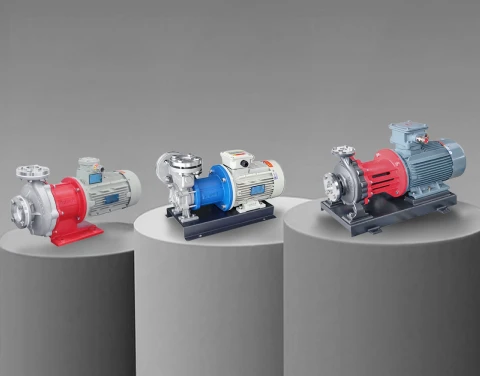
For dilute and mid-range acid, scrubber recycle and dilution-loop duty across the full 0 to 100 percent concentration range, the Aulank AMC-F PTFE-lined magnetic drive pump is the standard recommendation. Its one-piece F46/PFA lining isolates all wetted surfaces from the acid, sintered silicon carbide bearings tolerate the low lubricity of the fluid, and the sealless design removes the leak path that dominates acid pump maintenance. The range covers 3.6 to 100 m³/h at heads of 20 to 80 m, manufactured and tested under the HG/T2730 magnetic pump standard. For duties that genuinely sit in metallic-material territory, such as cool concentrated acid at controlled velocity or alkaline side streams on shared skids, the AMC-L metallic magnetic drive pump in 316L provides flows to 200 m³/h with the same sealless architecture. Both ranges support customised impeller trims, motor sizing to your actual specific gravity, and material certification for the wetted set.
If you are specifying a sulfuric acid transfer pump for a new line or replacing a sealed pump that has become a maintenance burden, contact the Aulank engineering team with your concentration, temperature, flow and head figures. We will return a material recommendation and a sized selection, typically within one working day.
