
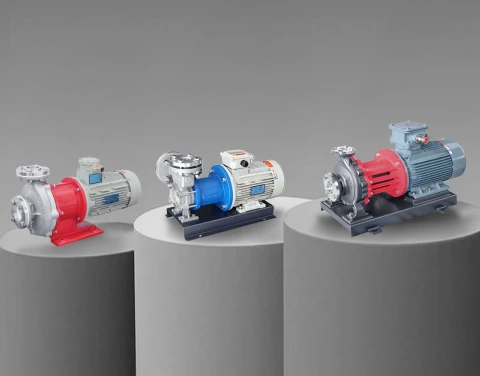





When you need a pump for a thermal oil system, the first decision is the pump type. The two main categories are centrifugal pumps and gear pumps. They work on different principles, handle viscosity differently, and fit different operating scenarios. Magnetic drive is a sealing configuration that applies to both — it is not a separate pump type, though it often gets treated as one.
This article puts all three options side by side: centrifugal hot oil pumps, gear pumps for thermal oil, and magnetic drive configurations. We compare how they work, what they are good at, and where each one fits. The goal is to give you enough clarity to pick the right type before getting into model-level selection.
For our complete product lineup including all three types, see the hot oil pump product page.
Centrifugal Hot Oil Pump — Working Principle and Characteristics
How It Works
A centrifugal hot oil pump uses a rotating impeller to move thermal oil. The motor spins the impeller at high speed inside the pump casing. Centrifugal force throws the oil outward from the impeller center to the casing wall, where the volute shape converts velocity into pressure. The oil exits through the discharge port, and new oil is drawn in at the suction side continuously.
Some centrifugal hot oil pumps use radial vanes on the back of the impeller. These balance axial thrust and reduce the pressure load on the mechanical seal — a useful design detail for pumps running at high temperatures for extended periods.
Performance Traits
Centrifugal pumps deliver variable flow. As system resistance increases, flow decreases. As resistance drops, flow goes up. This means the actual flow rate depends on the interaction between the pump curve and the system curve.
They work best with low-viscosity fluids. At operating temperature, most heat transfer oils drop to 0.5–5 cSt, which is ideal for centrifugal pump efficiency. Once viscosity rises above roughly 20 cSt — for example during a cold start — centrifugal pump performance drops noticeably: flow decreases, head drops, and power consumption goes up.
The flow is smooth with very low pulsation, which makes centrifugal pumps well-suited for continuous circulation loops where steady, uninterrupted flow matters.
Seal Options
Centrifugal hot oil pumps come in two main seal configurations:
Mechanical seal — The standard approach. Aulank's WRY-H coupled centrifugal hot oil pump uses a high-temperature mechanical seal with an air-cooled bearing housing. No external water cooling needed. Rated for thermal oil up to 350°C. This is the workhorse configuration for boiler rooms and factory heating systems.
Magnetic drive — Eliminates the mechanical seal entirely. Aulank's MDH stainless steel vortex magnetic drive pump and MDW series use permanent magnet coupling through an isolation sleeve. Zero leakage. Rated up to 400°C. Used in chemical processing, semiconductor TCU systems, and other applications where any oil leakage is unacceptable.
Typical Applications
- Thermal oil boiler circulation loops
- Mold temperature controllers
- Heat exchanger and reactor jacket heating systems
- Large-flow continuous heating circuits

Gear Pump for Thermal Oil — Working Principle and Characteristics
How It Works
A gear pump is a positive displacement pump. Two meshing gears rotate inside a close-fitting housing. As the gears turn, oil fills the spaces between the teeth on the suction side, gets carried around the housing wall, and is squeezed out at the discharge side when the teeth mesh again. Each revolution displaces a fixed volume of oil.
Because the displacement is fixed per revolution, the flow rate is directly proportional to speed and largely independent of downstream pressure. This is the fundamental difference from a centrifugal pump.
Performance Traits
Gear pumps deliver near-constant flow regardless of pressure changes in the system. This makes them reliable for processes where a steady, predictable flow rate matters — metering, dosing, or feeding operations.
They handle high-viscosity fluids well. In fact, gear pump efficiency actually improves as viscosity increases, because the tighter internal clearances seal better with thicker fluid. This is the opposite of centrifugal pumps, which lose efficiency as viscosity rises.
The trade-off: gear pumps produce some flow pulsation (though helical gear designs reduce this significantly). They are also not ideal for very low-viscosity fluids at high temperature, because internal leakage through the clearances increases when the oil becomes thin.
Gear pumps typically have good self-priming ability, which can be useful in systems where the pump is not flooded at startup.
Seal Options
Like centrifugal pumps, gear pumps are available with mechanical seals or magnetic drive:
Magnetic drive gear pump — Aulank's MDC-X medium and large magnetic gear pump uses magnetic coupling for zero-leakage operation. It handles viscosities from 0.3 to 100,000 cP, with flow rates from 0.01 to 100 m³ per batch. Used in fine chemicals, pharmaceutical intermediates, adhesives, and food processing where leak-free handling of viscous hot media is required.
Mechanical seal / magnetic hybrid — The MDC-K series offers both magnetic and mechanical seal options in the same platform. Operating temperature range from -60°C to 250°C, handling viscosities from 1 to 20,000 cP. This gives flexibility to match different system requirements on the same gear pump base.
Typical Applications
- High-viscosity thermal oil transfer (cold-state or specialty oils)
- Precise metering and dosing of heated fluids
- Bitumen, resin, and adhesive heating circuits
- Chemical and pharmaceutical processes needing constant flow
- New energy applications: electrolyte handling, battery material processing
Centrifugal vs Gear Hot Oil Pump — Side-by-Side Comparison
The table below puts the key differences in one place:
| Feature | Centrifugal Hot Oil Pump | Gear Pump for Thermal Oil |
|---|---|---|
| Working Principle | Kinetic — impeller rotation | Positive displacement — gear meshing |
| Flow Type | Variable (depends on system resistance) | Near-constant (proportional to speed) |
| Best Viscosity Range | < 20 cSt (at operating temp) | Wide range, improves with higher viscosity |
| Max. Temperature (Aulank) | 350°C (WRY-H) / 400°C (MDH mag-drive) | 250°C (MDC-K) / custom configs available |
| Self-Priming | No (needs flooded suction) | Yes |
| Flow Pulsation | Very low | Moderate (reduced with helical gears) |
| Seal Options | Mechanical seal or magnetic drive | Mechanical seal or magnetic drive |
| Flow Adjustment | Valve throttling or VFD | Speed control (VFD) |
| Maintenance | Seal and bearing inspection | Gear wear, seal, and clearance checks |
| Efficiency at Low Viscosity | High | Lower (internal slip increases) |
| Efficiency at High Viscosity | Drops significantly | High |
| Noise Level | Low | Moderate |
| Initial Cost | Lower for standard models | Higher, especially magnetic drive |
| Best For | Boiler loops, large circulation, low-viscosity oil | Metering, dosing, high-viscosity oil, constant flow |
In short: if you are circulating low-viscosity thermal oil in a standard heating loop, a centrifugal pump is the practical and cost-effective choice. If you need to move thick oil, deliver precise flow, or handle specialty media that does not tolerate flow variation, a gear pump is the right tool.
Magnetic Drive — A Seal Option, Not a Pump Type
This is a point worth clarifying, because we often see "magnetic drive hot oil pump" listed as though it is a separate category of pump. It is not. Magnetic drive is a sealing method — a way to transmit torque from the motor to the impeller (or gears) without a shaft seal penetrating the pump casing.
Both centrifugal pumps and gear pumps can be built with magnetic drive. In Aulank's lineup:
- Centrifugal / vortex + magnetic drive: MDH series, MDW series, LMZ series — stainless steel vortex and centrifugal pumps using permanent magnet coupling, up to 400°C, zero leakage.
- Gear + magnetic drive: MDC-X series, MDC-K series — magnetic gear pumps for high-viscosity and precision flow applications, zero leakage.
The core benefit of magnetic drive is simple: no mechanical seal means no seal to leak, no seal to wear out, and no seal to replace. In hot oil service, mechanical seals are the most common failure point — high temperature accelerates seal face wear, and even small leaks of 300°C thermal oil create safety and environmental problems. Magnetic drive removes that risk entirely.
The trade-offs to consider:
- Cost — Magnetic drive pumps cost more upfront than their mechanical seal equivalents.
- Oil cleanliness — The internal magnetic coupling and bearings (often ceramic or SiC) are sensitive to ferromagnetic particles in the oil. A good suction filter is important.
- Efficiency — There is a small efficiency loss from eddy currents in the metallic isolation sleeve. Newer materials (PEEK, Hastelloy) reduce this.
- Dry running — Most magnetic drive pumps should not run dry. The pumped fluid lubricates the internal bearings.
For many hot oil applications — especially in chemical plants, semiconductor fabs, pharmaceutical production, and any environment where leakage cleanup is expensive or hazardous — the magnetic drive premium pays for itself quickly in reduced maintenance and eliminated leakage risk.
How Viscosity Affects Your Pump Choice
Viscosity is often the deciding factor between centrifugal and gear pumps in thermal oil service. And it is a moving target — the same oil behaves very differently at 30°C versus 300°C.
Most heat transfer oils have very low viscosity at their operating temperature. At 250–300°C, viscosity is typically in the range of 0.5–2 cSt. At these conditions, a centrifugal pump runs at peak efficiency. The oil flows easily, friction losses are low, and the pump delivers its catalog performance.
But when the system is cold — during startup, shutdown, or if you need to transfer oil at ambient temperature — viscosity may jump to 30, 50, or over 100 cSt depending on the oil grade. At these viscosities, centrifugal pump performance degrades fast. Flow drops, head drops, and the motor draws more power. In some cases the pump cannot even establish flow at all.
Gear pumps behave the opposite way. Higher viscosity means better internal sealing between the gears and housing, which actually improves volumetric efficiency. A gear pump handling 100 cSt oil will often perform better than the same pump handling 2 cSt oil.
A practical rule of thumb for thermal oil pump selection:
- Operating viscosity below 20 cSt → centrifugal pump works well
- Operating viscosity above 50 cSt → gear pump is more reliable
- 20–50 cSt → either type may work; check performance data carefully
- System requires both hot circulation AND cold oil transfer → consider using a centrifugal pump for the main loop and a gear pump for the cold transfer task
Always use viscosity values at your actual operating temperature, not room temperature, when selecting a centrifugal pump. And always check cold-start viscosity if the system is not continuously running. For a deeper look at temperature and viscosity in pump selection, see our upcoming guide: How to Choose a High Temperature Oil Pump for Your System.
Quick Selection Logic
If you want a fast answer before getting into detailed engineering, here is the decision path we use with customers:
Low-viscosity oil at operating temperature (< 20 cSt) + flow above 5 m³/h + continuous circulation → Centrifugal hot oil pump. This covers most standard heating systems, boiler loops, and TCU applications.
High-viscosity oil (> 50 cSt) or cold-state transfer + need for constant, predictable flow + metering/dosing → Gear pump for thermal oil. This covers bitumen, resin, adhesive heating, and precision chemical feeding.
Any type + zero leakage requirement → Add magnetic drive. Available for both centrifugal and gear pumps in our product range.
System needs both a main circulation pump and a separate dosing/transfer pump → Use a centrifugal pump for the loop and a gear pump for the precision task. This is common in chemical plants and new energy processing lines.
Not sure which type fits? Share your operating conditions with us — oil type, temperature, viscosity, flow, head, and any leakage or safety constraints — and we will recommend the right configuration.
Browse all available models on our hot oil pump page.
Let Us Help You Choose
Not sure whether your thermal oil system needs a centrifugal pump, a gear pump, or a magnetic drive version? Send us your system parameters and we will confirm the right pump type, seal configuration, and specific model for your operating conditions.
