
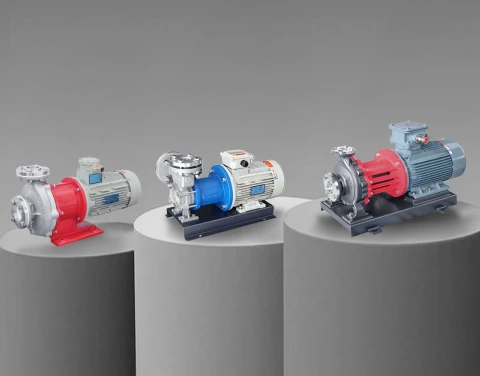





Choosing a hot oil pump sounds straightforward until you start working through the details. Temperature, viscosity, flow rate, head, seal type, materials, motor configuration, installation constraints — each one narrows your options, and getting any of them wrong means the pump either underperforms or fails early.
We have published separate guides on specific topics within hot oil pump selection: how circulation pumps work, centrifugal vs gear pump comparison, and long-distance transfer pump sizing. This article ties everything together into one step-by-step selection process. If you are making a purchasing decision and need a clear path from operating conditions to a confirmed pump specification, this is the guide to follow.
For our full product range, visit the hot oil pump product page.
Start with Your Operating Conditions — Not the Pump Catalog
The most common mistake in hot oil pump selection is starting with the pump catalog. You find a model that looks about right, check the price, and order it. Three months later, the seal leaks, the motor trips on cold startup, or the flow is short because the system resistance was higher than expected.
The correct approach: define your operating conditions first, then match a pump to those conditions. You need to know what fluid you are pumping, at what temperature, how much flow and pressure the system requires, what the piping looks like, and whether leakage is acceptable. Only after you have these answers does it make sense to look at specific pump models.
The following seven steps walk you through this process in the order we use with our own customers.
Step 1 — Define Temperature Range and Thermal Oil Type
Temperature is the first filter. It determines which pump structures, seal materials, and bearing designs are suitable. Start by answering two questions: What is the maximum continuous oil temperature in your system? And what thermal oil brand and grade are you using?
The oil grade matters because it gives you the viscosity-temperature curve — a piece of data you will need in Step 3. Get this from your oil supplier's technical datasheet.
As a general reference for pump structure selection by temperature:
| Operating Temperature | Recommended Pump Configuration | Aulank Reference |
|---|---|---|
| Up to 200°C | Standard centrifugal or gear pump with conventional seals and materials. Most pump types work at this range. | WH, WD, RGP, RGZ series |
| 200–350°C | High-temperature mechanical seal, air-cooled or heat-dissipating bearing housing, cast iron or stainless steel body. | WRY-H series |
| 350–400°C | Magnetic drive (sealless) recommended. Eliminates high-temperature seal failure risk. Stainless steel construction. | MDH / MDW series |
| Above 400°C | Beyond standard thermal oil pump range. Requires custom engineering evaluation. | Contact us for assessment |
Step 2 — Calculate Flow Rate and Head
Flow rate and head are the two numbers that determine your pump size. They come from different parts of your system.
Flow rate is driven by the heat load. If your system needs to deliver 200 kW and the supply-return temperature difference is 30°C, the formula Q = P / (ρ × Cp × ΔT) gives you the required circulation volume. We walk through this calculation in detail in our Thermal Oil Circulation Pump guide.
Head is driven by system resistance — the total friction and pressure drop the pump must overcome to push oil through the piping, fittings, valves, and equipment. For long pipe runs and boiler systems, this can be the dominant factor. We covered head calculation in detail in our Hot Oil Transfer Pump guide.
Once you have both numbers, plot them on the pump's performance curve. Your operating point — the intersection of the required flow and head — should fall near the pump's best efficiency point (BEP). If it sits far to the left or right of BEP, choose a different pump size.
Step 3 — Account for Viscosity at All Operating Conditions
Viscosity Changes Everything
This step catches more people off guard than any other. Thermal oil viscosity changes dramatically with temperature. A typical heat transfer oil might be 0.8 cSt at 300°C but 30 cSt at 40°C and over 100 cSt at 0°C. The pump catalog performance — flow, head, efficiency — is based on testing with water at around 20°C (viscosity ~1 cSt). When the actual viscosity is higher, the real performance is worse than what the catalog shows.
If you select a pump based only on catalog data without correcting for viscosity, you will get less flow, less head, and lower efficiency than expected. In cold-start situations, the difference can be large enough to cause motor overload or cavitation.
Viscosity Correction for Centrifugal Pumps
When a centrifugal pump handles fluid with viscosity above water, correction factors must be applied to the catalog values for flow rate, head, and efficiency. The Hydraulic Institute (HI) publishes standard correction charts for this purpose.
A simplified example: if your thermal oil has 30 cSt viscosity at the expected operating temperature, a centrifugal pump's catalog flow might drop by 5–10%, head by 3–8%, and efficiency by 15–25% compared to the water-based catalog values. At 100 cSt, the corrections become severe — efficiency may drop by 40% or more, and the motor power requirement increases substantially.
This is why getting the viscosity-temperature data from your oil supplier is not optional. It directly affects pump sizing.
When to Switch from Centrifugal to Gear Pump
As a practical guideline for thermal oil pump selection:
- Oil viscosity at operating temperature below 20 cSt → centrifugal pump works well
- Oil viscosity above 50 cSt → gear pump is more efficient and reliable
- Oil viscosity between 20 and 50 cSt → either type may work; run the numbers with viscosity correction
Remember to check viscosity at both operating temperature and cold-start temperature. Many systems run fine at steady state but struggle during startup because the cold oil is too thick for the centrifugal pump to handle.
For a detailed comparison of both pump types, see: Centrifugal vs Gear Hot Oil Pump: Which Type Is Right?
Step 4 — Choose the Seal Type
Mechanical Seal
The standard approach for most industrial hot oil pumps. A pair of precision-lapped seal faces contain the oil at the shaft penetration point. The seal materials must be rated for the oil temperature and chemical properties. High-temperature carbon/silicon carbide face combinations are common for service above 200°C.
Mechanical seals are cost-effective and well-proven, but they are also the component most likely to fail in a hot oil pump. High temperature accelerates face wear, and even a small leak of thermal oil at 300°C creates a safety issue. Seals require periodic inspection and eventual replacement — plan for this in your maintenance schedule.
Magnetic Drive (Sealless)
Magnetic drive eliminates the shaft seal completely. Torque passes from the motor through an isolation sleeve to the impeller using permanent magnets. No shaft penetrates the pump casing. No dynamic seal. Zero leakage.
The trade-offs: higher upfront cost (typically 30–60% more than a mechanical seal equivalent), sensitivity to ferromagnetic particles in the oil (a good suction filter is required), and a small efficiency loss from eddy currents in the containment shell. Magnetic drive pumps should also not run dry.
But for many applications, the benefits outweigh the costs — especially when you factor in eliminated seal replacement, zero leakage cleanup, and reduced unplanned downtime.
Quick Decision Guide
- Standard boiler room with trained maintenance staff → mechanical seal is practical and economical
- Chemical plant, semiconductor fab, pharmaceutical facility → magnetic drive for safety and compliance
- Flammable or toxic thermal fluid → magnetic drive strongly recommended
- Remote or hard-to-access installation → magnetic drive reduces maintenance visits
- Budget-constrained but willing to maintain seals regularly → mechanical seal works
Step 5 — Select Materials of Construction
Every wetted component — pump body, impeller, shaft, bearings, and seal or isolation sleeve — must be compatible with the thermal oil at the operating temperature. The wrong material leads to corrosion, thermal cracking, or accelerated wear.
Here is a reference for the materials used in Aulank hot oil pump series:
| Component | WRY-H (Centrifugal, up to 350°C) | MDH/MDW (Magnetic Drive, up to 400°C) |
|---|---|---|
| Pump Body | Cast iron | Stainless steel 304/316L |
| Impeller | Cast iron | Stainless steel |
| Shaft | Carbon steel | Ceramic / stainless steel |
| Bearings | Sliding bearing (oil-lubricated) | Ceramic / silicon carbide (SiC) |
| Seal / Isolation Sleeve | High-temp mechanical seal | Stainless steel / Hastelloy / PEEK |
For applications requiring higher chemical resistance or lower eddy current losses in the containment shell, PEEK and Hastelloy isolation sleeves are available. Ceramic bearings are standard in magnetic drive models for wear resistance at high temperatures.

Step 6 — Specify the Motor and Controls
The motor needs to match the pump's power requirement — and then some, to cover cold-start conditions.
Power: The motor kW rating should cover the pump's shaft power at the design operating point, plus a margin for viscosity effects during startup. If the oil is very viscous when cold, the startup torque can be significantly higher than the steady-state load. Undersizing the motor by ignoring this leads to overload trips on cold mornings.
Voltage and frequency: Confirm your local supply — 380V/50Hz, 220V/60Hz, 460V/60Hz, etc. We configure motors to match your site conditions.
Explosion-proof rating: If the pump operates in an area classified as hazardous due to flammable vapors (common in chemical and petrochemical plants), you need a motor with the appropriate Ex rating. Specify the zone classification and gas group, and we will match the motor accordingly.
Variable frequency drive (VFD): A VFD is worth considering in several scenarios. For cold starts, it allows the pump to ramp up slowly as the oil warms and viscosity drops. For systems with variable heat loads, it adjusts pump speed to match demand, saving energy. For magnetic drive pumps, a VFD provides additional protection against dry running by enabling flow monitoring at the drive level.
Step 7 — Confirm Installation, Interface, and Certification
These are the final details that must be confirmed before placing an order. They seem minor compared to flow and head calculations, but a mismatch here delays installation and commissioning.
- Mounting orientation: Horizontal is standard for most hot oil pumps. Vertical options are available for specific space constraints.
- Inlet and outlet direction: End-suction, top-discharge is the most common. Verify that it matches your piping layout.
- Connection type and size: Flanged connections are typical for industrial thermal oil systems. Confirm the flange standard — DIN, ANSI, or JIS — and the nominal diameter (DN or inch size). Threaded connections are used on smaller models.
- Pump dimensions: Check the overall length, width, and height against the available installation space. Include clearance for maintenance access — especially if you need to pull the pump rotor or replace a mechanical seal on site.
- Certifications: CE marking is required for European markets. ATEX certification for explosion-proof requirements. CCC for China domestic use. Confirm which certifications your project requires and verify that the pump model carries them.
Total Cost of Ownership — Beyond the Purchase Price
Purchase price is what most buyers compare first. But in hot oil pump service, the purchase price is a small part of what the pump actually costs over its lifetime.
The real cost includes:
- Energy consumption — A pump that runs 24/7 for years. Even a few percentage points of efficiency difference adds up to a meaningful electricity bill. An oversized pump running at partial load wastes energy continuously.
- Seal maintenance and replacement — For mechanical seal pumps, plan for seal inspection every 6–12 months and replacement every 1–3 years depending on conditions. Each replacement involves downtime, labor, and parts cost.
- Leakage cost — Hot oil leaks are not just a cleanup problem. They create fire risk, environmental liability, production interruption, and in some facilities, regulatory consequences.
- Unplanned downtime — A pump failure during production can cost more in lost output than the pump itself. Reliability directly affects your bottom line.
- Spare parts availability — If replacement parts take weeks to arrive, every failure becomes an extended shutdown. Work with a supplier who stocks or can deliver key spares quickly.
When you compare a mechanical seal pump at a lower purchase price versus a magnetic drive pump at a higher price, run the total cost over 3–5 years. The magnetic drive pump eliminates seal replacement cost, eliminates leakage incidents, and typically requires less routine maintenance. In many applications — chemical, semiconductor, pharmaceutical, and any 24/7 operation — the magnetic drive pump's total cost of ownership is equal to or lower than the mechanical seal alternative over a 3–5 year period.
Selection Checklist — Fill In and Send to Us
We use this checklist with every customer inquiry. Fill in what you can, and send it to us. Our engineering team will review your conditions, confirm the pump type and model, and provide a quotation with full technical documentation.
| Parameter | Your Data | Notes / Reference |
|---|---|---|
| Thermal oil brand and grade | Provide oil datasheet if available | |
| Operating temperature range | Min / normal / max (°C) | |
| Cold-start temperature | Lowest ambient or oil storage temp | |
| Required flow rate | m³/h or L/min | |
| Required head | Meters, or provide pipe layout for calculation | |
| System pressure | Bar or MPa | |
| Oil viscosity at operating temp | cSt — from oil datasheet | |
| Oil viscosity at cold-start temp | cSt — from oil datasheet | |
| Seal type preference | Mechanical seal / magnetic drive / no preference | |
| Pump body material preference | Cast iron / stainless steel / other | |
| Motor voltage and frequency | e.g. 380V/50Hz, 460V/60Hz | |
| Explosion-proof requirement | Yes / No — if yes, specify rating | |
| VFD needed? | Yes / No | |
| Connection type and size | Flange (DIN/ANSI/JIS) or threaded, DN size | |
| Installation space constraints | Max L × W × H if limited | |
| Certifications required | CE / ATEX / CCC / other | |
| Special requirements | OEM nameplate, custom color, etc. |
You do not need to fill in every field. Even partial information helps us narrow down the options and ask the right follow-up questions. The more you provide upfront, the faster we can deliver an accurate recommendation.
