


Pushing thermal oil through a short loop inside a compact machine is one thing. Moving it 50, 100, or 200 meters across a factory — through bends, valves, risers, and multiple branch lines — is a different challenge. The longer the pipeline, the more friction the pump has to overcome. Add elevation changes, long suction lines, and heat loss along the way, and you quickly end up needing more head than a standard catalog selection would suggest.
This article focuses on pump selection for thermal oil transfer and long-distance piping applications, including boiler system supply lines, tank-to-system transfers, and multi-building distribution. We cover how pipe length, diameter, fittings, elevation, and oil temperature loss affect your pump head requirement, and how to avoid the most common sizing problems in these scenarios.
For our complete hot oil pump product range, visit the hot oil pump product page.
Transfer Pump vs Circulation Pump — What Is the Difference?
Both transfer pumps and circulation pumps move thermal oil. The difference is the job they do in the system.
A circulation pump works inside a closed loop. It keeps oil moving around the same circuit — from the heater to the process equipment and back — at a relatively constant flow rate. The piping is usually short to moderate in length, and the system resistance is predictable once the loop is built. We covered circulation pump selection in detail in our guide: Thermal Oil Circulation Pump: How It Works and Selection Guide.
A transfer pump, on the other hand, moves oil from one location to another — often over a longer distance, with more pipe, more fittings, and sometimes significant elevation changes. Examples include pushing oil from a boiler room to a workshop 150 meters away, transferring oil between storage tanks, or unloading oil from a tanker truck into a system.
The key difference in pump selection: transfer applications are dominated by pipe friction loss and static head. Circulation applications are more about matching heat load and system loop resistance. Both need the right flow and head, but the numbers come from different places.
Common Applications for Hot Oil Transfer Pumps
Hot oil transfer pumps show up wherever thermal oil needs to travel a meaningful distance or overcome a height difference. The most common scenarios we see:
Boiler system supply lines. A thermal oil boiler in a central plant room supplies heated oil to process equipment in one or more remote workshops. Pipe runs of 50–200 meters are common. The pump must generate enough head to push oil through the full length of supply and return piping plus all the equipment in between.
Tank-to-system transfer. Fresh thermal oil stored in drums or bulk tanks needs to be pumped into the heating system during initial fill or oil replacement. The transfer distance may be short, but the oil is cold and viscous, which changes the pump requirements.
Loading and unloading. Transferring oil between a tanker truck and a storage tank. Suction conditions are often poor — long hose runs, limited elevation, and cold oil.
Multi-building or multi-floor distribution. One boiler room serves several buildings or multiple levels of equipment platforms. The piping network is branched, with different run lengths and elevation to each endpoint. The pump must handle the worst-case branch — the one with the highest total resistance.
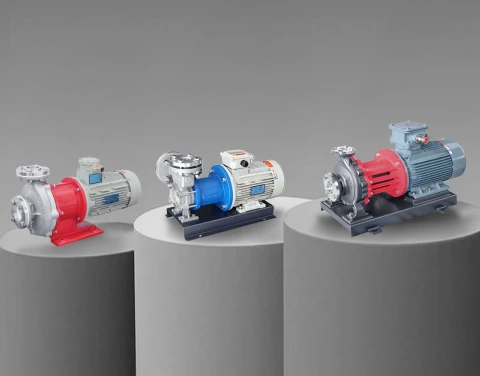
For boiler system applications, the WRY-H coupled centrifugal hot oil pump is our most commonly supplied model, with flow rates from 1.5 to 100 m³/h and heads from 22 to 125 m.

What Makes Long-Distance Hot Oil Piping Different
Pipe Friction Loss Dominates the Head Requirement
In a short circulation loop, pipe friction is only one part of the total system resistance. In long-distance transfer, it becomes the dominant factor. Friction loss is proportional to pipe length — double the pipe run, and friction loss roughly doubles (at the same flow rate and pipe size).
Friction loss also depends heavily on pipe diameter and flow velocity. A smaller pipe at the same flow rate means higher velocity and much higher friction. And unlike water, thermal oil viscosity changes with temperature, which directly affects the friction factor. We will come back to that point below.
Fittings, Valves, and Equipment Add Up Fast
Every elbow, tee, gate valve, check valve, strainer, and flow meter in the line adds resistance. In a 100-meter pipe run with 15–20 fittings and a few valves, the total fitting loss can easily equal 30–50% of the straight-pipe friction loss. These are sometimes called "minor losses," but in long systems with lots of fittings, they are anything but minor.
When calculating total head, convert each fitting to an equivalent pipe length and add it to the straight-pipe total. Your valve and fitting suppliers provide these equivalent length values.
Elevation Changes Require Static Head
If your process equipment sits higher than the pump — on a mezzanine, upper floor, or elevated platform — the pump must generate additional head just to lift the oil to that height. Every 10 meters of elevation difference adds roughly 1 bar of static head requirement (exact value depends on oil density at the transfer temperature).
In multi-floor facilities, this can be a significant portion of the total head. Do not overlook it.
Heat Loss Along the Pipeline Changes Oil Properties
This is a factor many engineers miss. When thermal oil travels through a long pipeline, it loses heat to the surroundings — even with insulation. The oil temperature drops gradually along the run. As temperature drops, viscosity increases. As viscosity increases, friction loss goes up.
The result: the friction loss at the far end of a 200-meter pipe is higher than the friction loss at the pump discharge, because the oil is cooler and thicker at the far end. If you calculate friction using only the oil temperature at the pump outlet, you underestimate the actual head requirement.
For accurate sizing on long runs, use the expected oil temperature at the pipe midpoint or — for a more conservative approach — at the pipe endpoint. This matters most in outdoor installations, uninsulated or poorly insulated piping, and cold-climate locations.
NPSH Challenges with Long Suction Lines
If the pump draws oil from a remote storage tank or a low-mounted vessel through a long suction line, the available Net Positive Suction Head (NPSH) can drop to dangerous levels. Friction in the suction pipe and any negative elevation between the oil surface and the pump inlet both reduce available NPSH.
When available NPSH falls below the pump's required NPSH, cavitation starts. You hear it as a crackling or rattling noise, and it damages the impeller over time.
Solutions for low-NPSH suction situations:
- Raise the tank or oil level above the pump to increase static suction head
- Increase suction pipe diameter to reduce friction loss
- Shorten the suction pipe run and minimize fittings
- Use a pump with a lower NPSH requirement
How to Size a Hot Oil Transfer Pump for Your Piping
Map Out the System Layout First
Before you can size a pump, you need a clear picture of the piping. Gather the following information:
- Total pipe length — supply line and return line (if applicable)
- Pipe diameter for each section
- Number and type of fittings: elbows (90° and 45°), tees, reducers
- Number and type of valves: gate, globe, check, butterfly
- Strainers, filters, flow meters in the line
- Heat exchanger or equipment pressure drop data (from equipment manufacturer)
- Elevation difference between pump and the highest delivery point
- Suction pipe length and conditions (if pumping from a tank)
If you do not have exact piping drawings, a rough sketch with approximate lengths and fitting counts is still far better than guessing.
Calculate Total Head Requirement
Total pump head = straight pipe friction + fitting/valve losses + equipment pressure drop + static head (elevation).
For the pipe friction calculation, you need the oil's viscosity at the expected temperature along the pipe — not at the pump outlet, and not at room temperature. Use the viscosity-temperature chart from your oil supplier.
A common reality check: for a standard 100-meter thermal oil pipe run with typical fittings, DN50 pipe, and 10 m³/h flow, the total head requirement easily reaches 40–60 meters or more. That is significantly higher than what many customers initially expect.
Pipe Diameter Makes a Bigger Difference Than You Think
In long-distance thermal oil transfer, the choice of pipe diameter has a dramatic impact on the pump head requirement and long-term energy cost. To illustrate this, consider the following comparison for transferring thermal oil at 10 m³/h through a 100-meter straight pipe (simplified, using typical heat transfer oil at operating temperature):
| Pipe Diameter | Flow Velocity (approx.) | Friction Head Loss (approx.) |
|---|---|---|
| DN50 | ~1.4 m/s | ~35–45 m |
| DN65 | ~0.8 m/s | ~12–18 m |
| DN80 | ~0.55 m/s | ~5–9 m |
Going from DN50 to DN65 cuts friction loss by roughly 60%. Going to DN80 cuts it by over 80%. The larger pipe costs more to purchase and install, but the pump can be smaller, uses less power, and runs closer to its best efficiency point. Over years of continuous operation, the energy savings often far outweigh the pipe cost difference.
If you are designing a new long-distance thermal oil line, always run the numbers for at least two pipe diameters before finalizing. It is one of the highest-ROI decisions in system design.
Match to Pump Performance
With the required flow rate and total head calculated, find a pump model whose performance curve passes through or near your required operating point. The operating point should fall within the pump's recommended operating range — ideally near the best efficiency point (BEP).
For available pump models and their performance data, see our hot oil pump product page.
Hot Oil Pump for Boiler Systems
Thermal oil boiler systems are the single most common application for hot oil transfer pumps. The pump sits at the heart of the system, pushing heated oil from the boiler through the supply header to all connected process loads, and pulling return oil back for reheating.
What makes boiler system pump selection specific:
- Continuous duty — The pump runs 24/7 in most boiler systems. It must hold up under sustained high temperatures without seal degradation or bearing failure.
- Long pipe runs — In many plants, the boiler room is centrally located but feeds equipment across the entire facility. Supply and return pipe runs of 100+ meters are normal.
- Multiple branch loads — The pump feeds several pieces of equipment in parallel. Total flow must account for all branches, and head must overcome the resistance of the longest/highest branch.
- System control integration — The pump often works with temperature controllers, VFDs, and safety interlocks tied to the boiler's control system.
The WRY-H series is our standard recommendation for boiler-system hot oil transfer. Its split-body design allows easy on-site maintenance without disconnecting the piping. The air-cooled bearing housing eliminates the need for cooling water connections. Available models cover 1.5–100 m³/h flow and 22–125 m head, which fits the majority of small to medium industrial boiler installations.
For larger boiler systems exceeding these ranges, we can configure larger-frame pumps or advise on series/parallel arrangements based on your system layout.
Furnace Oil and Heavy Oil — Different Media, Different Pump
We regularly get inquiries where "hot oil pump" actually means a pump for furnace oil, heavy fuel oil, or bunker oil. These are different fluids with different properties, and they need a different pump type.
Thermal oil (heat transfer oil) is a specialized heat transfer fluid. At working temperature — 250°C, 300°C — it is very thin, typically 0.5–2 cSt. A centrifugal pump handles it well.
Furnace oil and heavy fuel oil are combustion fuels. At ambient temperature, their viscosity can range from 100 to over 1,000 cSt. Even with trace heating on the pipeline, they remain much thicker than thermal oil. A centrifugal pump struggles with this viscosity — flow drops, efficiency collapses, and the motor overloads.
For furnace oil and heavy oil transfer, gear pumps are the standard solution. They handle high viscosity without losing performance, offer good self-priming for tank unloading, and deliver steady flow independent of system pressure. If this matches your application, see our article: Centrifugal vs Gear Hot Oil Pump: Which Type Is Right?
When to Consider Series or Parallel Pump Configuration
Sometimes a single pump cannot meet the head or flow requirement for a long-distance transfer. In that case, you have two options:
Series configuration (two pumps in series) — The discharge of pump 1 feeds the suction of pump 2. Total head is approximately the sum of both pumps' heads at the operating flow rate. This is useful when the piping is very long and the head requirement exceeds what any single pump can deliver. In thermal oil service, the connection between the two pumps must handle high temperatures, and both pumps should be matched carefully so they operate at compatible flow points.
Parallel configuration (two pumps in parallel) — Both pumps feed into the same header. Total flow increases, but head stays roughly the same as one pump. This helps when you need more flow than a single pump can provide. However, parallel operation in thermal oil systems adds control complexity — both pumps must share the load evenly, and if one trips, the system response must be managed.
In practice, before committing to a two-pump arrangement, first check whether increasing the pipe diameter can bring the head requirement down to a single-pump solution. As shown in the table above, going up one pipe size can cut friction loss dramatically. A single larger pump on a larger pipe is almost always simpler, more reliable, and cheaper to operate than two smaller pumps on a smaller pipe.
If you still need a multi-pump configuration after optimizing pipe size, we can help design the arrangement and recommend matched pump pairs.
Share Your Piping Layout — We Will Help You Size the Pump
If you have a piping drawing, a system sketch, or even a rough description of your pipe run — length, diameter, elevation, oil type, and temperature — send it to us. Our engineering team will calculate the head requirement and recommend the right transfer pump model and configuration for your system.
