


Ask what liquid runs inside a liquid-cooled data center and the honest answer is: it depends which loop you open. The cold plate loop behind a row of AI servers carries a fluorescent-tinted water-glycol blend with a corrosion inhibitor package. The immersion tank down the hall holds a dielectric fluid that costs ten to thirty times more per liter. A two-phase installation may still be running on chemistry its manufacturer has already announced it will stop making. The fluid is an engineering decision with consequences for thermal performance, pump energy, maintenance intervals, regulatory exposure, and total cost over a ten-to-fifteen-year infrastructure life. This guide maps the coolant landscape as it actually stands in 2026: what each fluid family is, why the industry settled where it did, the chemistry that separates a stable loop from a corroding one, and what the choice means for the pumps that move it.
Two Families, One Dividing Line: Conductivity
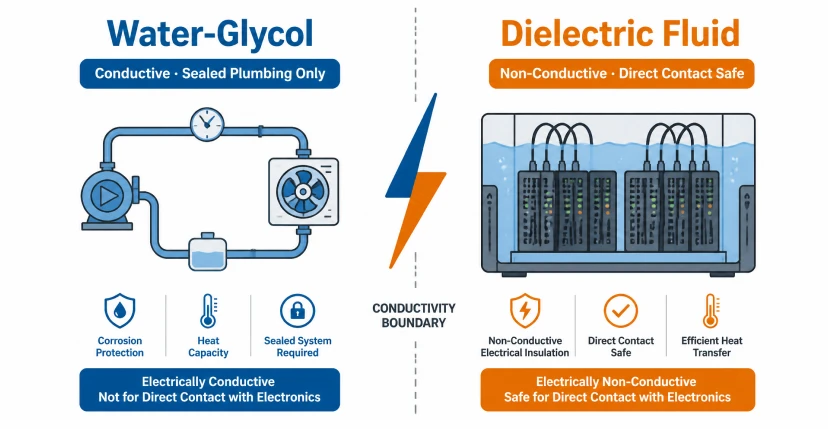
Every data center coolant belongs to one of two families. Water-based fluids, led by inhibited water-glycol blends, offer the best thermal performance per dollar and dominate direct-to-chip loops; they conduct electricity, so they live inside sealed plumbing and never touch live components by design. Dielectric fluids, including synthetic hydrocarbons, esters, and fluorocarbons, do not conduct electricity in their clean state, which is precisely what makes immersion possible: servers can be submerged directly. The dividing line runs through every downstream decision. Water-glycol wins on heat transfer, with thermal conductivity five to ten times that of dielectric oils, and on cost, at a tenth to a thirtieth of the price, which is why NVIDIA, AMD, and the major ODM ecosystem specify water-based chemistry for cold plate systems. Dielectric fluids win the one capability water can never have: direct contact.
Water-Glycol: What PG25 Actually Is
The workhorse of direct-to-chip cooling is PG25: 25 percent propylene glycol by volume in deionized water, carrying an inhibitor package, a pH buffer, and a fluorescent dye for leak detection. A typical specification shows freezing point near −10°C, boiling at 101.4°C, pH between 8.0 and 10.5, and viscosity of about 2.5 cP at 20°C against 0.89 cP for pure water. The glycol content deserves explanation, because it is widely misunderstood: the blend performs worse thermally than pure water, conducting less heat and demanding more pumping energy. Facilities accept that penalty for what the glycol package delivers: corrosion inhibitors that protect copper cold plates and mixed-metal manifolds, suppression of the biological growth that would clog micron-scale channels, a modest freeze and boil margin covering shipping, commissioning, and idle states, and multi-year chemistry stability. Concentration is a dial: PG25 covers typical deployments up to roughly 130 kW per rack, while PG55 extends freeze protection toward −40°C for outdoor plant exposure, at the cost of higher viscosity still.
Propylene glycol holds the server-side position over ethylene glycol despite EG's slightly better freeze protection, lower viscosity, and higher conductivity. The deciding factors are toxicity and handling: PG's lower acute toxicity reduces the leak-response burden in occupied technical spaces, and it treats aluminum components more gently. EG persists on the facility side, where loops stay in plant rooms and the existing infrastructure was built around it.
The Chemistry That Separates Stable Loops from Corroding Ones
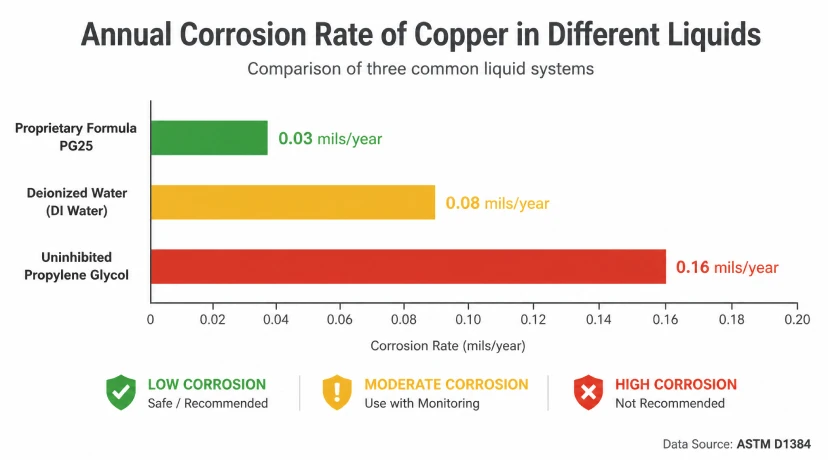
Comparative corrosion testing under ASTM D1384 makes the value of inhibition concrete: a formulated PG25 fluid corrodes copper at about 0.03 mils per year, against 0.08 for plain water and 0.16 for uninhibited propylene glycol. The inhibitor package does the work, typically azole compounds guarding copper, molybdate or silicate passivating aluminum, and organic acid buffers holding pH in the 7.0 to 8.5 band where protection stays effective. Three disciplines follow. First, the base water must be deionized; chloride and hardness in tap water attack the same metals the inhibitors protect. Second, inhibitor reserves deplete with time and temperature, so the fluid wants periodic analysis and reinhibition on a scheduled program. Third, glycol oxidizes over years of service, and oxidation products are acids; a loop whose chemistry is never tested drifts silently toward the corrosion rates of uninhibited fluid.
Dielectric Fluids: The Immersion Chemistry
Immersion fluids fall into three chemical families with distinct trade positions:
- Synthetic hydrocarbons: highly refined oils and synthetic base stocks. Lowest cost and simplest disposal, with higher viscosity that limits heat removal in dense configurations and real flammability considerations.
- Fluorocarbons: the historical performance benchmark, including 3M's Novec family with boiling points of 34 to 76°C and dielectric strength above 40 kV/mm. This family sits directly in the PFAS regulatory path.
- Silicone oils and esters: emerging alternatives with better biodegradability and lower toxicity, trading a modest thermal penalty and thinner long-term field data.
Operational reality adds two lessons the datasheets omit. Fluid clings: a single server pulled from a tank carries out several liters that must be captured, topped up, and accounted for across the maintenance life. And dielectric strength is a perishable property. One colocation operator watched breakdown voltage drift from 40 kV to 28 kV over eighteen months as moisture and particulates entered the tank, ending in an unplanned fluid replacement and clean-out measured in hundreds of thousands of dollars. Mature immersion programs include periodic dielectric testing as a standing discipline.
The PFAS Question Reshaping Two-Phase Cooling
Two-phase immersion was built on fluorocarbon chemistry, and the foundation moved: 3M announced in late 2022 that it would exit all PFAS-related manufacturing by the end of 2025, discontinuing the Novec line that anchored commercial two-phase deployment. The EU's universal PFAS restriction proposal under REACH and US EPA evaluation of rules targeting non-essential uses point the same direction, with potential restrictions arriving within three to five years against infrastructure depreciation cycles of ten to fifteen. The post-Novec landscape fragments three ways: secondary-market HFE fluids from suppliers such as Syensqo's Galden line, carrying the same regulatory exposure; HFO-based fluids with disputed PFAS classification and limited thermal data at GPU-scale loads; and hydrocarbon two-phase fluids whose flammability has so far blocked commercial deployment at scale. Operators running Novec-based systems need inventory, qualification, and transition plans already in motion, and new two-phase projects need a fluid strategy that survives the regulatory horizon.
What the Fluid Decides for the Pump
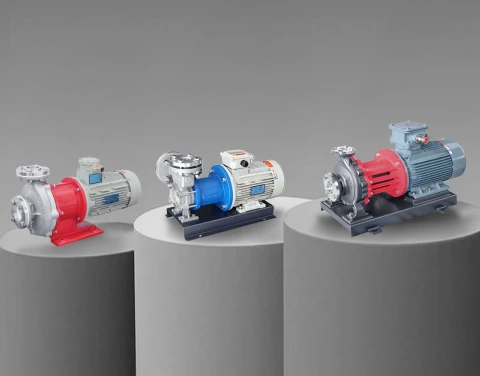
Every coolant property lands on the circulation pump. Viscosity sets shaft power: PG25 at cold supply temperature runs near three times water viscosity, and pump curves and motors must be derated for the coldest condition the loop will see, with glycol's poor lubricity favoring hard bearing materials such as silicon carbide. Chemistry sets wetted materials: inhibitor packages assume a compatible material set, and stainless steel wetted paths align with the monometallic or validated mixed-metal designs the OEM whitelists describe. Dielectric fluids raise a different pairing: low lubricity and specific elastomer compatibility requirements, with leak containment valued for fluid cost and housekeeping since the fluid itself is non-conductive. Across all of them, the constant is containment: a loop that cannot leak protects both the fluid investment and the equipment around it, which is why seal-less magnetic drive pumps such as the MDW series appear so consistently in this duty, with the full selection framework in the AI data center liquid cooling pump selection guide and loop architecture context in what a coolant distribution unit is.
Coolant Selection Checklist
- Architecture first: cold plate loops take inhibited water-glycol; immersion takes dielectric; the fluid follows the architecture, always.
- Concentration to the freeze margin actually needed, since every additional point of glycol costs thermal performance and pump energy.
- Inhibitor package and pH band matched to the loop's metallurgy, with DI water as the non-negotiable base.
- Chemistry maintenance plan: analysis interval, reinhibition policy, and for immersion, dielectric strength testing.
- Regulatory horizon for fluorinated fluids against the infrastructure depreciation schedule.
- Pump compatibility: cold-temperature viscosity, bearing materials, and wetted metallurgy confirmed against the chosen fluid.
Aulank Pump manufactures seal-less vortex magnetic drive pumps for water-glycol and dielectric coolant circulation, with stainless wetted paths, helium leak-tested containment, and media ratings from −196°C to +400°C. Send us your coolant specification and loop data, and our engineering team will return a matched pump with material confirmation. Contact us for engineering support.