



A thermal oil pump is an industrial pump built to circulate heat transfer oil through a closed-loop heating system. It keeps thermal oil moving between a heat source — such as a boiler or electric heater — and the process equipment that needs the heat. The pump runs continuously, often at media temperatures between 150°C and 400°C, and must maintain stable flow and pressure over extended periods.
If you have worked with standard water pumps, the difference is clear the moment you deal with thermal oil. The seals, bearings, body materials, and cooling method all need to handle sustained high temperatures without degradation. A regular water pump will fail quickly in this service — the seals are not rated for it, and the lubrication system is not designed for the viscosity behavior of thermal oil at elevated temperatures.
This guide covers what a thermal oil pump does, how it works, what types are available, and what specifications matter when you evaluate one. If you are looking for specific pump models and configurations, visit our hot oil pump product page.
What Is a Thermal Oil Pump?
A thermal oil pump — also called a hot oil pump, thermic oil pump, or heat transfer oil pump — is a pump designed specifically for moving thermal oil in industrial heating systems. Its job is straightforward: push thermal oil from the heat source through piping to wherever the heat is needed, then pull the cooled oil back for reheating. This continuous loop is what keeps process temperatures stable and controllable.
The reason many industries use thermal oil instead of water or steam is practical. Water boils at 100°C under atmospheric pressure. To reach 200°C or 300°C with water, you need a high-pressure steam system, which adds cost, complexity, and safety risk. Thermal oil stays liquid at those temperatures without pressurization. A typical thermal oil system runs at atmospheric or very low pressure even when the oil is 300°C or above. That means simpler piping, no steam traps, no condensate recovery, and more uniform temperature distribution across the system.
The pump is the heart of this loop. Without it, there is no circulation, no heat delivery, and no temperature control.
How Does a Thermal Oil Pump Work?
The working principle of a thermal oil pump follows the same physics as other industrial pumps — it converts motor energy into fluid movement. But the operating environment is different. The pump must handle oil at high temperatures, deal with viscosity that changes as the oil heats up and cools down, and run continuously for long periods without failure.
Here is the basic cycle: the heat source heats the thermal oil. The pump pushes the hot oil through the supply pipe to the process equipment — a mold, a reactor jacket, a heat exchanger, or a drying roller, for example. The oil releases its heat at the equipment, cools down, and flows back through the return pipe to the heat source. The pump keeps this loop going around the clock.
Two main drive types are used in thermal oil pumps:
Centrifugal Type
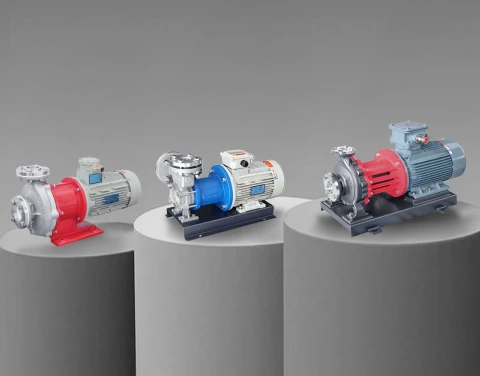
Most thermal oil pumps used in boiler systems and large heating loops are centrifugal. The motor spins an impeller inside the pump casing. The impeller throws the oil outward by centrifugal force, building pressure that pushes the oil into the discharge pipe. The suction side draws in return oil continuously. This gives you a steady, high-volume flow suitable for medium to large systems. Aulank's WRY-H coupled centrifugal hot oil pump is a typical example, handling thermal oil up to 350°C with an air-cooled bearing structure.
Magnetic Drive Type
In a magnetic drive thermal oil pump, the motor turns an outer magnet assembly. This magnetic field passes through an isolation sleeve and spins an inner magnet connected to the impeller — all without any shaft penetrating the pump casing. Because there is no shaft seal, there is zero leakage. This makes magnetic drive pumps the choice for applications where thermal oil leakage is not acceptable, such as semiconductor temperature control units, chemical reactors, or cleanroom-adjacent equipment. Aulank's MDH stainless steel vortex magnetic drive pump handles thermal fluids up to 400°C with this sealless design.
Main Types of Thermal Oil Pumps
Thermal oil pumps fall into three main categories based on their drive and sealing structure. Each serves a different range of operating conditions.
Coupled Centrifugal Hot Oil Pump
This is the most widely used type in industrial thermal oil systems. The pump and motor are connected through a coupling, and the pump uses a mechanical shaft seal to contain the oil. The structure is simple, maintenance is straightforward, and these pumps cover a wide range of flow rates and heads. Aulank's WRY-H series is a split-body centrifugal hot oil pump rated for thermal oil up to 350°C. Its bearing housing has integrated cooling fins for air-cooled operation — no external water cooling required. It is used in thermal oil boiler loops, heat treatment systems, mold temperature controllers, and industrial heating equipment.
Magnetic Drive Hot Oil Pump
Magnetic drive pumps eliminate the mechanical shaft seal entirely. The impeller is driven by magnetic coupling through an isolation sleeve, so there is no rotating seal to wear out or leak. This is the go-to solution when zero leakage is a hard requirement. Aulank's MDH and MDW stainless steel vortex magnetic pump series are built for this purpose, operating with thermal fluids up to 400°C. They are commonly used in semiconductor precision temperature control, chemical processing, and reactor circulation systems where even minor leakage is unacceptable.
Gear Pump for Thermal Oil
Gear pumps are positive displacement pumps that deliver a fixed volume of oil per revolution regardless of system pressure. This makes them well-suited for high-viscosity thermal oil applications or situations where precise, metering-level flow control matters. They are less common in standard boiler circulation loops but serve specific process needs. For a detailed side-by-side comparison of centrifugal and gear-type hot oil pumps, we will cover this in a separate article: Centrifugal vs Gear Hot Oil Pump: Which Type Is Right?

Key Specifications at a Glance
When you evaluate a thermal oil pump, a handful of specifications determine whether it fits your system. Here are the key parameters to check:
Operating temperature range — The media temperature the pump can handle continuously. This is the first filter. If your system runs at 280°C, you need a pump rated well above that. Our centrifugal WRY-H series covers up to 350°C; the magnetic drive MDH/MDW series goes up to 400°C.
Flow rate — How much thermal oil the pump moves per unit time, usually in m³/h or L/min. This needs to match your system's heat transfer requirement and pipe sizing.
Head — The pressure the pump can generate, measured in meters. It must be enough to overcome the total resistance of your piping, valves, fittings, and heat exchangers.
Motor power and voltage — Motor kW rating should match the pump's actual shaft power requirement. Voltage and frequency (50Hz/60Hz) depend on your local power supply. Explosion-proof ratings apply in certain working environments.
Connection type and size — Flange or threaded connections, and the inlet/outlet diameter. These must match your existing piping.
Material of construction — Pump body, impeller, shaft, bearings, and seals all have material requirements driven by temperature and media compatibility. Common options include cast iron, stainless steel (304/316L), ceramic bearings, and PEEK or Hastelloy isolation sleeves for magnetic drive models.
The table below shows typical specification ranges for two representative Aulank hot oil pump series:
| Parameter | WRY-H (Centrifugal) | MDH (Magnetic Drive) |
|---|---|---|
| Max. Media Temperature | 350°C | 400°C |
| Flow Range | 1.5 – 100 m³/h | 0.8 – 69.8 m³/h |
| Head Range | 22 – 125 m | 30 – 120 m |
| Motor Power | 0.75 – 37 kW | 0.37 – 22 kW |
| Seal Type | Mechanical seal | Sealless (magnetic coupling) |
| Cooling Method | Air-cooled (cooling fins) | Self-circulating |
| Pump Body Material | Cast iron | Stainless steel (304/316L) |
These are reference ranges. Actual model selection depends on your specific operating conditions. For a step-by-step walkthrough of how to select the right pump for your system, see our upcoming guide: How to Choose a High Temperature Oil Pump for Your System.
Common Applications
Thermal oil pumps are used wherever a closed-loop heating system needs to deliver stable, controllable heat to industrial processes. Here are the most common application areas:
Thermal oil boiler systems — The pump circulates hot oil between the boiler and all connected heat-using equipment. This is the most basic and widespread application.
Mold temperature control — In injection molding and die casting, mold temperature controllers (TCUs) use thermal oil pumps to maintain precise and uniform mold temperatures.
Heat treatment and die casting — Furnaces and die casting equipment rely on thermal oil circulation for consistent part heating and cooling cycles.
Reactor jacket heating — Chemical reactors with external heating jackets use thermal oil pumps to deliver and maintain process temperatures in the jacket loop.
Roller and plate temperature control — Calender rollers, lamination presses, and hot plate equipment require uniform surface temperature, achieved through internal thermal oil circulation.
Textile dyeing and finishing — Dyeing machines and stenter frames use thermal oil heating for stable, high-temperature fabric processing.
Asphalt and bitumen plants — Storage tanks and mixing equipment keep bitumen at the right temperature and viscosity through thermal oil heating.
For specific pump models matched to these applications, visit our hot oil pump product page.
Need Help Selecting the Right Thermal Oil Pump?
Tell us your operating conditions — thermal oil type, temperature, flow rate, head requirement, pipe connection, and motor specs — and our engineering team will recommend a suitable model. We support both standard pump supply and OEM customization for equipment manufacturers.
