




Ferric chloride, handled industrially as a 40% to 42% aqueous solution, holds two major roles: it is the standard etchant for copper in printed circuit board manufacturing, and it is one of the most widely used coagulants in municipal and industrial water treatment. It also holds a third role that pump engineers should notice. Ferric chloride solution is the medium specified in ASTM G48, the standard test method for pitting and crevice corrosion resistance of stainless steels. A fluid severe enough to serve as the industry's corrosion test fluid demands respect in pump material selection. Add a specific gravity of 1.43, a pH below 1, continuous hydrolysis that releases hydrochloric acid, and a habit of crusting every leak point with solid hydrate, and the selection logic for ferric chloride transfer becomes clear. This guide covers the corrosion mechanisms, the material hierarchy, the two dominant pumping duties, and the magnetic drive configurations that deliver long service life on FeCl3.
Fluid Profile and Handling Characteristics
| Property | 40% FeCl3 Solution |
|---|---|
| Specific gravity at 20°C | approx. 1.43 |
| Viscosity at 20°C | approx. 10 cP |
| pH | Below 1 (strongly acidic from hydrolysis) |
| Crystallization point | approx. -12°C |
| Appearance | Dark brown; stains equipment, concrete, and skin yellow-brown |
The Industry's Corrosion Test Fluid
ASTM G48 exposes stainless steels and nickel alloys to a 6% ferric chloride solution at controlled temperature to rank their resistance to pitting and crevice attack. Commercial ferric chloride at 40% is far more aggressive than the test solution. The fluid combines a high free chloride concentration with ferric ions, a powerful oxidizing couple that drives pitting into passive films and crevice corrosion under gaskets and deposits. 316L, the default stainless of general chemical service, pits rapidly in warm FeCl3 and fails crevice tests even at room temperature. Any pump specification that reads stainless steel for ferric chloride duty needs to be sent back for revision.
Hydrolysis and Acidity
Ferric chloride in water hydrolyzes continuously, producing ferric hydroxide species and hydrochloric acid. This keeps the solution pH below 1 and gives the fluid a faint but persistent hydrochloric acid vapor pressure. The practical consequences are twofold: the fluid attacks materials as a hot mixture of chloride, oxidizer, and mineral acid rather than as a simple salt solution, and any open venting or weeping releases HCl-laden vapor that corrodes surrounding equipment in the same way a hydrochloric acid installation does.
Crusting, Staining, and Housekeeping
At any leak point, escaping ferric chloride solution evaporates and deposits solid ferric chloride hexahydrate, a hard crystalline crust. Between mechanical seal faces, this crust grinds the precision surfaces and converts a weep into an open failure within weeks. Around flanges and valves it accumulates into deposits that complicate maintenance. The fluid also stains everything it contacts a persistent yellow-brown, including skin, where it acts as an astringent irritant. Housekeeping around ferric chloride equipment is a direct indicator of containment quality: clean equipment means intact containment.
Material Selection for FeCl3 Service
| Material | Suitability in FeCl3 | Principal Limitation |
|---|---|---|
| 316L stainless | Rapid pitting and crevice attack | Fails ASTM G48 class tests; unsuitable |
| Titanium Gr.2 | Good in oxidizing chloride service | Crevice attack at elevated temperature; cost |
| Hastelloy C-276 | Good across commercial concentrations | Cost; usually reserved for hot severe duty |
| PTFE / PFA / F46 | Inert at all concentrations within temperature rating | Lining temperature limit only |
| PVDF | Excellent to ~90°C | Temperature ceiling |
| Polypropylene | Good at ambient temperature | Temperature and pressure ceiling |
| Vinyl ester FRP / rubber-lined steel | Standard for bulk storage tanks | Fabrication quality dependence |
Titanium deserves a note because it confuses specifications carried over from other chloride duties. Ferric chloride is an oxidizing chloride fluid, so the titanium oxide film remains stable, and titanium performs credibly in cooler etchant service. The same fluid attacks titanium in crevices as temperature climbs, and titanium components are costly to fabricate and repair. For pump construction, fluoropolymer systems carry the duty: PTFE and PFA are inert at any commercial concentration, PVDF covers the 45 to 55 degrees Celsius range of etching service economically, and both avoid the crevice geometry problems that metals bring.
The Two Dominant Pumping Duties
PCB Etchant Recirculation and Regeneration
In printed circuit board manufacturing, ferric chloride etches exposed copper from the board surface through spray machines that recirculate etchant continuously at 45 to 55 degrees Celsius. The chemistry is direct: metallic copper reduces ferric ions, and the etchant accumulates dissolved copper as ferrous and cupric chlorides build up. Working etchant runs at specific gravities up to 1.5 as copper loading rises, so recirculation pumps are sized on a moving fluid. Regeneration systems oxidize the ferrous chloride back to ferric with chlorine or with hydrogen peroxide and hydrochloric acid, which adds an oxidizer handling problem to the same loop. Pump duty in this service is continuous circulation through spray headers, where stable pressure at the nozzles controls etch uniformity and line yield. Our PCB and surface finishing pump selection guide covers the wider machine-side context.
Water Treatment Coagulant Transfer and Dosing
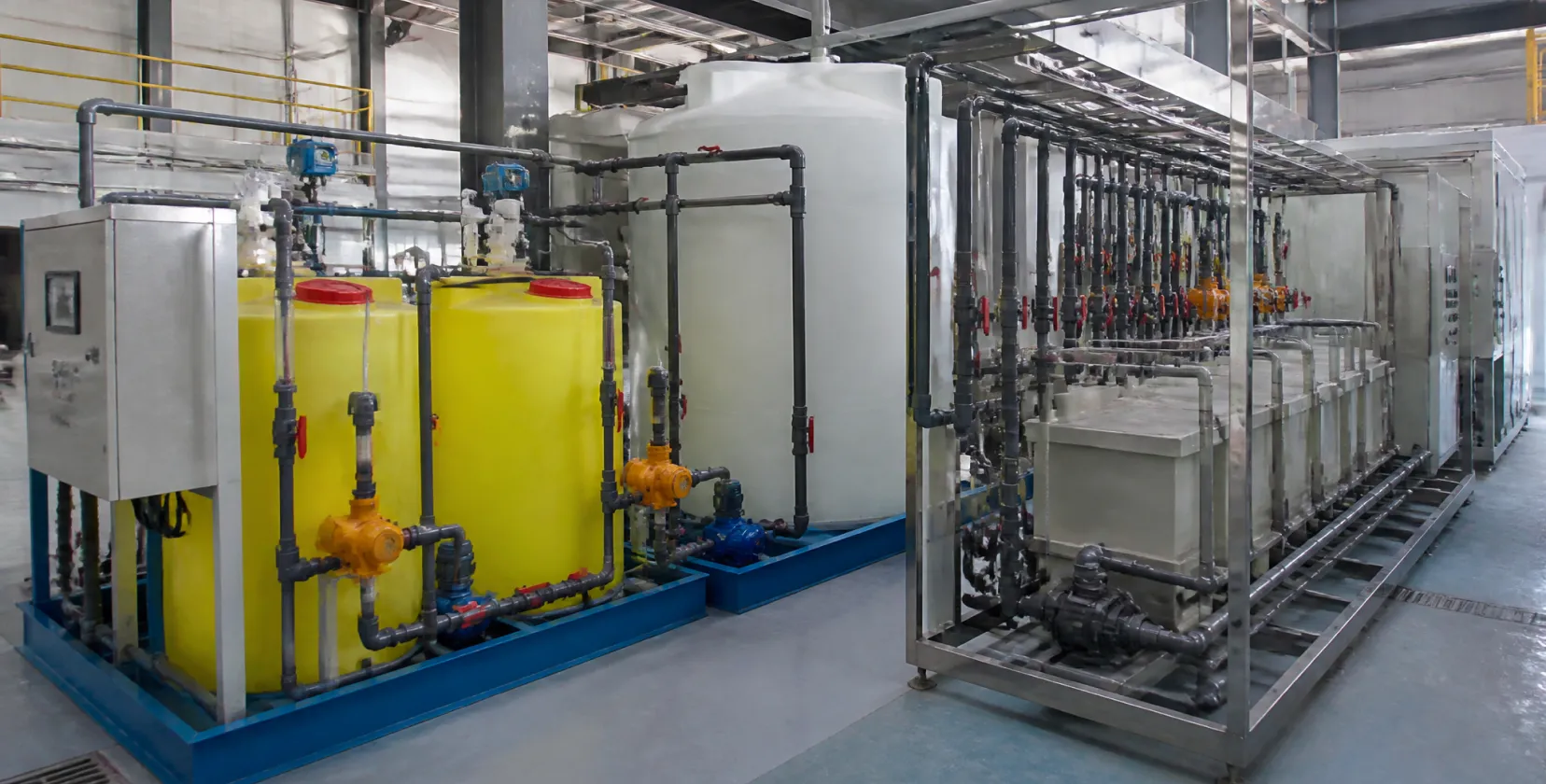
In water and wastewater plants, ferric chloride is received in bulk tankers, transferred to storage in vinyl ester or rubber-lined tanks, and dosed as a coagulant for phosphorus removal and sludge conditioning. The transfer duty is intermittent unloading at moderate flow; the dosing duty is continuous low-flow metering into the process stream. Both duties share the same containment requirements, since ferric chloride spills stain structures, attack nearby metals with chloride vapor, and send regulated copper- and iron-bearing waste to drains. The water treatment chemical dosing guide covers metering pump selection for the dosing side in detail.
Why Sealless Containment Is the Default Choice
Every dynamic mechanical seal operates on a controlled microscopic leak, and in ferric chloride service that leak is the failure mechanism. The escaping film evaporates, deposits hexahydrate crust on the faces, and the crust destroys the seal within weeks. Around the pump, chloride-laden vapor corrodes motors and instruments, and drips stain floors and attack concrete. A magnetic drive pump closes the leak path with a static containment shell. There is no rotating shaft penetration and no seal face, so there is no crust formation, no staining, and no vapor release at the pump. In fluoropolymer-lined construction the containment shell is non-metallic, eliminating eddy current heating and leaving no metal exposed to the fluid anywhere in the wetted path. The wetted bearing set in pressureless sintered silicon carbide is inert to FeCl3 across the full concentration range.
Recommended Configuration: AMC-F Fluoropolymer-Lined Magnetic Drive Pump
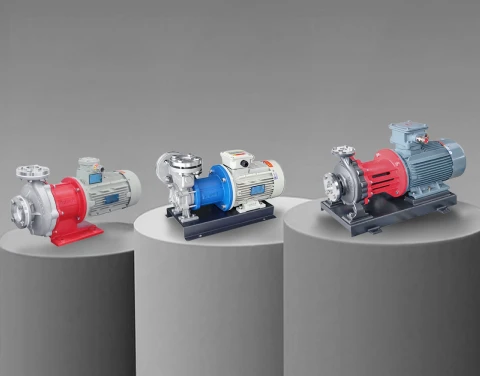
For ferric chloride transfer and recirculation we configure the AMC-F PTFE-lined magnetic drive pump. The one-piece injection-molded F46 or PFA lining is inert to FeCl3 at every commercial concentration, and the ductile iron pressure shell carries full system pressure independently of the lining. The pump is manufactured to the HG/T2730 chemical pump standard with pressureless sintered silicon carbide bearings as standard equipment. The series covers 3.6 to 100 cubic meters per hour at heads to 80 meters, which spans etchant recirculation, tanker unloading, bulk transfer, and coagulant system feed. An overview of the corrosion-resistant range is available on our chemical pump page.
Installation and Operating Rules
- Size motors at the working specific gravity, 1.43 for fresh 40% solution and up to 1.5 for copper-loaded etchant, with the usual service margin.
- Water flushing is safe and standard for maintenance; ferric chloride mixes freely with water, and flush water goes to the etchant or chemical waste stream, never to storm drains.
- Keep stainless steel fasteners, brackets, and fittings out of the splash zone; use vinyl ester FRP, lined, or plastic hardware near the equipment.
- Provide flooded suction on bulk transfer duties and keep suction lines short; the fluid's viscosity at 10 cP is mild but its density doubles friction losses per meter versus water.
- Treat spent etchant and any leak collection as regulated copper-bearing waste under local environmental rules.
- Enforce PPE at the pump area: chemical splash goggles, face shield, and acid-resistant gloves, and treat skin contact as a chemical exposure requiring prolonged water flushing.
Send Your FeCl3 Duty for Engineering Review
The correct configuration depends on concentration, copper loading, temperature, flow, head, and whether the duty is etchant recirculation, unloading, or coagulant feed. Submit your parameters through the contact page and our engineers will return a sized selection with a material confirmation for your specific ferric chloride service.
