


During the first week of November 2026, the global energy industry's attention converged on Abu Dhabi. ADIPEC 2026 opened on November 2 at the ADNEC Centre, hosted by ADNOC and organized by dmg events, bringing together more than 2,250 exhibiting companies, over 239,000 expected attendees and upwards of 380 conference sessions under the theme Energy. Intelligence. Impact. Behind the exhibition floor, the procurement signal for fluid handling equipment is unmistakable. The show arrives in the middle of a sustained execution wave across the region: a major refinery restart program under way in Saudi Arabia, a multi-year maintenance contract recently awarded for a large-scale Saudi petrochemical complex, and Qatar's LNG expansion approaching first production before year-end. Across these programs, engineering, procurement and construction contractors are rewriting pump specifications around one principle—zero leakage. This industry report analyzes what the November 2026 Middle East capex wave means for pump selection, and details the sealless, high-temperature and corrosion-resistant configurations that current project specifications demand.
The November 2026 Signal: ADIPEC and the Regional Execution Wave
ADIPEC has always been a demand barometer for the Gulf's energy capital, and the 2026 edition carries an unusually heavy execution agenda. The strategic conference program devotes entire tracks to industrial decarbonization, carbon management, downstream chemicals and workforce capacity for capital-intensive build rates, while the AI and Digital Transformation technical category drew 1,296 abstract submissions, the highest of any discipline—evidence that operators are pairing mechanical investment with digital asset management. Figures cited by the organizer from the International Energy Agency estimate that wider deployment of existing AI applications could deliver up to USD 110 billion in annual power generation savings by 2035, a framing that pushes owners toward instrumented, predictable, low-maintenance rotating equipment. For pump buyers, the practical translation of this agenda is straightforward: projects financed in this environment are specified for documented reliability, minimal emissions and long service intervals, because unplanned downtime and fugitive emissions now carry measurable balance-sheet cost.
Why Zero-Leakage Specifications Are Winning in the Gulf
Three forces converged in late 2026 to make hermetic pump containment the default requirement in Middle East refinery and petrochemical work. First, fugitive-emission enforcement: leak detection and repair programs have matured across the region's national oil companies, and every dynamic mechanical seal on hazardous or volatile service represents a registered leak point with an ongoing monitoring cost. A sealless magnetic drive pump, which replaces the dynamic shaft seal with a static containment shell, removes the leak path entirely and simplifies LDAR compliance documentation. Second, lifecycle economics: market research published during 2026 values the global magnetic drive pump segment between USD 1.0 and 1.6 billion, growing at 4.5 to 7.5 percent annually, with adoption driven by total-cost-of-ownership accounting in which eliminated seal maintenance, eliminated flush plans and avoided product loss outweigh higher first cost. Third, turnaround-scale timelines: the Saudi restart and maintenance programs compress decision windows, favoring standardized, pre-engineered pump packages over custom engineering cycles.
The Duty List: What These Projects Actually Pump
| Project Duty | Fluid Conditions | Pump Requirement |
|---|---|---|
| Thermal oil / hot hydrocarbon circulation | 280-400 °C, low vapor margin at temperature | High-temperature rated hydraulics, SmCo magnets above 350 °C, thermal barrier design |
| Corrosive chemical transfer (amines, solvents, acids) | Corrosive, often toxic or flammable | 316L or fluoropolymer-lined wetted path, sealless containment, SiC bearings |
| Reactor and regenerator temperature control loops | Frequent cycling, high head at low flow | Vortex/turbine hydraulics, stable curve at partial load, bidirectional capability |
| Utility, quench and cooling water | High flow, moderate head, continuous duty | High-efficiency centrifugal hydraulics, low NPSHr, stainless construction |
| Cryogenic-adjacent LNG utilities | Down to sub-zero process media | Wide temperature envelope, materials rated for thermal shock |
The duty pattern of the current project mix differs from a typical greenfield cycle. Restart and debottlenecking work concentrates on circulation and transfer services inside existing plot limits, where space, flange ratings and driver constraints are already fixed. That favors pump ranges with broad hydraulic coverage on standard footprints, and it penalizes any design whose installation requires piping modification. Temperature is the second discriminator: thermal oil systems serving reactor heating and regenerator loops in these complexes run continuously at 280-350 °C, with excursion capability toward 400 °C, a regime where conventional sealed pumps consume seal plans, cooling water and maintenance hours at rates that no longer clear the owner's cost review.
Containment, Materials and Bearings: The Specification Details That Matter
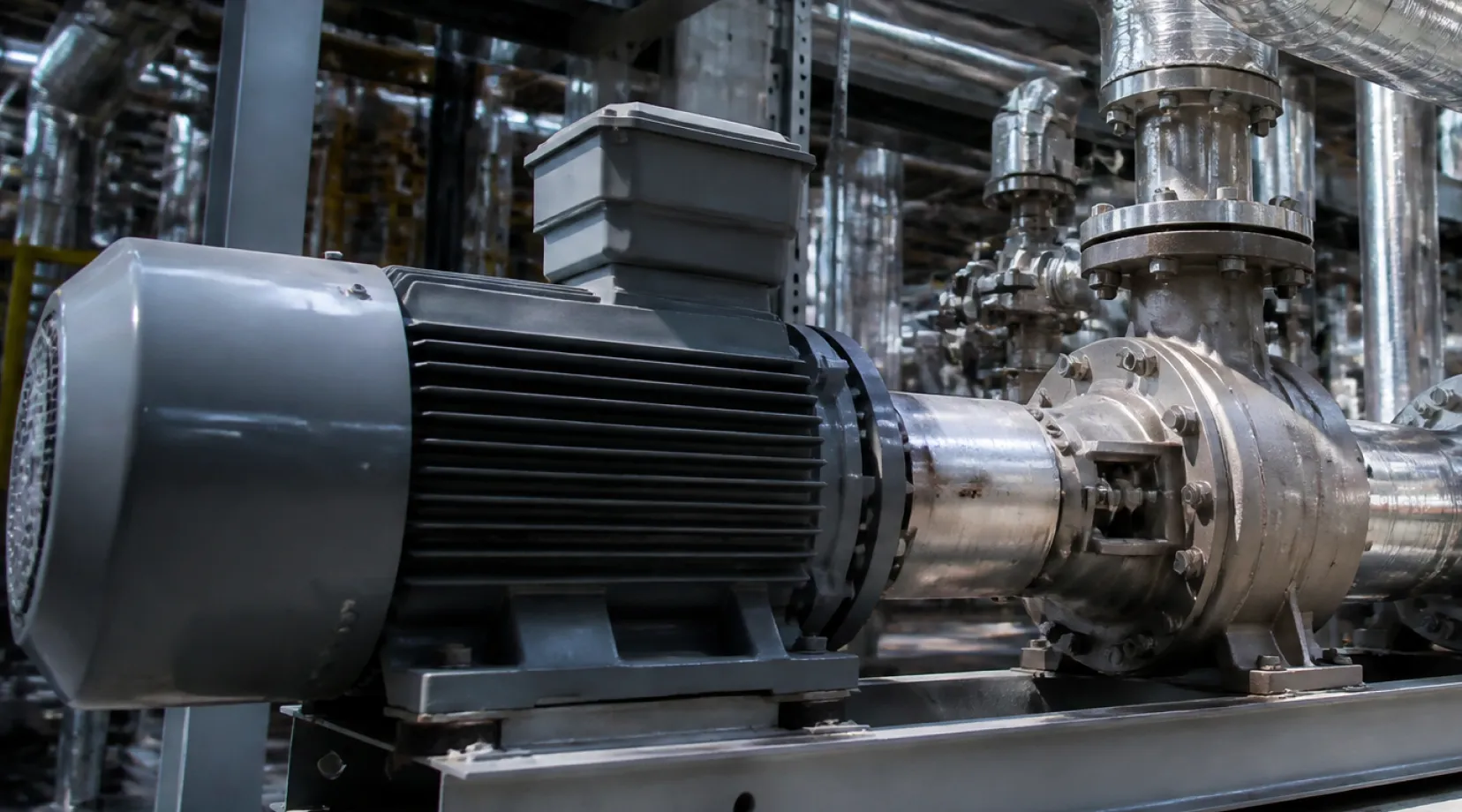
Specifications circulating in current Middle East tenders converge on a recognizable technical core. Containment must be static and hermetic, with metallic shells for high-temperature service and non-metallic fluoropolymer shells where chemical immunity takes priority and eddy-current heating must be avoided. Wetted metallurgy is 316L stainless as the baseline, with F46 or PFA one-piece lined construction specified for mixed-oxidant, acid and solvent duties where feedstock purity varies between shipments. Bearing sets are pressureless-sintered silicon carbide, chosen for chemical inertness and tolerance of the transient dry or gas-lubricated conditions that occur during priming and process upsets. For services above 350 °C, samarium-cobalt magnet assemblies replace neodymium to hold coupling torque at temperature. Isolation of the magnetic coupling from process heat, through thermal barrier sections and generous air gaps, appears as a line item in datasheets rather than an assumption.
Market Data: Where 2026 Pump Spending Is Concentrating
Independent market research released during 2026 frames the commercial backdrop. Future Market Insights values the global magnetic drive pump market at USD 1,031.62 million for 2026, projecting 4.5 percent compound annual growth, with pumps up to 80 m³/h holding a 52.3 percent segment share and stainless steel construction accounting for 48.7 percent of material demand. Fact.MR's parallel assessment values the segment at USD 1.61 billion for 2026 on a 7.5 percent growth trajectory, with chemical processing representing 34.8 percent of applications. The two estimates bracket the same conclusion: mid-capacity, stainless and corrosion-resistant sealless pumps constitute the center of gravity of current global demand, and that description matches the Middle East project duty list almost line for line. Regional spending concentrates where the hydrocarbon chain meets chemical processing, which is precisely the intersection where containment, temperature capability and material resistance carry the highest specification weight.
Configuration Guide for the Current Project Wave
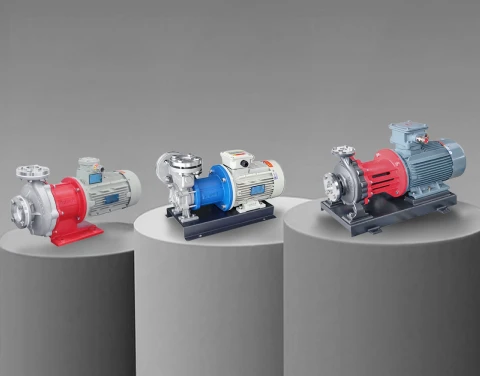
- AMC(L) Magnetic Drive Chemical Process Pump: For clean corrosive transfer and circulation duties to 200 m³/h in 316L construction, covering amine, solvent and intermediate services across refinery and petrochemical units.
- AMC-F Fluoropolymer-Lined Magnetic Drive Pump: For mixed-oxidant, acid and variable-purity duties from 3.6 to 100 m³/h, with a one-piece F46 or PFA liner and standard SSiC bearings keeping every wetted surface chemically inert.
- MDW Stainless Steel Vortex Magnetic Pump: For high-head, low-flow temperature control and circulation loops across a -196 to +400 °C envelope, including bidirectional operation for reactor heating and cooling skids.
- WRY-H Coupled High-Temperature Thermal Oil Pump: For continuous thermal oil circulation to 350 °C in reactor heating, regenerator and hot oil boiler loops.
- CPS-L Stainless Steel High Flow Centrifugal Pump: For high-volume utility, quench and cooling services where hydraulic efficiency and low NPSHr govern the selection.
Each configuration above ships with documented hydraulic coverage, material traceability and the hermetic or high-temperature design features that current Gulf tenders enumerate line by line. For restart and turnaround programs working to compressed schedules, datasheets and curves for the full duty list can be issued against project specifications within standard working days.
Outlook After ADIPEC Week
The procurement pattern visible during the first days of November 2026 will outlast the exhibition. Saudi restart work, the awarded petrochemical maintenance program and Qatar's LNG ramp-up each carry multi-year equipment tails, and the zero-leakage specification language written into this cycle's tenders tends to persist into the next. Pump suppliers positioned on sealless containment, high-temperature engineering and corrosion-resistant construction will find the region's procurement increasingly written in their vocabulary. To review pump curves, NPSH calculations for high-temperature circulation, or material compatibility for your project's fluid list, contact our engineering team directly.
