




Hydrogen peroxide, traded at 35%, 50%, and 70% concentrations, is the primary bleaching agent of the pulp and paper industry, a workhorse oxidant in chemical synthesis and electronics cleaning, and a growing reagent in water treatment and mining. It earns that reach by being chemically unstable on purpose: every molecule carries oxygen it wants to release. For pump engineers, hydrogen peroxide is a two-sided problem. The fluid is only mildly corrosive to correctly chosen materials, yet it decomposes continuously into water and oxygen gas, and that decomposition accelerates violently in the presence of the wrong metals, heat, or contamination. A pump that handles peroxide safely must control gas evolution, exclude catalytic materials from the wetted path, and tolerate the consequences of the fluid's constant slow self-destruction. This guide covers the engineering of hydrogen peroxide transfer: decomposition kinetics, material selection, the blocked-line hazard, and the magnetic drive configurations proven in peroxide service.
Fluid Profile and Handling Characteristics
| Property | 35% H2O2 | 50% H2O2 | 70% H2O2 |
|---|---|---|---|
| Specific gravity at 20°C | 1.13 | 1.20 | 1.29 |
| Viscosity | Near water, 1.0 to 1.2 cP | ||
| Decomposition product | Oxygen gas + water, releasing approx. 98 kJ per mol H2O2 | ||
| Decomposition accelerants | Iron, copper, nickel, chromium ions; alkaline pH; heat; sunlight; organic contamination | ||
Decomposition: The Defining Behavior
Hydrogen peroxide decomposes into water and oxygen, releasing about 98 kilojoules per mole. Commercial grades carry stabilizers such as stannates, phosphates, and chelating agents to slow this reaction to a fraction of a percent per year in storage. The stabilizers do not survive contact with catalytic surfaces. Dissolved iron at part-per-million levels, a copper fitting, or a speck of rust in a suction line can accelerate decomposition locally by orders of magnitude. The oxygen released is the practical problem: it accumulates at the high point of a pump casing and at the impeller eye, and a standard centrifugal pump loses prime on gas exactly as it does on any vapor pocket. Pumps in peroxide service are specified and installed with this continuous gas evolution in mind.
Catalytic Attack and Prohibited Materials
Copper, brass, bronze, carbon steel, galvanized steel, and iron-bearing contamination are prohibited anywhere in contact with hydrogen peroxide. These materials do not simply corrode; they catalyze decomposition, which means a wrong fitting converts the equipment around it into a gas and heat generator. Nickel and chromium ions act similarly at elevated concentration. This is the reason peroxide equipment lists read differently from general chemical service: valves, instruments, flexible hoses, and even pipe thread compounds must all be verified against the peroxide compatibility list, not assumed from acid experience.
The Blocked-Line Hazard
A valved-shut section of peroxide line or a dead-headed pump casing is a pressure vessel with a built-in gas generator. Decomposition continues in the trapped volume, oxygen accumulates, and pressure climbs until something relieves. Industry guidance is unambiguous: peroxide systems are designed so that no section can be fully blocked in, dead legs are eliminated, and where isolation is unavoidable, relief is fitted. The same logic applies to the pump itself, which should never run against a closed discharge for longer than the manufacturer's minimum-flow allowance.
Material Selection for H2O2 Service
| Material | Suitability in H2O2 | Principal Limitation |
|---|---|---|
| 304L / 316L stainless, passivated | Standard for all commercial grades | Requires nitric passivation before service; avoid chlorides |
| Aluminum 1060 / 5254 | Classic for storage and transfer to 70% | Requires passivation; attacked by chlorides and caustic |
| PTFE / PFA / F46 | Inert at all concentrations | Lining temperature limit only |
| HDPE / PVC | Dilute grades, ambient storage | Concentration and temperature limits |
| Titanium | Not recommended for concentrated grades | Corrodes in strong peroxide; reserve for other oxidizers |
| Copper alloys / carbon steel / galvanized | Prohibited | Catalyze runaway decomposition |
Two points in this table catch engineers transferring from other oxidizer duties. First, stainless steel works in peroxide only because of passivation: the chromium oxide film must be deliberately formed and maintained, which is why new or repaired stainless equipment is cleaned, degreased, and passivated with nitric acid before first fill, and why chloride contamination, which breaks down that film, is controlled. Second, titanium, the hero metal of sodium hypochlorite service, reverses roles here: strong hydrogen peroxide attacks titanium, so specifications written for bleach plants must not be reused. For wetted polymers, PTFE and PFA are inert at every commercial concentration, which makes fluoropolymer-lined construction the chemistry-proof option where contamination risk is high or where the same pump serves several oxidizers.
Pump Duties Across the Peroxide Industries
Pulp bleaching runs peroxide continuously in high-volume circulation and make-up transfer, where the duty punishes gas accumulation and rewards open, self-venting hydraulic designs. Chemical synthesis and electronics cleaning dose 35% to 50% grades in controlled batches, where purity and contamination exclusion dominate the specification; semiconductor wet processes in particular cannot tolerate metal ion pickup, which is covered in our high-purity and ultrapure fluid pump solutions. Water treatment and mining receive bulk peroxide for oxidation duties, an unloading and day-tank transfer profile. Across all three, the gas-management problem is the common thread, and our gas-entrained and off-gassing fluid pump solutions page details the hydraulic approaches for liquids that continuously evolve gas.
Why Sealless Containment Wins in Peroxide Service
Every dynamic mechanical seal operates on a microscopic weep, and in peroxide service the weep has two failure modes. Escaping fluid evaporates at the seal boundary and concentrates stabilizer salts and peroxide residues into crusts that score the faces, while the same leak path admits airborne contaminants and metallic dust that catalyze decomposition in the product. A magnetic drive pump closes the path with a static containment shell: no rotating shaft penetration, no seal face, nothing for crusts to form on, and nothing entering the product. The wetted bearing set in pressureless sintered silicon carbide is inert to peroxide and tolerates the gas-lubricated transients that outgassing fluids produce during priming. In fluoropolymer-lined designs the containment shell is non-metallic, which also eliminates eddy current heating of the fluid.
Recommended Configurations for Peroxide Transfer
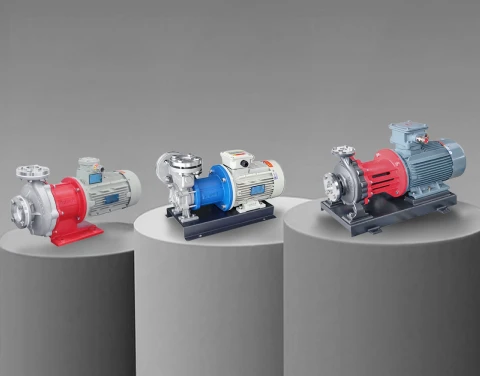
For clean, high-volume peroxide transfer we configure the AMC(L) chemical process magnetic drive pump in passivated stainless construction, covering flows to 200 cubic meters per hour with the efficiency of a metallic hydraulic end; wetted surfaces are passivated before dispatch for oxidizer service. For mixed oxidizer service, higher-contamination environments, or duties where the wetted path must be chemically indifferent, the AMC-F fluoropolymer-lined magnetic drive pump covers 3.6 to 100 cubic meters per hour with a one-piece F46 or PFA lining and standard SSiC bearings. Both series carry static containment, so neither introduces a weepage path for crusting or contamination. An overview of the corrosion-resistant range is available on our chemical pump page.
Installation and Operating Rules
- Verify every wetted and splash-zone component against the peroxide compatibility list: no copper alloys, no carbon steel, no galvanized hardware, no unverified elastomers or thread compounds.
- Passivate all new or repaired stainless wetted parts with a nitric acid procedure before first fill, and record the passivation in the equipment file.
- Design out dead legs and blocked sections; where isolation is unavoidable, fit relief sized for decomposition gas generation.
- Protect against extended dead-head operation with minimum-flow control, since trapped peroxide heats and pressurizes the casing.
- Keep the installation clean: dirt, rust, and organic contamination are decomposition catalysts, so flushing and cleanliness procedures matter more here than in ordinary chemical service.
- Vent storage and day tanks correctly, and treat any unexpected pressure or temperature rise in peroxide equipment as a decomposition event requiring immediate investigation.
Send Your Peroxide Duty for Engineering Review
The correct configuration depends on concentration, temperature, duty profile, and the purity requirements of your process. Submit your parameters through the contact page and our engineers will return a sized selection in passivated stainless or fluoropolymer-lined construction, with a material confirmation for your specific grade of hydrogen peroxide.
