


The pump industry's busiest deal year in recent memory added its largest closing on November 9, 2026, when Xylem Inc. announced completion of its previously announced acquisition of Cornell Pump and Roper Pump from Indicor for USD 1.46 billion. The transaction, first agreed in August, is Xylem's third closed acquisition of 2026 and lands two months after Franklin Electric completed its purchase of high-pressure specialist Cat Pumps. Taken together, the deals sketch a consistent picture of where strategic buyers see value in the pump sector: engineered products for difficult fluids, premium aftermarket economics, and niches where application depth commands pricing power. This article reviews the transaction details, the financial logic behind the multiples being paid, the implications for buyers of chemical and process pumps, and the position of specialist manufacturers in a consolidating market.
The Deal in Brief: Xylem Closes on Cornell and Roper
Xylem confirmed on November 9 that it had completed the acquisition of the Cornell Pump and Roper Pump businesses from industrial technology company Indicor. Cornell, founded in 1946 and headquartered in Clackamas, Oregon, builds centrifugal pumps for agriculture, industrial, municipal, mining and food processing duties, including solids-handling and slurry designs and patented self-priming technology for demanding suction-lift applications. Roper adds positive displacement capability in gear pumping. Xylem said the businesses expand its capabilities across industrial markets including mining, power, semiconductors and food and beverage — sectors the company linked to infrastructure investment, industrial modernization and growing resource demand. The acquired businesses will initially be reported within Xylem's Water Infrastructure segment and will move to the Flow Solutions segment from January 2027. Xylem President and CEO Matthew Pine described the acquisition as an example of deliberate portfolio choices, pointing to strong positions in markets benefiting from major investment trends and to technologies that broaden what the company can do for customers.
The Numbers Behind the Price
The financial profile disclosed with the August agreement explains the strategic appetite. Cornell and Roper are expected to generate more than USD 260 million in combined 2026 revenue with EBITDA margins above 30 percent — roughly double the margin profile of a typical volume pump business. Xylem expects USD 23 million in run-rate cost synergies and approximately USD 170 million in tax benefits, bringing the effective multiple to about 11.6 times projected 2026 EBITDA after those adjustments. Xylem, which reported USD 9 billion in 2025 revenue and employs around 22,000 people, has now closed three acquisitions this year: TriOS on July 1, WaterFleet on September 2, and Cornell/Roper on November 9, each described as historically growing faster than the company's target growth rate. Days after the closing, on November 13, Xylem's board authorized a further USD 1.5 billion share repurchase program, underlining the cash-generation confidence behind the acquisition cadence.
A Broader 2026 Consolidation Wave
The Xylem closing sits inside a wider pattern. Franklin Electric completed its acquisition of Cat Pumps on September 4, paying USD 350 million in cash plus a potential earnout of up to USD 50 million in stock. Cat Pumps, a Minneapolis-based maker of high-pressure plunger and piston pumps for industrial cleaning, reverse osmosis and water treatment, vehicle cleaning and energy applications, generated approximately USD 115 million in 2025 revenue with adjusted EBITDA margins above 35 percent and an unusually high share of recurring aftermarket parts revenue. It was Franklin Electric's first acquisition since early 2025, when it added Barnes de Colombia and Australia's PumpEng. The common thread across these transactions is visible in our running coverage of global pump industry market trends: strategic buyers are paying premium multiples for specialized, engineered niches with durable aftermarket streams, while the global industrial pump market itself — valued near USD 73.7 billion in 2025 and projected toward USD 118 billion by 2034 — grows at a steadier single-digit pace.
Why Engineered Niches Command Premium Valuations
The premiums being paid rest on three structural advantages that difficult-fluid niches hold over commodity pumping. First, specification barriers: a pump moving abrasive slurry, high-pressure wash water or corrosive chemistry is chosen on documented performance, materials certification and application track record, which locks in incumbents and slows price erosion. Second, aftermarket intensity: engineered pumps consume parts and service at rates that create decades of recurring revenue on each installed unit, and both the Cornell/Roper and Cat Pumps disclosures highlight aftermarket share as core deal logic. Third, demand secularization: mining investment, water infrastructure spending, food processing capacity and semiconductor construction — a sector whose chemical pump demand we tracked in our analysis of semiconductor fab expansion — are driven by multi-year capital cycles instead of consumer sentiment. Buyers of these assets are acquiring exposure to those cycles with margin protection attached.
What Consolidation Means for Pump Buyers
For plant engineers and procurement teams, consolidation among the majors carries practical consequences worth watching. Post-acquisition integration typically reorganizes sales channels and product lines over twelve to twenty-four months, which can shift lead times, pricing structures and local support coverage for legacy brands. Synergy programs concentrate portfolios on the acquiring company's strategic core, and products outside that core risk slower investment. At the same time, integration rarely weakens the engineering value of well-run niche brands, and Xylem's stated intent is to extend Cornell and Roper technologies through its global reach. Buyers should expect continuity in the acquired product lines themselves, with the more meaningful changes appearing in commercial terms, distribution and service organization. When reviewing total lifecycle economics under new ownership, the framework in our guide to pump total cost of ownership remains the reliable reference point for comparing alternatives on equal terms.
The Specialty Chemical Angle: Sealless Duty Keeps Outgrowing the Category
Within this consolidating landscape, the segment most relevant to chemical processors is expanding on its own trajectory. The global chemical pump market, estimated at USD 5.68 billion in 2025, is projected to reach USD 9.92 billion by 2034, and sealless magnetic drive technology is growing faster than the category average — market researchers value the magnetic drive segment between roughly USD 1.0 and 1.6 billion in 2026 with compound growth projections between 4.5 and 7.7 percent depending on methodology. The drivers are regulatory and operational: tightening fugitive emission rules, workplace safety requirements for toxic and corrosive media, and lifecycle cost pressure against mechanical seal maintenance. Our coverage of Asia-Pacific chemical capex and the corrosion-resistant pump market documented how these forces concentrate demand in regions where new chemical capacity is actually being built. Supply is responding in parallel: Chinese customs data show centrifugal pump exports under HS 841370 reaching USD 4.1 billion in January through August 2026, up 9.7 percent year on year. Applications with the strictest containment requirements are specified through solutions such as our corrosion-resistant pump solutions for aggressive chemicals, where wetted material selection determines service life.
How Specialist Manufacturers Fit the Post-Consolidation Market
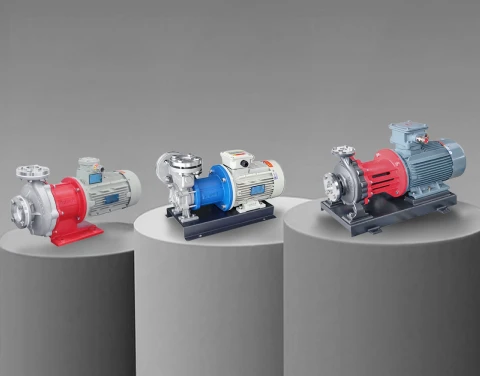
The logic that made Cornell, Roper and Cat Pumps acquisition targets — engineering depth in difficult fluids, certified performance, aftermarket durability — is the same logic on which focused specialists compete independently. As the majors integrate broad industrial portfolios, the corrosive and hazardous corner of chemical duty continues to reward manufacturers whose entire engineering organization works on containment, materials and application matching. Aulank operates precisely in this space: the AMC-L metallic magnetic drive pump covers chemical process transfer to 200 m³/h in 316L with sintered silicon carbide bearings, and the fluoropolymer-lined AMC-F handles the full spectrum of aggressive acids and mixed chemistries from 3.6 to 100 m³/h with a one-piece F46/PFA lining. Both series are manufactured and tested to the HG/T2730 magnetic pump standard with documented material certification, and both are supported by an engineering team that sizes every selection against the actual medium, concentration and duty profile — the specialization premium that this year's deal multiples have priced so explicitly.
Discuss Your Transfer Duty with a Specialist
Market consolidation changes who owns pump brands; it does not change the physics of corrosive, hazardous or high-purity transfer. Whether the project is a new chemical unloading point, a circulating loop upgrade ahead of a capacity expansion, or a sealless conversion driven by emission compliance, the selection rests on the same inputs: the medium and its concentration range, temperature profile including upset cases, duty points for each service, and the site's containment requirements. Send your medium, temperature and operating points through the contact page, and the Aulank engineering team will return a prepared selection with curves, material confirmation and installation notes.
